
Trending

Future Generations University file photo
Inside the World Room, located in the former Anderson home, in the North Mountain Campus complex.

Anderson family photo circa 1912
William Boggs Anderson's wife, Kitty Dyer Anderson, watches over her daughter, Effie, left, and son, Billy, father to Dyer Anderson, on the porch railing of the Anderson house.
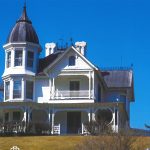
FRANKLIN -- William Boggs Anderson built the impressive Queen Anne style home on his 300-acre farm overlooking the town of Franklin in 1900 at a cost of $1,900.
"Tradition has it, that it was a wedding present for my grandmother," said Dyer Anderson, the grandson of the couple.
A self-taught architect, William Boggs Anderson designed the house shortly after he married Kitty Dyer on Dec. 6, 1899. Taking three years to build, it was family-owned for 117 years until Dyer Anderson, who now lives in Annandale, Virginia, sold it to Future Generations University in 2017.
The house has multiple gables, elaborate porches and a polygonal tower with a cast-iron roof peak. A small windmill behind the house pumped water into a reservoir in the attic where gravity provided the town's first indoor plumbing, Dyer Anderson said.
Born Sept. 7, 1861, in Charlotte, Va., during the Civil War, "my grandfather was a refugee (from Franklin) because he was the grandson of Confederate Gen. James Boggs, and the family feared for his safety," Dyer Anderson said. Growing up in Franklin, he became a farmer dealing in cattle, owned a hardware store and sold farm machinery.
"He hired the work done from lumber that came from about 10,000 acres he owned in Pendleton, Pocahontas and Randolph counties. The brick was fired at the site," Anderson said.
The intricate porch railings were made by hand on a foot-powered jig-saw or ordered by catalogue from Sears, a source used locally where architects and artisans were scarce.
Brides or young girls, dressed in their Sunday best and framed by an ornate oval porch railing, loved having their pictures taken while "Kodaking" around Franklin. It is one of the most photographed houses in town and has been featured in numerous publications including National Geographic
Magazine.
William Boggs Anderson died in 1920, from the after effects of the 1918 flu epidemic. His widow Kitty lived in the house until she died in 1946 and the house was handed down through the family.
In Victorian times families held lots of parties.
"Entertainment was easy in this house with its large parlor, formal dining room and open stair case downstairs. The family mostly lived upstairs," Dyer Anderson said.
"My grandmother Anderson loved to entertain and give dinner parties. She even hosted troops, training on Seneca Rocks for future climbing expeditions in France during World War II, and received several nice thank you notes," he said.
The open space entertainment value appealed to Daniel C. Taylor, president of Future Generations University, looking for housing for a future university president, Dyer Anderson said.
"It was ideal for a university president who needs room to host faculty, students or dignitaries. The original three bedroom house was a huge house, but not functional for contemporary living," he added.
Taylor founded Future Generations University along with eight Future Generations organizations worldwide and has been engaged in social change and conservation for 40 years, with a focus on building international cooperation to achieve ambitious projects. In 1985 he headed the creation of Nepal's Makatu-Barun National Park and, later, in close partnership with the Tibet Autonomous Region, China's Qomolangma (Mt. Everest) Nature Preserve, Lalu (Lhasa) Wetlands National Nature Preserve and other international nature preserves.
"We research, study and teach how communities develop. Communities are our classroom around the world, unlike a campus with walls or computers with simulations. We are a university in the world that studies the world. We're accredited in West Virginia by the Higher Learning Commission in Chicago -- the oldest accreditation body in the United States," Taylor said.
The non-profit Future Generations organization was founded in 1992 with a UNICEF charge to examine global evidence of sustainable and scalable community-driven development.
"UNICEF wanted to understand how communities develop. They do it on their own, but how does it happen?" Taylor said.
"UNICEF created a task force, and I was invited to co-chair with some of the most prestigious scholars in the world. I was invited, because I was credited with starting two national parks in partnership with the local communities, not just developed from the government down," he noted.
In 2001 the North Mountain acreage in Pendleton County was purchased for constructing Future Generations offices and a graduate school was founded to train leaders of communities wanting to shape their futures. In 2002 they started a global Master's Degree program, and the first of three endowed Professorships was founded. In 2003 the first class matriculated in the Master of Arts in Applied Community Change and Conservation.
In 2016 Future Generations Graduate School was renamed Future Generations University.
"Future Generations was based at Johns Hopkins University in Baltimore. Since I liked Franklin better than Baltimore, we brought the university here," Taylor said.
The campus is located on North Mountain halfway between Franklin and Circleville. The faculty and students come from all over the world.
"We will use the Anderson house as a residence for faculty, visitors and, long term, it will be for the university president when I retire," Taylor said.
A university brochure indicates that the university advances heritage and has become the stewards of a landmark of the Franklin community.
"As with monasteries in Tibet, ancestral practices in India and our home in West Virginia, the university blends preservation of each community's legacy and simultaneously ushers forward sustainable opportunities for generations to come," the brochure states.