
Flood of 1985
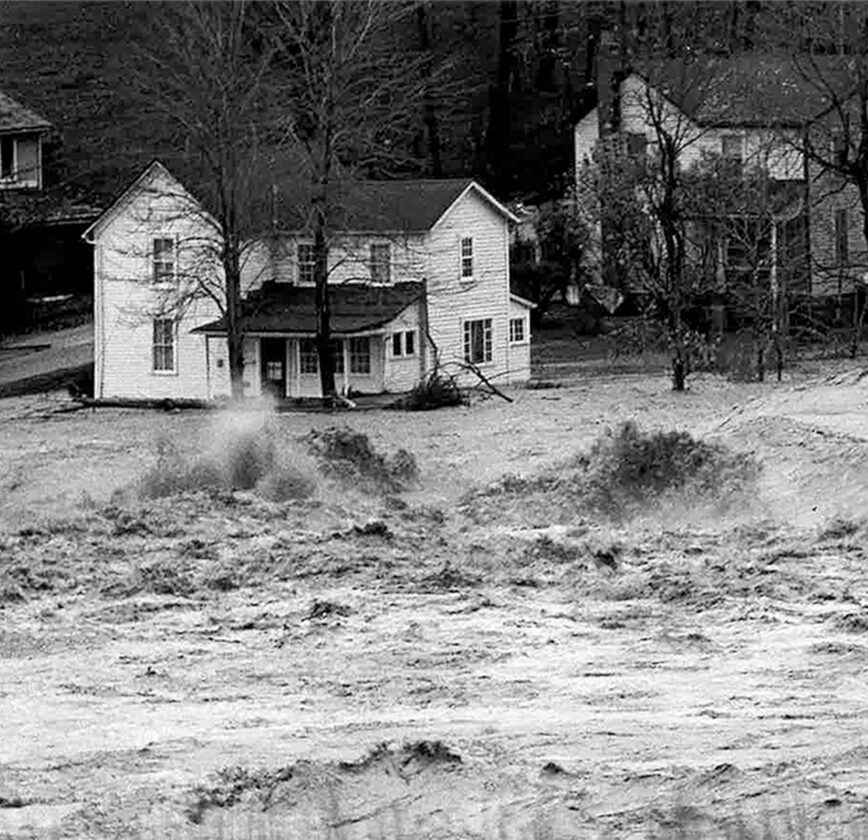
Photo courtesy of Nancy Abrams Emilie Geary’s house is shown as floodwaters roar past at 9 a.m. Nov. 5, 1985.
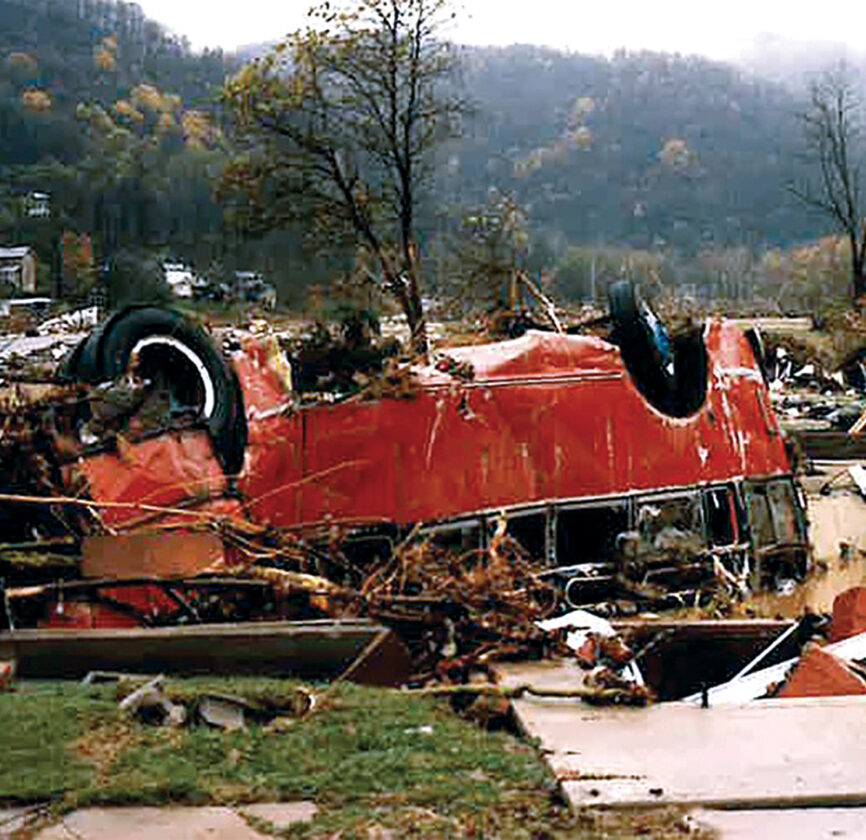
Photo courtesy of Rick Felton Cars and trucks, tossed like toys, in the aftermath of the 1985 Election Day Flood in Rowlesburg.
Photo courtesy of Nancy Abrams Emilie Geary’s house is shown as floodwaters roar past at 9 a.m. Nov. 5, 1985.
Photo courtesy of Rick Felton Cars and trucks, tossed like toys, in the aftermath of the 1985 Election Day Flood in Rowlesburg.
Trending
MOOREFIELD -- "My God, Jen. I gotta get Jen. Help me. Please."
Call that a clothesline prayer.
Robin Moore sent it bubbling through the chop just after midnight on Nov. 5, 1985, when she was pulled under.
The rain was pounding like Hell's drumline. The river was a rabid dog.
Mobile homes aren't made for this.
It was her dad's place. Rob Roy Watkins served for years as assistant postmaster of Morgantown.
When it came time for retirement, he knew right where to forward his mail: the mountains of Hardy County and his hometown of Moorefield, a little burg in the valley, nestled in the confluence of the Potomac River and its South Fork branch.
He had been a widower, and his second marriage to Virginia was both a new book, and a dog-eared page, flipped back to the narrative of a familiar locale, much-loved.
Rob Roy was an outdoorsman. No snoozing in the recliner for this retiree.
The card-carrying member of the Izaak Walton League had a camp near Moorefield, and when she was a kid, on those glorious summer weekends when the light went on forever, Robin knew right where her family would be.
"It was always, 'Well, let's go,'" the Brookhaven Road woman said, smiling at the memory. "He didn't even have to say anything else."
She was soldiering as a single mom to 10-year-old Jennifer when Rob Roy moved back to Moorefield with his new bride.
Hardy County kept calling a daughter's heart, too.
She and Jen would also relocate from Morgantown a few months later. Robin took a job in medical billing at Grant Memorial Hospital in nearby Petersburg.
"I felt I needed to be close," she said. "It was just one of those things, you know?"
The weather after midnight on Nov. 5, 1985 wasn't just one of those things, meteorologically. It was unprecedented.
The cow under the bridge
What was left of Hurricane Juan was still spiraling out from the Gulf, and when the tropical depression met up with another storm system over the Mid-Atlantic, the end result would be 47 West Virginians dead, with $700 million in damages in the Mountain State alone.
Rivers roiled 20 to 30 feet over their normal flood stages, swamping whole towns and surrounding farm land.
Even if you weren't there, you'll still likely remember a now-famous photograph of the carcass of a cow, actually wedged in the supports underneath a roadway bridge in Tucker County -- as the water was that high and the current that pronounced.
It had started raining the day before.
Jennifer was at the trailer, because school was called early due to the weather and the bus couldn't make it to their house -- on River Road, ironically.
Robin was able to cut her shift short, also. With a numb sense of inevitability, she conceded to the weather.
This isn't letting up. We have to do something.
"Water was coming in," Robin said. "It was already too late."
She grabbed a clothesline on the porch and tied it to her and Jennifer and was trying to fashion a knot for Rob Roy and Virginia when the water hit. As tough as he was, her 69-year-old dad by then was weakened and tired, from fighting to quell that water all evening.
The impact of the surge caused the whole home to lurch forward and buckle.All four of them were swept into the tumult. It was the last time Robin would see her father and stepmother alive.
Remembering
what Dad said
She remembers the shock of the water and being enveloped.
"I knew I was drowning," she said. "I remember thinking it was my time."
Robin almost let it happen, but when she broke the surface, awareness and a mother's instinct were both instantly reactivated.
"Mom! Mom!"
"Jen! Jennifer! Hold on to me, honey!"
Then, another voice: Remember, don't fight the current. You'll get exhausted. Ride it until you find something you can grab onto.
"I could hear Dad saying that in my head. I learned how to swim in the Potomac. He'd tell us that all the time. Never go against the current. That's why Jen and I are still here."
She flailed for that clothesline.
The mother and daughter, clinging to one another tight, were spilled another 300 yards or so from the now-ruined mobile home.
An uprooted tree stump slammed into Robin's hip -- hard -- and she knew from the silhouette of gas pumps poking up that she and Jen were in the lot of the service station on Main Street.
Robin again made a wild reach.
"And that's where we were, for 12 hours."
Letting go
(and not letting go)
In the dark that went on forever, they could hear people screaming.
They could hear the panicked screeches of farm cats and the crunch of metal and snapping of wood, which they countered with stories, prayers, songs and corny jokes ... anything.
"We're gonna be OK, Jen. We're gonna be OK."
As it turns out, they were also next to the attendant's booth, which had taken on water -- but, amazingly, not quite as much. They could see it at first light.
That water, meanwhile, wasn't going anywhere. In fact, it kept creeping up. Could that booth serve as a refuge?
Only one way to find out.
When Robin tried to break the plexiglass, she got a comic reprimand, but she was too tired to laugh. "Mom, we'll get in trouble."
"Honey, with what's going on, I don't think we have to worry this time."
Then, they heard the helicopter. It was from the state Division of Natural Resources.
"It wasn't a rescue helicopter," Robin said. "It was DNR. They didn't have a basket or anything."
But they did have a resourceful pilot, and Howard Mehringer had an idea.
After a few passes, he angled the bird in, balancing, in part, on the bed of a partially submerged pickup truck.
DNR officers Ken Painter and Jerry Jenkins were motioning and mouthing words in the propeller-noise: You're gonna have to let go.
Robin pointed to her daughter and mouthed back.
Her. Take her.
Jen didn't want to let go.
Honey, you have to.
"I'll never forget them," Robin said of the helicopter crew. "Never."
At a local church serving as a makeshift hospital and shelter, a doctor said if they had been in water a half-hour longer, they likely would have died, wracked with hypothermia as they were.
On the stretcher, Robin looked down at her hands and started crying. She realized she was still holding part of that clothesline.
'No, she saved mine'
After 30 years in Ohio, Robin, now widowed, moved back to Morgantown, just like Rob Roy and Moorefield.
She can still get emotional when she thinks back to what happened just after midnight on Nov. 5, 1985.
The rain. The dark. Her dad. And Jen, always.
It doesn't always happen, but on some days when the precipitation is particularly steady, she might find herself switching on every light in the house -- and then doing whatever she can to stay busy.
She and Jen, of course, grew even closer. If she doesn't see her, she at least talks to her on the phone. Every day.
Robin doesn't tell her story, but she has family members who do.
"People are complimentary. They'll say, 'Oh, you saved your daughter's life,' and I'll say, 'No, she saved mine.' And I know that was my dad talking to me that night."