
Income Taxes
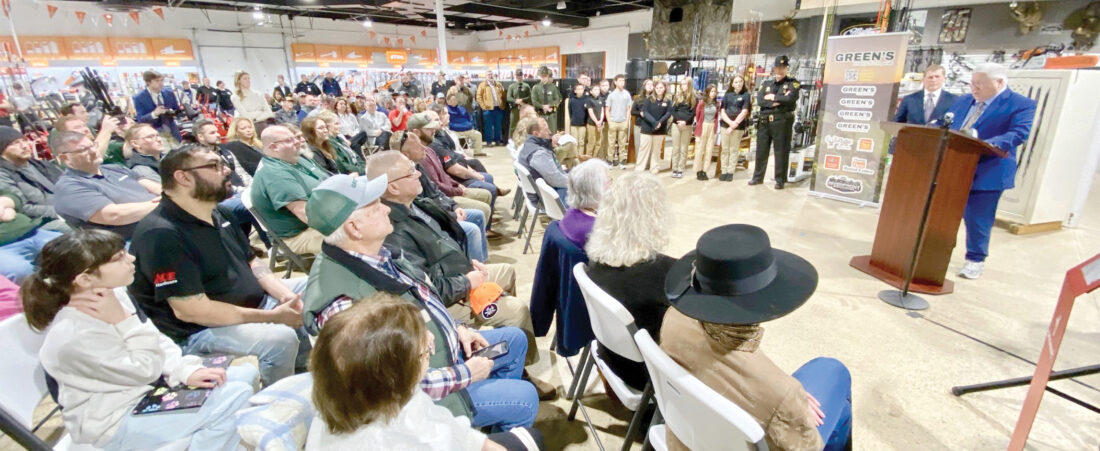
Photos by Brett Dunlap A crowd of well over 100 people gathered at Green’s Supply Depot at 1050 Division St. in Parkersburg on Thursday where West Virginia Gov. Patrick Morrisey talked about lowering the state income tax level with the hopes of eventually eliminating it to increase investment in the state.
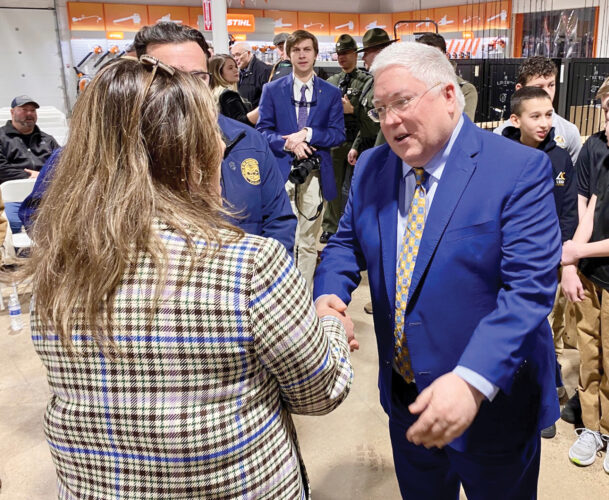
West Virginia Gov. Patrick Morrisey greets people Thursday during an appearance Thursday at Green’s Supply Depot in Parkersburg where he urged state lawmakers to pass a 10% income tax cut.
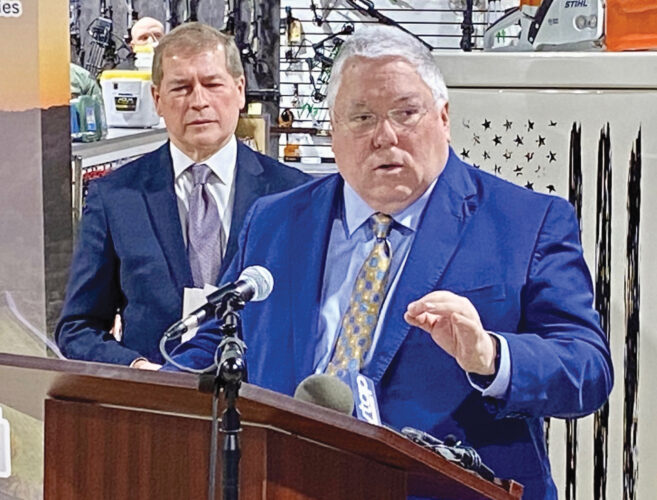
Grover Norquist, president of Americans for Tax Reform, and West Virginia Gov. Patrick Morrisey addressed a crowd of well over 100 people Thursday at Green’s Supply Depot in Parkersburg talking about the need to eliminate income tax as a factor to increase investment.
PARKERSBURG — Gov. Patrick Morrisey has called on West Virginia lawmakers to pass a 10% income tax cut during an event in Parkersburg on Thursday.
Morrisey appeared at Green’s Supply Depot at 1050 Division St. with Grover Norquist, president of Americans for Tax Reform, and addressed a crowd of well over 100 people about what he saw in the direction the state is heading in terms of economic development and how cutting income tax could make the state more attractive to potential investors and developing economic development with new businesses.
Since October, West Virginia has seen almost $6.5 billion in new private-sector investment announced, which will help create over 7,000 projected jobs across energy, manufacturing, and infrastructure, Morrisey said. When that is combined with federal investments supported by President Donald Trump, including broadband expansion and rural health initiatives, total investment commitments approach $8 billion and more than 8,000 projected jobs, he added.
Morrisey touted many temporary jobs will be created in construction and many permanent jobs will be created in the energy sector because “West Virginia is America’s energy state.”
“We are seeing record breaking investments in West Virginia,” he said. “This is our second biggest year in the last 15 years for economic investment from the private sector.
“There is a lot more that needs to be done.”
Morrisey said the state has already factored in 5% of the income cut through spending restraint, restructuring, and cost reductions implemented over the past year. He wants to work with the Legislature to identify offsets and additional savings to complete the remaining 5%.
He also talked about cutting bureaucratic red tape and burdensome regulations which he described as “disguised taxes.”
“In West Virginia we are cutting red tape and we are moving faster than we ever have before,” Morrisey said. “That means more business opportunities for our citizens.”
He spoke about a $2.5 billion 1.2 GW natural gas power plant by First Energy to be located in West Virginia; a $1.2 billion joint venture with Kindle Energy, Blackstone, and GE Vernova to create a gas-fired plant in Harrison County; a $850 million coal reformation plant in Mason County as well as other opportunities that will create construction jobs as well as trade jobs for electricians, plumbers, others and many permanent jobs relating to the energy sector.
“We have to continue to double down on investing in our economy and ensuring the free market works,” Morrisey said. “One of the best ways of doing it is lowering the state income tax.”
Putting more money back in people’s hands will help with affordability issues for many people, he added.
Norquist said tax cuts help provide growth and West Virginia is one of a number of states looking to eventually reduce income taxes to zero.
“West Virginia is leading the states who want to go to zero,” he said. “Investors are looking at where the taxes are.
“The states committed to go to zero are where businesses are investing.”
Chris Deweese, owner of Green’s Supply Depot, talked about how his business is continuing to grow and the tax cuts being proposed by Morrisey would allow them to hire more people as they plan to open a new store in Ripley in April.
“We are excited to be there and excited about what’s coming,” he said. “We have great employees and that is what has made this happen.
“For our employees, this means more money in your pocket. You get to make the decisions on where you get to spend that money.”
Deweese feels these cuts will help bring people back to the state and keep the new generation of West Virginians in the state with jobs and opportunities.
As companies are looking at investing in building long-term facilities, they are looking at places where taxes are going down, Norquist said. He felt this region was moving forward with the exception of Virginia who he foresaw as creating higher taxes which would decrease investment there.
Norquist feels West Virginia is taking the first steps to be able to create opportunities for investment, economic development and job growth with a 10% rate cut across the board.
Morrisey said the state is in a “competitive world” where they have to compete for investment with the states around West Virginia.
“What we are doing here in West Virginia, it makes a big difference for our people and influences neighboring states in what they are doing,” he said.
Norquist talked about Ohio going to a single tax rate with plans to eventually go to zero because leaders in other states are doing so and they want to remain competitive.
“This region is on track for tremendous growth and tremendous new opportunities, he said. “At the state level, families decide where to live, kids decide if they will leave the state after they graduate college.
“A lot of that is based on whether investment is coming to the state and if jobs are coming to the state.”