
‘Cue Country Roads’
Beloved song has enduring legacy in W.Va.
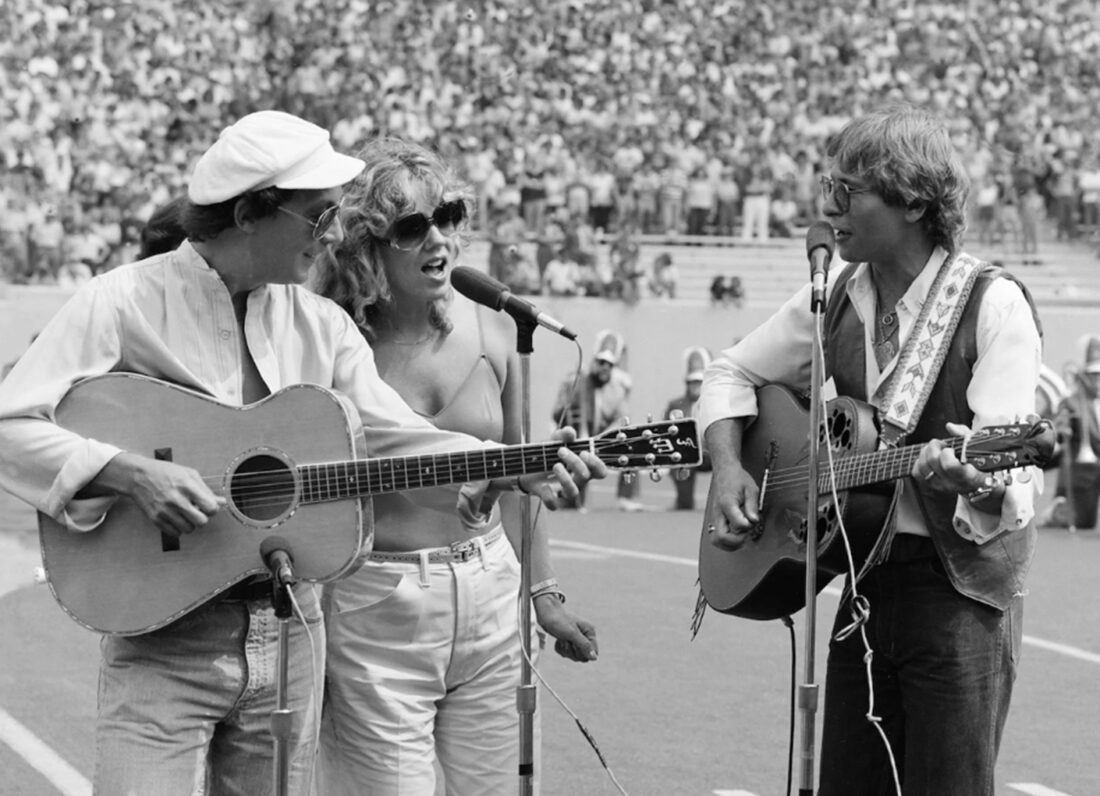
Bill Danofff, Taffy Nivert and John Denver perform ‘Take Me Home, Country Roads’ at Mountaineer Field on Sept. 6, 1980.
MORGANTOWN — On Aug. 31, 1971, a 27-year-old folk singer and songwriter with a hit on the Billboard charts came to Charleston, West Virginia, where he performed that tune on the Capitol lawn.
The singer was John Denver, whom United Press International described as “unknown to the general public” before the April 1971 release of “Take Me Home, Country Roads.” But on that summer evening four months later, after he sang it once, “The entire crowd rose as one and Denver then repeated it as an encore, the song that has done more for the Mountain State than any amount of official promotion could have hoped to accomplish.”
The song’s journey from new single to state anthem proceeded with a breakneck speed inadvisable on any of West Virginia’s actual winding thoroughfares.
West Virginia University leaders almost immediately saw the song’s potential as an anthem. The Mountaineer Marching Band began performing the song in 1972, only one year after its release. That year’s Homecoming Parade featured a student-designed float bearing the song’s title in blue letters on a gold crepe background.
Since then, the song has been part of every home football game, where it became traditional to play it after victories, as the crowd sways and sings along.

Grammy-winning country music star and West Virginia native Brad Paisley performed the song at Mountaineer Field in 2015.
Official WVU merchandise has often referenced the song’s lyrics, from “Take me home,” to “country roads,” to “almost heaven,” to “the place I belong.” The Erickson Alumni Center’s bell tower rings out the song, and campus phones have used it as hold music. Played at official events such as Commencement, the song evokes unity and celebration. Students have also put it to unsanctioned use as an a cappella party anthem.
WVU student recruitment materials have frequently referenced the song, with its international popularity making it an especially useful way to connect with prospective international students.
On Sept. 6, 1980, the people behind the song — Denver, Bill Danoff and Taffy Nivert — appeared in Morgantown to sing it at the opening of the then-new Mountaineer Field. About 50,000 fans sang along, before watching new Head Coach Don Nehlen lead his team to a 41-27 victory over Cincinnati.
Thirty-five years later, Grammy-winning country music star and West Virginia native Brad Paisley performed the song at Mountaineer Field.
Today, the song “remains an anthem across time, space, and context, even after 50 years,” according to Sarah Morris, assistant professor of English and coordinator of undergraduate writing at WVU. Her own experiences with the song, along with its historical and rhetorical legacy, inspired her to use it as a teaching tool and to research and write the book, “Lessons from ‘Take Me Home, Country Roads:’ Identity, (Be)Longing, and Imagined Landscapes.”

WVU professor Sarah Morris recently wrote a book examining ‘Take Me Home, Country Roads.’
In her book, from WVU Press, Morris recalls the song’s frequent and often unexpected appearances throughout her life. Shortly after her birth in West Virginia, her family moved briefly to Utah before returning to the Mountain State. During that time away, the song brought pangs of homesickness to her parents. Decades later, as a graduate student at the University of Maryland, Morris heard the song’s notes echoing across campus one evening from the soccer stadium and stopped to listen, transfixed by her own longing for home.
Like many Mountaineers, she has also encountered the song in unlikely places during travels abroad. While in Japan on a teacher exchange program, she heard a middle school marching band perform it; in Bangkok, a Thai band played it in a curry shop.
Why did a song about West Virginia become a global phenomenon, spawning nearly 300 recorded versions in English and translated versions in more than 20 other languages, including Romanian, Hebrew and Slovenian?
The song achieves generality, Morris argues, because it mentions West Virginia but is not about West Virginia — it expresses a universal longing for home. Fittingly, some of its earliest fans were military personnel serving in Vietnam.
Morris connects the song’s appeal with a Welsh concept called hiraeth — an “unattainable longing for a place, a person, a figure, even a national history that may never have existed.”
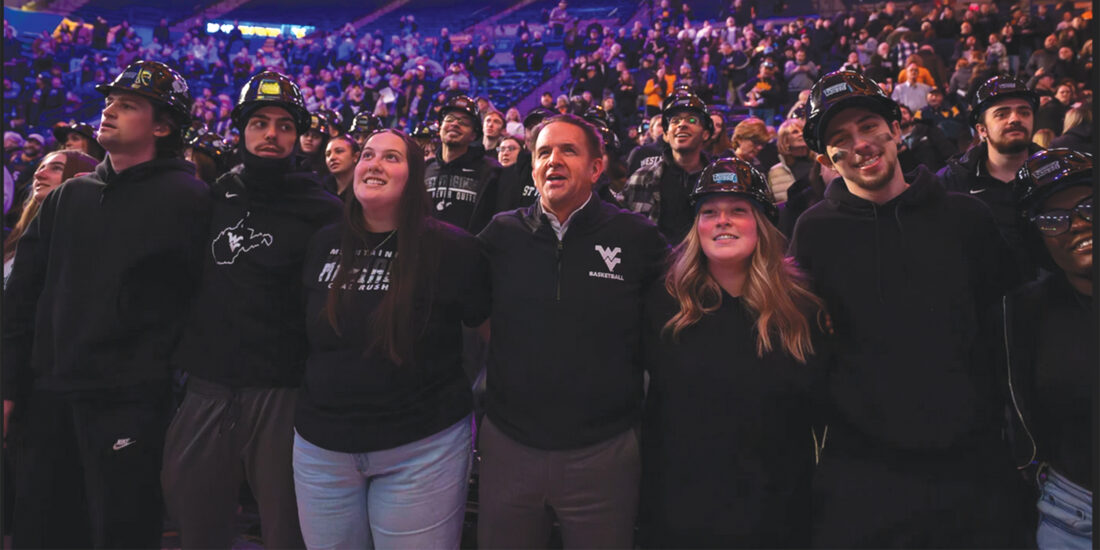
Resident Michael Benson sings ‘Country Roads’ with students after a women’s basketball win over Baylor on Feb. 1.
Many have noted that the song’s landmarks — “Blue Ridge Mountains, Shenandoah River” — evoke neighboring states. Only from one vantage point within West Virginia, at Harper’s Ferry, is the song geographically accurate.
It is unsurprising, then, that its primary writers, Taffy Nivert and Bill Danoff, found its inspiration on a drive through Maryland rather than on our state’s own country roads. Danoff had never even visited West Virginia before the song’s release, and Denver had made only a few appearances within the state during the late 1960s with his band The Mitchell Trio. Nivert had some familiarity with the Northern Panhandle from her time attending college in Steubenville, Ohio.
West Virginians’ eager embrace of the song reflected a hunger for positive portrayals, something rare in preceding decades. Economic problems had driven statewide population loss beginning in the 1950s. Meanwhile, poverty and social problems in Appalachia drew attention from national policymakers and media.
For example, Morris quotes a 1959 article in “The Nation,” portraying the “shaggy, shoeless children of the unwanted — the ‘hillbilly’ coal miners who have been displaced by machines and largely left to rot on surplus government food and the small doles of a half-hearted welfare state.”
By 1971, the state’s economic prospects were improving slightly. A decade of positive population growth was beginning. A folk music revival was sparking interest in Appalachian culture, and a burgeoning environmental movement was encouraging homesteaders — including friends of Danoff and Nivert — to settle here.

Essence Drake, right, smiles as she and classmates sing ‘Country Roads’ at a WVU Commencement on May 10, 2019.
No wonder that an optimistic, if simplistic, vision of West Virginia had more appeal than gritty realism.
“When our story is told with love and longing instead of disdain and deficit,” Morris writes, “we easily embrace that narrative, even if it is told from the outside.”
Many West Virginia songwriters have written more complex and authentic songs about the state, but none has achieved similar popularity. Morris compares those songs to snapshots in our collective family album, whereas “Country Roads” is a glamour shot — West Virginia as we want it to be seen.
The song’s embrace — by West Virginians and by people worldwide who share a longing for home — has propelled it into surprising places.
Morris has heard it sung at both weddings and funerals. She has seen “Country Roads” and “Almost Heaven” on products from baby onesies to craft beers, from funeral vault decals to porta potties.
The song has popped up in the Fallout 76 video game and on TV’s “The Office,” as Dwight and Andy played dueling versions. It has made its way into TikTok videos and online memes. Its familiar strains have graced protests and political rallies across the ideological spectrum.
In 2017, the West Virginia Division of Tourism began using it in its marketing. During the COVID-19 pandemic, videos from the WVU Mountaineer, then-U.S. Sen. Joe Manchin and others suggested using the song’s chorus to time handwashing.
The song’s malleability has made it an ideal teaching tool in Morris’ freshman composition classes.
“‘Country Roads’ is a frame for talking explicitly about social concerns, identities and ideas,” she said. “We interrogate the way the song’s meaning shifts depending on who is listening, who is singing and where the song occurs, and then we add more West Virginian voices into the conversation. It becomes a window into meaning.”
Through a teaching approach called place-based learning, the song takes on varying meanings for in-state, out-of-state, and international students. It sparks larger conversations about identity and authenticity. After studying it, students have gone on to explore such diverse research topics as the psychology behind sports fandom, the impact of local farmers’ markets, and an investigation of dilapidated towns.
Though the song’s reach is surprising, its universality reflects the goals of its songwriters and singer.
During his 1971 visit to Charleston, Denver told reporters that the song emerged at a volatile time and reflected people’s desire to find common ground:
“We wanted it to be melancholic and nostalgic but at the same time happy … ‘Country Roads’ says good things about what people everywhere can relate to.”
-

- Bill Danofff, Taffy Nivert and John Denver perform ‘Take Me Home, Country Roads’ at Mountaineer Field on Sept. 6, 1980.
-

- Grammy-winning country music star and West Virginia native Brad Paisley performed the song at Mountaineer Field in 2015.
-

- WVU professor Sarah Morris recently wrote a book examining ‘Take Me Home, Country Roads.’
-

- Resident Michael Benson sings ‘Country Roads’ with students after a women’s basketball win over Baylor on Feb. 1.
-

- Essence Drake, right, smiles as she and classmates sing ‘Country Roads’ at a WVU Commencement on May 10, 2019.