
Trending
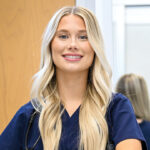
MORGANTOWN -- Alexis Cipoletti's fears of attending college as a first-generation student from a rural West Virginia community evaporated when she toured West Virginia University as a high school student. Now ready to graduate with a bachelor's degree in exercise physiology (December 2025), she's excelled beyond her expectations and is prepared for her next WVU journey -- a seat in the physician assistant graduate program.
"I know for a lot of students coming in as first generation, it's intimidating. It's scary. I want to show people that it's possible and it's especially doable at WVU because there's a lot of support," said Cipoletti, of Wellsburg, West Virginia.
Since high school, Cipoletti stamped medicine, health care and science at the top of her college study list. However, she was unsure of the path until she learned about a career as a physician assistant.
"I fell in love with it," she said. "I knew it fit every aspect of my personality. I'm someone who really likes to work with others more than on my own. I really like to collaborate and get opinions and ideas from others. There's a lot of value in that as this is a major aspect in the career of a PA because we work alongside a health care team to provide high-quality care."
At WVU, her first step toward that goal was the School of Medicine exercise physiology program. It's where students learn from experts in their field through classroom work and interactive labs that prepare them for immediate employment or further study, including physical therapy, occupational therapy, medicine or other rehabilitation careers.
"In the exercise physiology program, there is a strong sense of support from both my classmates and my mentors," Cipoletti said. "Even though it is a large school, it doesn't really feel like that to me. It feels like I always have peers and faculty to rely on whom I feel very close to and connected with."
Cipoletti describes the learning environment as "truly incredible" and one that fortified her skills for the next level of education and professional career.
The program allowed Cipoletti to gain hands-on experience in the University's cadaver lab - an opportunity unique to School of Medicine students.
"Being able to have that experience before I was even applying to PA school was awesome," she said. "I learned so much. We were able to get through every single system of the body. It gave me great appreciation for anatomy and how the body works. I have a high level of respect for not only this program, as they granted us this opportunity, but also for those who donated their bodies to science."
Exercise physiology students gain additional experience by choosing either an internship or research. Cipoletti joined Salik Hussain's lab, where students explore how what we breathe in from the environment impacts the lungs and other body functions. The work was part of the WVU Research Apprenticeship Program, or RAP, open to all undergraduates with limited or no research experience. Through two semesters of training working alongside faculty mentors, they earn course credit and federal work-study funds.
"It's been a great experience because research can be intimidating. Now, I feel so well-prepared heading into higher education," she said. "As a first-generation student, I didn't know if I was competitive enough or if it was something in reach for me. WVU graciously provided these opportunities."
In labs and other settings, students learn how to take blood pressure, interpret EKG readings, analyze body composition and other clinical skills.
In another effort to step up her career goals and learn more about interacting with patients, Cipoletti shadowed a physician assistant in her hometown of Wellsburg, which has one clinic for family medicine.
"I saw the trust PAs are able to build with their patients and that's what I want to pursue as a provider," she said. "I want to spend time with the patients, get to know them, and make sure they understand their care plan.
"I appreciated seeing the PA I shadowed form connections with patients because there's such a continuity of care in family medicine. You're seeing the same patients for years and you get to build a special relationship with them. That's something I really value."
It's the support for preparedness that solidified Cipoletti's decision to continue her studies at WVU. However, because of the competitiveness of physician assistant programs, she wanted to make sure she secured a seat somewhere and applied to several schools. None of them felt right.
"For all my other interviews, I remember being very nervous and very intimidated," she said. "The WVU interview was a little later, after I'd had a few others. I remember going into that interview feeling excited, which wasn't really something I felt at the other ones. It was a special experience because it felt so comfortable talking to them. It felt like a friendly conversation."
After completing the 28-month Physician Assistant Studies Program, Cipoletti has no plans to leave West Virginia.
"I want to be able to give back to the state that gave me so much and especially the school that gave me so much," she said. "I feel connected to the state more than ever because of the education that I was able to receive and connections that I've been able to make."