
Ally’s Hope founder visits Elkins Rotary Club
Trending
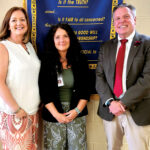
Ally's Hope founder and Director Shelby Wilson spoke with the Rotary Club of Elkins. Located in Elkins,
Ally's Hope is a faith-based nonprofit female sober living home that opened its doors on Dec. 15, 2025. The facility is a WVARR state certified program that follows strict guidelines for its operations. Board members include Elkins Rotarian Kristie Vandevander, Pastor Tim Edin, Pastor Roy Schneider and Jess Kerns-Galloway.
Prior to the establishment of Ally's Hope, there were no female sober living homes in the surrounding area except for One Unique Recovery House in Upshur County. "The ladies there helped me move this one along as far as guidance on setting up the program," said Wilson.
Ally's Hope is a personal mission for Wilson.
“Substance abuse affects so many people in our county and in West Virginia. There's no way to stop it if we don't step up and do something to help those suffering with substance abuse," said Wilson. "Substance abuse doesn't know boundaries. It doesn't care who your family is, how you were raised, who your parents are, what religion you have, it does not care. It will seek them out and it will find them and for whatever reason the ones that attempt it find themselves down a road that they have a very hard time getting out of."
As a registered nurse, Wilson has worked closely with those who were suffering from substance abuse.
"It's not something they enjoy. It's not a party to them as everyone may seem to think," added Wilson. "It is the hardest and worse thing I've ever seen somebody try to fight."
Wilson saidrecovery is possible and that is a compelling reason to provide support for those who are wanting to get out of addiction and change their lives.
Wilson's own family has been affected by substance abuse.
"My own child went down this nasty road, so it's been a living hell for quite some time," said Wilson. When her daughter completed her substance abuse rehabilitation program, she chose to go to a sober living home.
"We pulled up [to the home] and it was a little shocking to say the least. It was not in the best neighborhood, and I could see a little bit of fear come across her face. I asked her if she wanted me to call another place because coming home was not an option," Wilson said. Her daughter opted to stay at that facility, even though it was not the place Wilson wanted to leave her daughter. The house was small with three ladies sharing a bedroom.
"When God laid it on my heart to open this sober living home, I had lived through about five months of hell because my daughter had relapsed, which is a common thing. She had gone missing and I had to put in a missing person's report and those were the hardest months of my life. But God is good, he truly is good and he got us all through that," Wilson said. "So, when he laid it on my heart that this was what he wanted me to do, I said OK."
Wilson approached the Randolph County Commission for funding. After a presentation and an in-depth conversation, the County Commission and opioid advisory board voted unanimously to provide the funds for the purchase of the home located on Robert E. Lee Avenue.
"My whole goal was to make sure I had a home in a good neighborhood. You have ladies who are coming, who are wanting to change their lives and what better way than to put them in a home where they feel like they have something to live for and to fight for," Wilson said.
There is a house manager who is on-site Monday-Friday. 8 a.m. - 4:30 p.m. The house manager does the resident intake procedure as well as making sure that the residents have applied for all appropriate benefits, such as SNAP, if they are eligible.
"She also sets up their therapy appointments and their doctors' appointments. A lot of them have let things go while they've been down this road of substance abuse, so it's important to get them in to see their physicians," added Wilson.
Additionally, the house manager ensures that the residents are tending to their household chores, working their 12-steps, and attending all the required recovery meetings and therapy sessions.
Ally's Hope can accommodate up to ten ladies, between the ages of 18 and 65, with no more than two residents in a room. Residents are referred through a rehabilitation facility or the judicial system. Wilson is very selective in who she chooses in order to ensure success. Wilson also feels an obligation to the community and the neighborhood to make sure that Ally's Hope is what she promised at its inception.
Residents have a number of requirements to be accepted into the sober living home. They must have 30 days of confirmed sobriety, they have to agree to find a job, they have to attend five in-person recovery meetings a week, they have to attend therapy and they have to attend church on Sunday. The residents must pay an intake fee of $475 and the same every 30 days after. "The ladies I have now are incredible. They are good and they are succeeding," commented Wilson.
"All of the ladies have jobs, and they all obtained a job within their first 30 days. They're good workers and you don't have to worry about them because they are drug tested regularly so you know they're clean. If they would relapse, I have not had that happen, but if they would they are dismissed from the program immediately and I will do my best to get them back into rehab or WVARR certified higher level of care facility, if they so choose."
Ally's Hope does not accept residents who have certain criminal convictions, such as sex crime conviction, a child abuse causing harm conviction or a violent crime conviction. Additionally, those who have severe cognitive impairment that would prevent them from participating in peer-led, peer driven, social model house activities as well as those who have ongoing medical conditions that require a high level of monitoring or care are not accepted.
The intake fee and subsequent required payments from the residents help cover the cost of the operation of Ally's Hope. Wilson has requested some funds from the county commission to help with utility expenses/payroll and has received funding from the WV LEDA grant that was facilitated by the Elkins Rotary club. Additional funds have been received from the Pallottine Foundation and the Snowshoe Foundation. Ally's Hope has been a recipient of donations collected by Valley Health Care and fundraising by Danielle Dougherty. Private donations as well as donations from local churches have been received. Anyone wishing to make a donation to Ally's Hope can mail a check to "Ally's Hope" at PO Box 2592, Elkins, WV 26241.
More information about Ally's Hope can be found at the organization's Facebook page (Allys Hope, Inc), by emailing Wilson at allyshopeinc@gmail.com or by calling Wilson at 304.614.9711.
Rotary is a global network of 1.2 million neighbors, friends, leaders and problem-solvers who see a world where people unite and take action to create lasting change - across the globe, in their communities, and in themselves. Visit www.Rotary.org to learn more about Rotary International, visit the club's Facebook page - Rotary Club of Elkins – or contact 2026-2027 club president Karen Wilmoth at wilmothk@gmail.com for more information about the Rotary Club of Elkins.