
Local business offers products to help improve agriculture
Trending
The Inter-Mountain photo by Brooke Hinzman
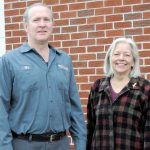
Wil and Delanne Spencer stand in front of their business, Environotics, which is located on Wilson Lane.
ELKINS -- A local business is working to "grow the future" in order to help create a better world through the use of its agricultural products and services.
Environotics, located on Wilson Lane in Elkins and owned by Wil and Delanne Spencer, offers products used to regenerate soil and improve growing mediums in order to produce food that is "healthier, more natural, stronger, more nutritious (and) more flavorful," officials said, while also offering agricultural consulting services.
The Spencers said Environotics products were created with the goal of cleaning up the environment through the use of biological agents in addition to rebuilding and remediating the environment to create healthy, chemical-free plants, food, animals and, ultimately, people.
"Most agricultural projects have to replenish the soil once they take a crop off because it's been stripped because it wasn't really very rich in the beginning. When you do it our way, the soil is richer after you harvest. It builds over time," Delanne Spencer stated in an interview with The Inter-Mountain. "It just makes a healthier microbiome."
"Microbes are everything. The world would not exist with out microbes; our bodies cannot even exist without microbes."
"Nothing really happens in the soil without microbes-- just like in our bodies," she said. "They keep things clean. They feed the plants, break down rocks into minerals that can be absorbed into the plant and then eaten by us. That's how we get our minerals-- or at least it's supposed to be. Plants today don't have enough."
According to a post on https://thehydroponicsplanet.com/ – Environotics offers supplements to hydroponic fertilizers, including the living microbes not found in soilless situations and the trace elements not found in base hydroponic nutrients.
"Our focus has been very much on microbes. If you have a problem in the soil, it's just like in the body. If you get sick, it's a microbe that's making you sick. So, if you put another thousand microbes in there, that one can't make a lot of fuss because it's in the balance of the whole community," Delanne Spencer said. "It's basically the same in the soil. If you get enough microbes in, it'll clean things up. They will eat the toxins and the impurities -- toxins, petrochemicals, glyphosate. They eat them, and what they excrete is healthy for the soil."
Environotics offers the largest diversity of soil microbes available, according to the company's website.
Wil Spencer, D.PSc, explained, "It's the same thing happening in and amongst the root hairs of the plant that happens amongst the villi in our gut."
"When you look at the health of people versus plant health, there are so many similarities that it's astounding."
Wil Spencer, who was raised on a farm in northern Minnesota, has been involved in agriculture his entire life.
"My dad was a pretty big farmer. At the height of his farming, there were 3,000 acres and over 800 head of cattle," he stated, adding that the operation involved chemical and conventional farming. "I was sick my whole childhood. Every time they sprayed, I'd get sick, so that led me down the path to discovering more about natural farming as well as natural health."
His discoveries led him to the practice of biodynamic farming, which is rooted in the work of Dr. Rudolph Steiner and his 1924 lectures to farmers.
"It's beginning to become pretty popular because of the higher yields, the health of the animals, soil and the people consuming the biodynamic products," he said, adding that he farmed a goat dairy in the 1990s using biodynamic methods.
"That's what started this. I went from chemical farming as a sick child to biodynamic farming, and there was no more illness," Wil Spencer said, adding that he's been very active in cleaning up the environment, which led to the creation of some Environotics products.
"I've had very unique relationships with some people who used to work for the United States Department of Agriculture who traveled the world collecting microbes from the 60s to the 80s," he said.
"Their job was to collect them to bring them back to see if there was an industrial or military application for them, and the microbes that didn't suit that bill were then kept and learned about -- hundreds of thousands of strains of these other microbes from around the world and what they do," he said, noting that he's incorporated that work into the efforts of Environotics to make it easily accessible and usable.
"We have over 88,000 chemical compounds that have been introduced in our environment in the last 100 years, and they're synthetic compounds that are toxic. This is what's behind a lot of the cancers and a lot of health problems and agricultural issues like blights, bugs and the honeybee (population)," he said. "It's the chemical toxins building up in our environment that are behind a lot of these problems."
The Spencers said 2019 field tests that were conducted on some of their products in California received attention from universities and agro-businesses, as the products were able to raise the yield of tomatoes by more than 47%, increase their nutrient density by approximately 21% and improve the taste, texture and overall health of the plants with less pesticide and fertilizer use.
"The tomatoes were growing, flowering and ripening more uniformly," Wil Spencer said.
Environotics also features a fodder system, which allows grain for feeding animals to sprout year-round.
"We sprout the seed and grow it for six days -- when it's at the most nutritional point that the plant ever reaches. So, it's feeding every single grain at its optimal nutritional level, and you have fresh fresh grass year-round regardless of the weather," Delanne Spencer said.
The business also sells a line of products to aid the honeybee population.
"The food chain is deficient, and everything's being sprayed. They're getting toxified everywhere they go, and so their immunity, generation after generation, is going down, and they're getting weak," said Delanne Spencer. "If we can build their immunity with microbes, clean the hives (with probiotics), keep things nourished and give them digestive aids, we can improve their internal strength.
"It has proven to be very effective," she said, adding that trials have shown that introducing Environotics products to hives caused an apparent decrease in contamination levels, allowing them to grow and regain health.
In the future, the Spencers hope to add a biochar plant to their business.
"We could burn municipal waste and reduce it by 95% -- just down to neutral ash," stated Delanne Spencer, adding that they have been looking for someone to partner with them for the project. "That's an expensive project to get started, but biochar is really good for the environment, for people, for all kinds of things."
Wil Spencer added, "Hardwood biochar is extremely beneficial versus other types of biochar, and we're in the hardwood alliances zone here, and we have access to massive amounts of volume of hardwood that's more of a waste stream that we could turn into an agricultural and environmental positive product."
To learn more about Environotics, visit www.environotics.com.