
McWilliams sentenced to 15 years in plea agreement
Trending
The Inter-Mountain photo by Amanda Hayes
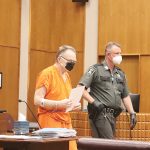
Timothy McWilliams is escorted out of Tuesday's hearing by court security officer Mark Cunningham after being sentenced for voluntary manslaughter.
BUCKHANNON -- A Buckhannon man incarcerated since 2018 for killing his father reached a plea agreement Wednesday in Upshur County Circuit Court and received the maximum sentence possible.
Timothy McWilliams, 67, first reached a Kennedy vs. Frazier plea agreement in April 2019 which meant he did not have to give a factual basis for the plea. At the time, 26th Judicial Circuit Court Judge Kurt Hall did not accept the plea and waited for various reports and diagnostic tests to be returned. Due to COVID-19, court matters were also delayed this spring.
The plea agreement had been negotiated by former prosecuting attorney David Godwin and reached in April 2019 but prosecuting attorney Bryan Hinkle was appointed in late 2019.
Wednesday, Hall said the court would accept McWilliams' plea of voluntary manslaughter, a lesser charge of first-degree murder he had been indicted for in January 2019.
"I have enough information now where I believe I can accept or reject this plea," he said. "The plea is in the best interest of this case."
Hall said that McWilliams' would have a potential defense in the case that could result in a more favorable verdict if the case went to trial.
On March 8, 2018, law enforcement was called to the McWilliams' home where Leo McWilliams was found deceased.
"He was attacked in the middle of the night by his father and was stabbed," Hall said. "That is how this was initiated. After he was attacked, McWilliams subdued his father and cut his neck in an act that could only be described as extreme overkill. The facts could go either way in this case. This plea resolves the matter so that both sides obtain a result that was negotiated in good faith."
Hinkle advocated for the maximum term of 15 years in prison for voluntary manslaughter.
He referenced the behavior of McWilliams who could have disarmed his father who was elderly and had dementia and Alzheimer's, instead of nearly decapitating him with a four to six inch knife wound.
"By his own statement he gave, [McWilliams] did that in retaliation for being stabbed not because he was in fear," Hinkle said.
Based on the Division of Corrections report which indicated McWilliams had a high risk to offend if agitated, Hinkle said he did not feel he could recommend anything else but the maximum term of 15 years.
McWilliams' attorney Phil Davis said McWilliams did not desire any alternative sentencing.
McWilliams competed high school, served in the U.S. Marine Corp and received an honorable discharge at the rank of sergeant.
"His desire after he is finished with his period of incarceration is to move back in his with mother and help around the house," he said.
Davis asked for four years of incarceration.
McWilliams, who sat quietly for the hearing, did not speak on his own behalf.
During sentencing, Hall noted the pre-sentence investigation and said the court wouldn't consider McWilliams' 1980s case as part of this sentencing. McWilliams was convicted of murder and malicious assault in 1980 stemming from an incident at a Morgantown night club, but this was later reversed by the West Virginia Supreme Court of Appeals and McWilliams was acquitted of both counts. The judge read again what Hinkle referred to from the DOC diagnostic report.
"Mr. McWilliams can live in society without many problems until he is challenged," Hall said. "When he is challenged, he becomes violent."
The report also references a high level of sociopathy noted with McWilliams and a lack of remorse on his behalf and states that out-patient counseling will not safeguard family and community.
"Incarceration is the only supportive venue that will decrease risk," Hall said the report stated.
Because McWilliams' father had Alzheimer's and dementia and had gone to neighbor's houses with a knife and threatened people, Hall said he was worried that McWilliams would inherit those conditions.
"The court is worried about what is going to happen when you finally discharge this sentence or you parole this sentence," he said.
This would leave McWilliams' family with an older, more violent version of McWilliams' father.
The judge said that separating McWilliams from the public for the longest period of time he could was in the best interest of public safety.
Hall sentenced McWilliams to a determinate sentence of 15 years in the penitentiary with credit for time served. Hinkle said that with credit for time served since March 8, 2018 and the parole statutes, McWilliams could come up for a parole hearing in a year and a half.
Hall then asked that the court be notified of any parole eligibility hearing.
"I want to be notified whenever he is eligible for parole," Hall said. "Put that in the order that the court recommends he not be eligible for parole."
The judge also asked that the following specifics be put in the order. First, the Department of Corrections will notify the prosecuting attorney's office no later than 90 days before release and a mental health evaluation will be completed.
The evaluation should answer two questions -- is McWilliams mentally ill and is McWilliams a danger to himself and others.
The findings should then be reported to the prosecuting attorney no later than 45 days before release so that the prosecuting attorney can proceed with a civil commitment against McWilliams if they believe it is necessary. The prosecuting attorney should also be notified no later than 45 days before release where McWilliams will be residing.
Hall said that McWilliams could have disarmed his father by sitting on him.
"You didn't have to kill him," he said. "You didn't have to cut his throat. It was extreme overkill which the court believes wasn't necessary."