
WVASC helping children gain skills
Trending
Submitted photo
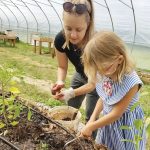
Americorps volunteer Sydney Leary, left, and WVASC Earth Ambassador Hallie Riddle are shown tending their plants in the garden, using a haybale as a compostable planter. Leary assists the Earth Ambassadors in learning how to care for the earth while also developing communication skills.
ELKINS -- The West Virginia Autism Supportive Center has just begun a new program for non-neurotypical children called the Earth Ambassador Program to help these kids develop social skills and a sense of responsibility.
"The Earth Ambassador Program is a way for us to work with people who are non-neurotypical," said Erin Browning, chairperson and president of the center. "That is a general way that we refer to people who have autism or other disorders related to autism."
The program allows the children to come to the center to work in the greenhouse and complete projects and experiments that develop social skills while instilling a love for the outdoors.
"They work in the greenhouse planting and growing food and learning about science related to water and soil. We also just believe that there's inherent learning that comes with the responsibility of caring for things in nature; plants and animals in particular," Browning said.
Also assisting with the program is Americorps volunteer Sydney Leary, a speech pathology student with an "affinity for communication."
"That's a struggle for people on the autism spectrum, that social communication, so we felt like it was super important for them to have more opportunity to learn in that capacity and really develop more of a growth mindset," said Browning. "We do all the earth-centered learning but we also work a lot with regard to mindfulness and social or emotional learning for people on the spectrum. There's a lot of research to back up that simply time in nature helps with all of that."
The Earth Ambassadors Program is currently serving six young people and their families, with three more joining soon. Browning says that the program also could potentially accept two more children for the summer.
"It doesn't have to be kids, just young people. We don't do lessons with preschoolers, they have to be at least 7 or 8 years old to benefit from this," she said. "Most of our clients are between the ages of 7 and 12, and then we have a couple that are teenagers."
In the upcoming weeks, Browning said the young people will be releasing 1,500 ladybugs into their garden and developing hypotheses about whether plants grow better when watered from the roots or the leaves.
"We've kind of given the comparison of if we water ourselves on our heads, it's not as effective as if we drink through out mouths. The plant roots are like their mouths," she said. "We've really tried to take abstract concepts and break them down into something a little bit more relatable and concrete for children."
WVASC also launched the G.R.O.W. Program for families in the community.
"We are just having families come out as a family unit and work in the garden together. They would come in the evening as a volunteer for our program and that gives them time to be in nature together, time to bond as a family and do something other than sit and look at a television," she said. "We're having them come in and do that and in exchange for that, they get to take the food home because we're growing a lot of food. We have more tomatoes than we know what to do with right now."
WVASC also provides fresh produce to the community in addition to offering educational programming and community events. Browning hopes that the Earth Ambassadors Program will continue through the years and be regularly offered as a summer course.
For more information on WVASC and any of their affiliated programs, visit the West Virginia Autism Supportive Center Facebook page.