
Trending
Submitted photos
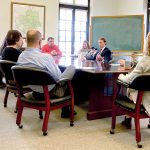
West Virginia State Auditor J.B. McCuskey meets in Elkins City Hall Wednesday with officials from the City of Elkins and Randolph County.
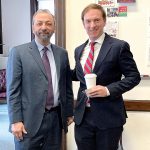
Elkins Mayor Jerry Marco, left, met with West Virginia State Auditor J.B. McCuskey at City Hall Wednesday.
ELKINS -- Elkins Mayor Jerry Marco met with West Virginia State Auditor J.B. McCuskey on Wednesday to discuss the city's dilapidated buildings issue.
Although a planned tour of several local dilapidated structures was canceled due to the wintry weather conditions, the two met with city and county officials to focus on the issue and a bill McCuskey has introduced.
McCuskey discussed the "The Community Resurrection and Economic Development Act'' bill with those in attendance. The bill, which McCuskey introduced this legislative session, addresses the issue and offers solutions in dealing with dilapidated buildings.
"The bill he's proposing would be tremendous for us and it really falls in line with what we are trying to do in cleaning up some properties," Marco told The Inter-Mountain Wednesday.
"It would give us the resources to try and expedite some of this, so that when we have some of these properties, we can get something done with them. It falls right in our wheelhouse of what we've been trying to do for quite a while here."
McCuskey is working with the Gov. Jim Justice's office to establish a fund with $30 million set aside for demolition projects throughout the state. The Community Resurrection and Economic Development Act will be introduced by the governor at the request of McCuskey.
"A lot of these properties are not only eyesores, but they are dangerous," Marco said. "We have property owners who live out of town and they sometimes forget that their property needs to be maintained. And then you have some involved that don't agree with what should happen with the property. This bill would allow the city the ability to maybe purchase the property if something is not done with it."
The bill addresses properties that can be saved and incentivizes ownership and repurposing of abandoned lands. The bill offers a hardship plan to property owners to allow for repayment arrangements or tax forgiveness when one or more conditions are met. If the taxes are delinquent and the property ends up in the Auditor's Office, it will first be offered to owners of neighboring parcels of land, then the city or county in which it sits, then nonprofit corporations and charitable groups.
"We would like the ability to be able to address having the owners take these buildings down, and if not, let the city step in and do it," Marco said. "We want to be able to attract people into bringing more businesses to town. But sometimes when they see some of these structures that are dilapidated, they decide to go elsewhere."
Marco said McCuskey also made it a point to discuss how the bill could help communities with student housing.
"It could provide better housing around the city for some of our students that go to Davis & Elkins College," Marco said. "Especially some of the international students who sometimes live here year-round. It could help us build small properties, or student housing for them that is off campus.
"I think that is a tremendous idea and a tremendous draw. It also helps us bridge that gap to make that rapport that we already have with D&E and the students even stronger."
Marco said he appreciated McCuskey taking time out of his busy schedule to come to Elkins.
"I'm very excited about it and I'm honored he was able to come to Elkins and talk with us," Marco said. "The first words out of his mouth were that Elkins is an amazing town. He really loves this area a lot."