
Owl Rescue, Release
Once injured, bird of prey now back in wild
Trending
The owl's fractured left wing required a splint. The bird was injured in a collision with a motor vehicle.
TUCKER COUNTY -- An injured great horned owl was rescued, nursed back to health and released into the wild by a group of concerned professionals and volunteers.
On Feb. 8, the owl was soundlessly gliding across a Tucker County road in pursuit of prey when his flight was cut short by a collision with an oncoming vehicle, officials said.
The driver stopped, saw the owl was alive but injured, and immediately contacted West Virginia Division of Natural Resources Wildlife Police Officer Joshua Prickett.
Elkins resident Dylan Lewis, who is trained in the rescue of birds of prey, responded to Prickett's request for assistance and met the officer at the scene.
The owl, an adult male, was taken to Jo Santiago, who works for the U.S. Forest Service International Programs and specializes in bird of prey, for immediate initial care. The owl was then transported to the Avian Conservation Center of Appalachia in Morgantown early the next morning.
Dr. Jesse Fallon, a raptor specialist at the ACCA, determined that the owl had suffered a fracture on the left wing, to which the doctor applied a splint. Over time the fracture healed, and officials exercised the owl to get him ready to be released back into the wild.
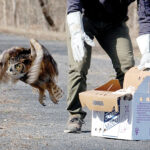
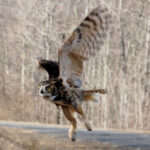
Lewis, along with another raptor rescue volunteer, Keri Lewis, drove the owl to a location in the bird's home territory, meeting with Prickett. The group released the owl, who quickly flew into the trees.
"Thanks to the kindness of the driver, Officer Prickett, the ACCA, and Dr. Fallon, the owl was free to fly again," officials said.
Katie Fallon, co-founder of the ACCA, said, "This was one of the feistiest, wildest great horned owls I've seen. He had to spend several weeks in a small enclosure while his fracture healed and he was not happy about it.
"He destroyed perches, scared volunteers, and put on quite a show of beak-clacking and puffing up," she said. "So glad he's back out in the wild!"
Great horned owls, also known as "flying tigers" for their fierce attitudes and hunting abilities, are protected by state and federal laws.
The birds provide a great service in our environment by keeping animals such as rodents in check.
If you find an injured or ill raptor, please call the ACCA at 304-906-5438 for help, or the WVDNR. If possible, stay with the bird until help arrives to protect it from humans and other animals.