
Owl Rescue & Release
Bird had been struck by vehicle
Trending
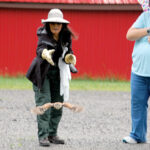
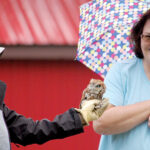
Raptor specialist Jo Santiago, left, releases a screech owl into the wild as the bird's rescuer, Sandra Teter, looks on. The owl immediately flew across an open field and into a dense cover of trees.
MILL CREEK -- After being struck by a vehicle in Randolph County, an Eastern Screech Owl recently got a new lease on life and in the process helped a group of orphaned owlets do the same.
Earlier this spring, Sandra Teter was driving to work next to Northwest Lumber on Route 219 when she heard a thud on the hood of her truck. Teter knew she had accidentally hit something small but could not see what it was.
Teter thought whatever it was she hit had gone underneath the truck and she proceeded to drive to work. After a 10-hour work day, she noticed a tiny owl laying on the pavement in front of her parked vehicle. Apparently the owl got stuck somewhere in the front of the truck and remained there for the four-mile trip to Teter's work.
Teter wasted little time helping the owl as she immediately put it in a box and called Randolph County 911 for assistance. Emergency operators put Teter in contact with Jo Santiago, who is a raptor specialist. Santiago took the owl to her facility for emergency care and then transported the bird to the Avian Conservation Center of Appalachian in Morgantown.
Once arriving at the ACCA, Dr. Jesse Fallon diagnosed the owl with a fractured leg and set the bone with a plastic sprint. Screech owls are masters of camouflage and finding places to hide, and the bird escaped the cage he was being kept in at the center and hid for some time before being found.
The ACCA received a clutch of orphaned screech owlets while the injured owl was still at the center recovering. Fallon introduced the adult owl to the chicks and he raised them until they were old enough to be released into the wild.
"Sometimes adult birds will take on the responsibility of raising orphaned chicks," said Santiago. "Being raised by an adult of their own species ensures the chicks will imprint on their own kind, instead of humans. If the chicks imprint on humans, they lose their fear of people, which puts them in danger."
Last week Santiago and raptor rescue volunteer Keri Lewis met Teter near the location where the owl was struck. The trio released the bird, who immediately flew across an open field and into a dense cover of trees.
"It's important that adult birds be returned to their established home territory," said Santiago. "They may have a mate there and they know where to find food, water, and shelter from other predators and weather."
Screech owls are known as "flying mouse traps" and are far better at catching mice than cats. The owl that was released back into the wild weighed only 5.5 ounces and stood 6 inches tall. Owls of his size can eat up to 550 mice a year, while a family of seven owls can eat up to 3,850 mice per year.
"People can attract Screech Owls to their property by putting up screech owl nest boxes," said Santiago. "People need to be aware that putting out rodent poison will harm more than rodents. Animals that eat rodents that have consumed poison will be poisoned as well. Sticky traps can also be a death trap for owls. Plastic reusable traps are the safest and most humane way to catch mice."
Owls and all raptors are protected by both federal and state laws. If an injured or ill raptor is located, secure the bird in a ventilated cardboard box. While injured or ill birds may seem tame, they are not. Never pet a bird, as it is stressful to a wild animal and further compromises the chance for recovery. Keep the injured or ill bird away from animals and other humans and call the ACCA hotline at 304-906-5438 or the WVDNR for assistance.