Officials approve delayed Mason County project
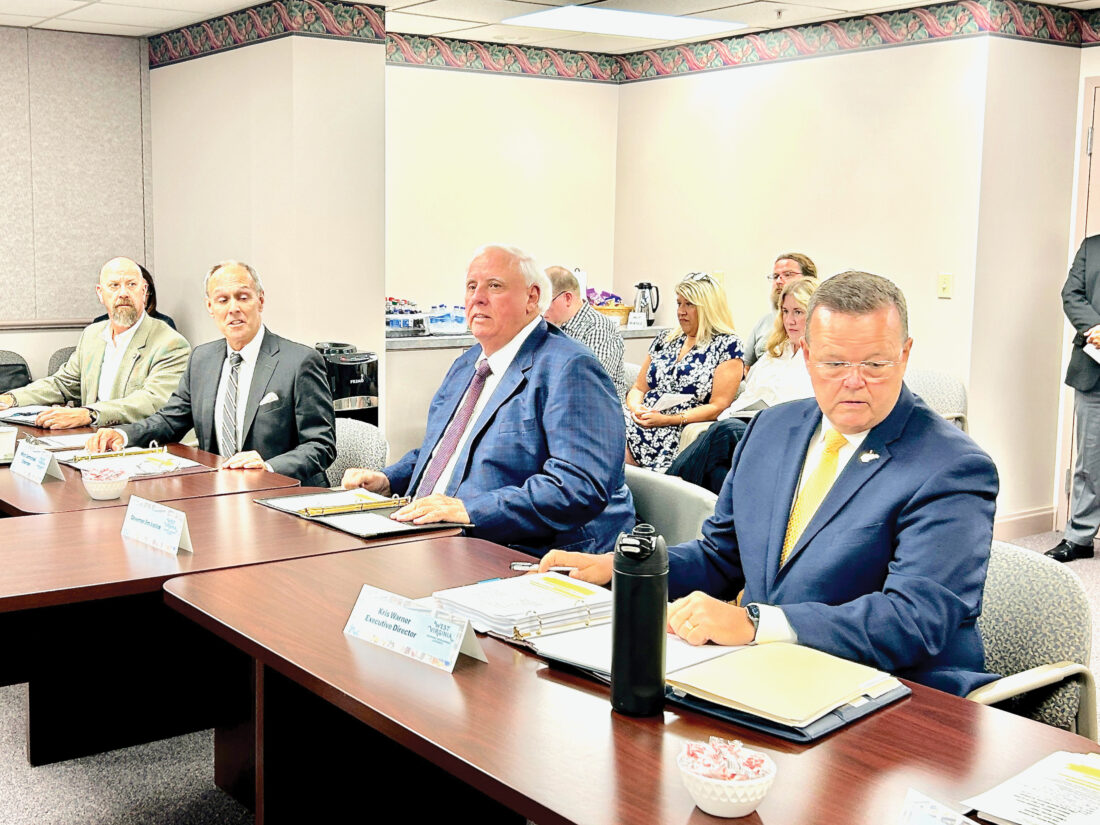
Photo by Steven Allen Adams Gov. Jim Justice, center, urges members of the West Virginia Economic Development Authority to approve forgivable loans for the Point Pleasant Mountaineer GigaSystem project
CHARLESTON — Gov. Jim Justice and West Virginia officials celebrated Wednesday a re-scheduled announcement for a hydrogen manufacturing project in Mason County that will store its emissions underground, but questions linger about the project.
Justice, officials with the Department of Economic Development and Department of Commerce and lawmakers gathered at the Culture Center at the Capitol Complex to welcome Houston-based Fidelis New Energy and its subsidiary, Mountaineer GigaSystem LLC, to the state.
“We created a situation now where we’ve had dollars to be able to go out and genuinely make a real-live effort to compete against the whole world and surely all other states to bring goodness to West Virginia,” Justice said. “This that we’re talking about today is cutting edge, an opportunity beyond belief.”
Prior to Wednesday morning’s celebration, the state Economic Development Authority approved up to $62.5 million in forgivable loans for Mountaineer GigaSystem through the High Impact Development Project program. The only nay vote was from a representative of State Treasurer Riley Moore.
Upon completion, the project would provide clean hydrogen power to chemical manufacturers, transportation companies, other electric utilities and data centers. The project will produce hydrogen using natural gas in a process called blue hydrogen. Fidelis would then take the greenhouse gas emissions and pump the carbon dioxide underground, making it a near net-zero emissions facility. The project would also involve a biomass power plant.
“We are all in,” said Dan Shapiro, CEO of Fidelis. “We have vast resources in West Virginia and in this country of dense energy that needs to be harnessed and serve as inputs, but there are proven technologies … to harness that energy while at the same time reducing CO2 emissions.”
According to a memorandum of understanding between the company and the state dated July 6, the loans would come in two tranches of $25 million and $37.5 million.
The first tranche would be used for preconstruction activities. Fidelis is required to obtain permits, drill its sequestration wells and have air permits in hand within two years to have the first $25 million forgiven and receive its class VI sequestration permit and all remaining air permits by year three of the project.
The Legislature passed Senate Bill 729 last year, allowing the Economic Development Authority to use monies in the newly established Economic Development Project Fund for projects with investments of more than $50 million and expected creation of at least 200 permanent jobs.
But according to the memorandum of understanding, Fidelis states that the Mountaineer GigaSystem facility would create 125 permanent jobs, though the company also estimates the project will involve more than 5,500 construction jobs. The second $37.5 million loan would be forgivable once Mountaineer GigaSystem meets its employment and investment commitments. The second tranche would be dedicated to construction and property acquisition.
According to a representative of the Department of Economic Development, the Mountaineer GigaSystem still qualifies for the High Impact Development Project program because the 125-job commitment from the company is for phase one, with more jobs expected to be created in phases two through four. According to the company, the project could employ up to 800 workers when all phases are completed. The company estimates its investment in the state for the project at $2 billion and $105 million in annual tax revenue through personal income tax income, severance tax income, public property lease income, and royalties to the state.
Those royalties would come from Fidelis leasing pore spaces beneath state forests, wildlife management areas, and other properties owned by the state to store its greenhouse gas emissions as provided by Senate bills 161 and 162 passed earlier this year.
According to the memorandum, DNR would award leases to Fidelis for the development of pore spaces for carbon capture and sequestration on state-owned properties, provided that the leases will afford DNR with a market value for greater royalty.
Unlike other recent economic development projects through the High Impact Development Project program, the memorandum between Fidelis and the state also doesn’t require collateral or security for the forgivable loans.
For the Berkshire Hathaway Energy — Renewables project in Jackson County, a $50 million loan, and Commercial Metals Corp. project in Berkeley County, a $75 million loan, the loans are forgivable when the companies achieve projected job commitments and private investment commitment with a pro-rata penalty for each job not created. For the Form Energy project in Weirton, a $290 million loan, the state owns the land where Form and the company will lease the property from the state. Once the company meets its commitments, the land and assets will be transferred to Form beginning in 2028.
According to the memorandum of understanding, Fidelis sees the Mountaineer facility as an anchor in a possible Appalachian Clean Hydrogen Hub. Last year, multiple natural gas and clean energy companies announced the creation of the Appalachian Regional Clean Hydrogen Hub, or ARCH2, which would take advantage of the state’s access to natural gas supplies and existing infrastructure to manufacture blue hydrogen and store the carbon emissions underground.
Several representatives of environmental groups were on hand at Wednesday’s EDA meeting to offer public comments opposing the project and the forgivable loans.
“It’s an unproven technology and basically, I feel like the state is asking taxpayers to not only gamble our own money, but also gamble with our health and public lands,” said Karen May, senior field organizer for the Sierra Club in West Virginia. “I don’t feel it is acceptable, especially when there are so many proven, inexpensive, efficient ways to generate power.”
“The agency not doing its due diligence in getting feedback from communities that will be affected by this, and also taxpayers because this is a forgivable loan and it is going to be funded by our taxpayers,” said Morgan King, climate campaign coordinator for the West Virginia Rivers Coalition. “Right now … hydrogen produced by shale gas is not being produced to scale and it is also prohibitable expensive. We’re going to see our taxpayers supporting this project further when it’s not even an economical project.”
Pete Hollis, the leader of Fidelis’ carbon capture and sequestration businesses, said detailed engineering is underway and all efforts were being made to ensure that carbon emission storage underground beneath state-owned properties would be safe.
“At Fidelis, we only utilize commercially proven technologies within our developments,” Hollis said. “This includes technologies and techniques and procedures that support the safe, permanent sequestration of CO2 in sandstones and dolomites that are prevalent in West Virginia. These will not interfere or impact any of the drinking water or existing oil and natural gas production.”
“Without any doubt, there is no question whatsoever, whether it be the EPA or DEP or whatever it may be, we’re going to do the right things,” Justice said at the EDA meeting. “We’re not going to endanger our way of life. With all of this, this could be an opportunity for jobs and greatness within this state.”
Local News

Warner preparing for 2026 primary
Cutting Bricks

New River Gorge designated underrated destination
Morrisey signs bill repealing transfer rule
LANSING, W.Va. —Gov. Patrick Morrisey said Tuesday he signed a bill repealing the controversial student ...

Foundation creates Meals on Wheels Randolph County Fund