
Trending
CHARLESTON -- As lawmakers in West Virginia inch closer to approving the budget for the next fiscal year, tax revenue for the current fiscal year is approaching half a billion dollars.
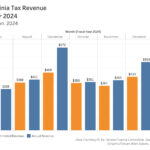
According to the Senate Finance Committee's monthly tax revenue report for the fiscal year 2024 general revenue budget, the state ended the month of January with nearly $531 million in tax collections, which was 10.9% more than the $478.7 million estimate from the Department of Revenue, providing the state with a $52.3 million surplus for the month.
Fiscal year-to-date tax collections of $3.3 billion was 16.2% more than the $2.8 billion revenue estimate for the first seven months of the current fiscal year, providing the state with $458.7 million in surplus tax revenue.
"West Virginia's economy continues to defy expectations," said Gov. Jim Justice in a statement Thursday. "Even after historic tax cuts, our January revenue collections shattered estimates by over $50 million, pushing our total surplus to an incredible $458 million. This momentum proves our investments in diversification and responsible budgeting are paying off as we build a brighter future for every West Virginian."
Personal income tax collections missed their monthly mark for the second time this fiscal year. January personal income tax collections of $233.5 million was 1.5% less than the $237 million revenue estimate and 23.5% below January 2023 collections of $305.3 million. Fiscal year-to-date collections of $1.4 billion were 16.3% more than the $1.2 billion revenue estimate, but 5% below the $1.5 billion collected during the first seven months of the previous fiscal year.
The West Virginia Legislature and Justice worked together last year to pass a 21.25% across-the-board cut in personal income tax rates retroactive to Jan. 1, 2023. Revenue officials last year projected the tax cuts and other rebates in House Bill 2526 could return as much as $793 million by fiscal year 2025 and as much as $829 million by fiscal year 2026. Triggers within the law could also cause anywhere between 1% and 10% in additional income tax cuts next year.
January revenue for the consumer sales and use tax was also down slightly. Sales tax revenue for last month was $156.2 million, which was .3% less than the $156.6 million revenue estimate. Fiscal year-to-date sales tax collections of $1.026 billion was 2.1% more than the $1.006 billion revenue estimate, providing the state with a $20.6 million surplus.
Tax collections for January were buoyed by improved tax collections for coal, oil, and natural gas severance taxes. Severance tax collections for the month were $55.8 million, which was 79.8% more than the $31 million revenue estimate, resulting in a $24.8 million surplus. However, fiscal year-to-date severance tax collections of $167.9 million was 4.7% less than the $176.2 million revenue estimate.
Corporate net income tax collections also remain strong, coming in at 124% above revenue estimates for the month. January corporate net income tax collections were $18.8 million, which was $10.4 million more than the $8.4 million revenue estimate. Year-to-date corporate net income tax collections of $237.1 million was 101.7% more than the $117.6 million revenue estimate, for a $119.5 million surplus.
Lawmakers are watching this fiscal year's tax collections as work begins by the finance committees in the House of Delegates and state Senate on the fiscal year 2025 budget that will begin July 1.
Justice presented lawmakers with the budget bill on the first day of the 2024 legislative session Jan. 10 during his State of the State address.
Justice kept the fiscal year 2025 general revenue budget flat at $5.265 billion – a 7.8% increase (or $381 million increase) from the $4.884 billion FY 2024 budget that went into effect in July.
Justice also presented lawmakers with proposals to cut tax further by $49.7 million, including a state child and dependent care tax credit, the exclusion of all Social Security benefits from the state income tax, and expansion of a senior citizen homestead property tax credit.