
Wounded owl rescued in Harman
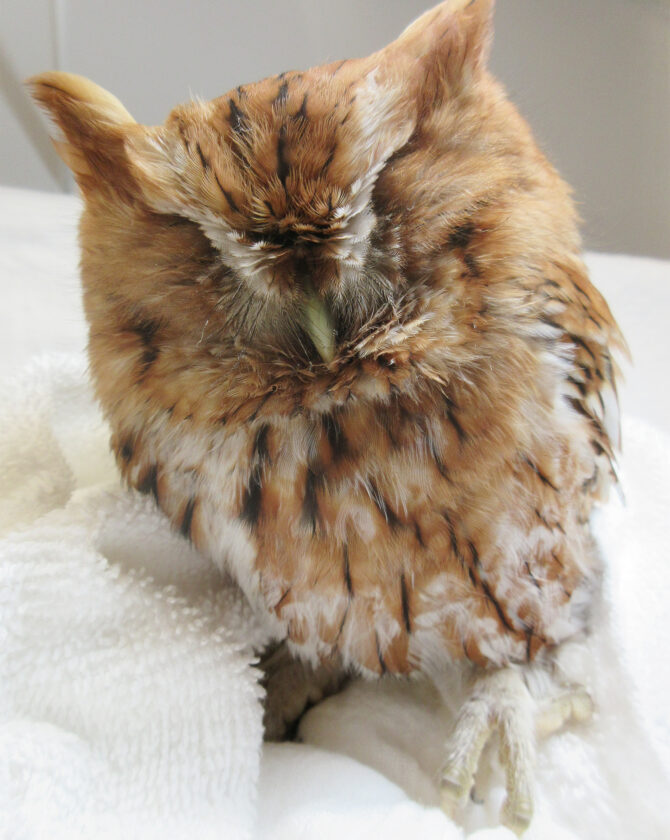
Submitted photo A local resident recently saved a red phase Eastern Screech Owl that was hit by a vehicle in Harman. The owl, above, was sent to the Avian Conservation Center of Appalachia in Morgantown for treatment.
HARMAN — The compassion and effort shown by a Harman resident has given a wounded owl a new lease on life.
Last week, Gabrielle Lambert was driving her vehicle past Warcamp Lane in Harman when the automobile in front of her struck a bird and sent it crashing into the middle of the road.
The vehicle that struck the bird didn’t stop, and Lambert immediately pulled over to help what was later identified as a red phase Eastern Screech Owl. Once out of the vehicle Lambert gently secured the owl by wrapping it up in a towel. She then drove to Elkins, where she was put in contact with local raptor specialist Jo Santiago.
Santiago, who rescues raptors and other native birds in need throughout the area, made arrangements to transfer the owl to Dr. Jesse Fallon, at the Avian Conservation Center of Appalachia in Morgantown.
The owl, an adult male approximately 5 inches tall and weighing 5 ounces, was given a complete examination after arriving at Dr. Fallon’s office in Morgantown. The doctor found that the owl had fractured bones in one wing. The injury was several weeks old and likely came from another vehicle strike. Fallon immediately put the owl on pain medication and fluid therapy.
“The owl had been unable to hunt and care for himself and was already starving when he was hit the second time,” Santiago told The Inter-Mountain. “Mice are a favorite food of screech owls, and one can hunt and eat up to 550 mice in a year.
“Unfortunately, when people throw trash out, especially items such as food wrappings, bits of food attract mice close to the road, and owls end up being killed or injured by passing vehicles. It’s fortunate there are people like Gabrielle Lambert who will stop and aid a bird in need.”
Santiago recommends calling the WVDNR Conservation Police, or the Avian Conservation Center at 304-906-5438, if you find an injured bird.
“Place the bird in a corrugated box with air holes and a soft clean rag or paper towels on the bottom,” Santiago said. “Keep the bird in a quiet, warm, safe place away from other people and pets. Refrain from petting or handling the bird as it causes significant stress to wild birds.
“Although an injured bird may seem tame, it is not. The bird is just too injured to respond.”
Local News

Barbour man sentenced on drug charges
Upshur man is facing two felony charges

House of Delegates quickly passes bill to help Hancock County Schools
Wounded owl rescued in Harman

Four candidates file to run for Randolph County Commission
Boil Water Advisory
The Town of Mill Creek has issued a boil water advisory beginning at 10 a.m. Thursday, Jan 22. The advisory will be ...