Rotary learns about Boy Scout trip
Rotary learns about Boy Scout trip
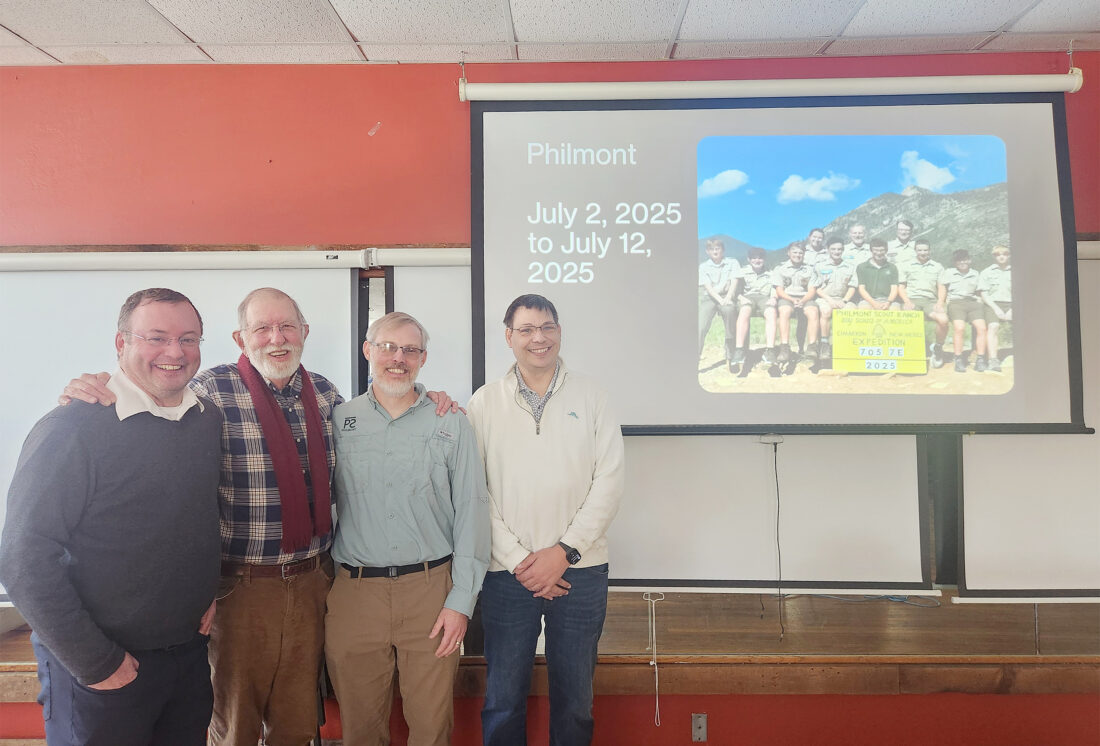
ELKINS — Troop 88 Scout Master (and former member of Troop 88) Scott Harris spoke with the Rotary Club of Elkins, giving the group details of the troops’ July 2025 visit to the Philmont Scout Ranch. Troop 88, which is sponsored by the First United Methodist Church, currently has 14 scouts.
The ranch covers 140,177 acres of rugged mountain wilderness in northeastern New Mexico, near Cimarron. The ranch was donated to the Boy Scouts by oilman Wade Phillips in the 1940’s. The criterion for the ranch is that it must remain a working ranch, members of the Phillips family may visit when they like and it must remain the property of the scouts. The main purpose of the property is to provide backpacking. “There are hundreds, probably thousands of miles of trails. We were told that last year over 17,000 scouts went through,” commented Harris.
During the hiking season, there are hundreds of scouts coming and going every day. There is a large map showing the location of every campsite and troop each day. There is also a large chart showing the locations and sources of water.
Harris traveled to Philmont in 1991 with his Scout Master, and current Rotarian, Jim Schnoover as well as fellow scout and current Rotarian Hoy Ferguson.
“It was one of those experiences you never forget. It was challenging, mentally and physically. It really is a neat trip,” said Harris.
Planning for the trip began approximately three years ago. Harris and fellow Scout Masters Sean and Mandy Sullivan began planning in earnest approximately a year and a half before the trip. “It’s almost like a lottery. You have to get your name in and you have to plan on it. There was lots of fundraising, lots of practice hikes and getting our gear ready,” said Harris.
On July 2, 2025, the scouts from Troop 88 began their trip from the Pittsburgh airport and traveled to Philmont to undertake a seven-day adventure. There was a small hiccup at the beginning of the trip involving the group’s camp stoves. TSA would not allow the group to take used camp stoves on the plane, only new, unused ones were allowed. Four of the group’s camp stoves had been used and had to be left behind with parents who had taken their scouts to the airport.
Initially, the group spent 2 days at the Scout Hut at the United States Air Force Academy, acclimating to the increased elevation (7,000 feet). The group was allowed to stay at the hut free of charge, saving on expenses. “While we were there, they were doing parachuting and flying hang gliders so every time we walked out, we got to watch that. It’s very safe and we didn’t have to worry about kids running around in a motel. We got to use the commissary, and the PX and the gym,” said Harris. “It was a very beautiful place. The security and the cost were very good.”
The group also visited the Manitou Cliff Dwellings and the Garden of the Gods.
The Philmont ranger, JJ, stayed with the group for two days and conducted a shake-down on the group’s first day, ensuring that each scout had what he needed (shorts, underwear, T-shirts, sleeping bag, tent, food, jacket, socks, first aid) and didn’t have unnecessary items.
“One of our heaviest items was water. A lot of days we had to carry 4-6 liters of water because there’s not a lot of water on the trail,” said Harris. Every couple of days the troop had stations where they could pick up food they wanted or needed and leave behind food that they didn’t care for. The items left behind were then available for the scouts coming along behind.
It was important for the scouts to keep in mind that they were in the ‘Bearmuda Triangle.’
“Each camp had a bear bag, where you put all your food and smellables. You had to be at least 100 feet away from that with your tent. Each camp had a sump for all leftovers. You didn’t want any food or smellables in your camp,” said Harris. “We practiced the first couple of nights hanging the bear bags and setting up the tents. It seemed like overkill but the more you’re there you can see it’s a process and they know what works,” commented Harris.
There are two destination choices for the hikes — Mount Phillips and Baldy; Troop 88 hiked Mount Phillips which has an elevation of 11,800 feet. The group wasn’t allowed to use GPS to navigate; they had to use a map and a compass and every day a scout served as crew leader. “At most trail crossings there was a post that had longitude and latitude on it so when you got there you got your map out and made sure you were in the right place or find out you’re in the wrong place. You had to learn to orient a map, do readings of longitude and latitude. The guys did pretty good. There was no GPS, no cell phones, just a regular map and compass,” said Harris.
The third day’s hike was the hardest of the week. They hiked 15 miles and climbed 4,000 feet in elevation. The troop left at daylight and it was imperative that they make the summit by 3 p.m. at the latest to avoid late afternoon storms. After making the summit, they had another 2 miles to their camp for the evening.
“All our boys are athletic, healthy guys, they did great and I think everybody that day had a headache, felt nauseous, felt tired so I was proud of them.
We pushed hard that day,” said Harris. “We saw the storms rolling in and we hightailed it out of there. That day was a real challenge but quite an accomplishment. It’s a day I’ll never forget.”
On the fifth day of the hike, the group had to do conservation work. There were destructive fires called the Ute Park fire in the area in 2018; It burned over 36,000 acres. To prevent more devastation to the area in the case of another fire, the troop worked to cut a 100-yard swath of firebreak. “They gave us loppers and saws and we cut everything. We worked there two hours and then we had another three to four miles to camp,” commented Harris.
On the last day the scouts were excited that the hike was almost over.
“I don’t know if our guys were just excited to be done, if they’re just good guys but they’re walking backwards, they’re doing cartwheels, they’re singing songs, they’ve got lots of energy. Our guys really enjoyed being there, it was a good experience, and they were happy to do it,” concluded Harris. “We did 53 miles and we did over seven thousand feet of elevation in seven days.”
Rotary is a global network of 1.4 million neighbors, friends, leaders and problem-solvers who see a world where people unite and take action to create lasting change — across the globe, in their communities and in themselves.
Visit www.Rotary.org to learn more about Rotary International, visit the club’s Facebook page — Rotary Club of Elkins — or contact 2025-2026 club president Phillips Kolsun at phillipskolsun@gmail.com for more information about the Rotary Club of Elkins.
Local News

Abortifacients bill heads to full Senate
Wreck in a Snow Storm
Delegate introduces two new bills
CHARLESTON — An Upshur County delegate introduced two bills that would place residency restrictions on those ...
Rotary learns about Boy Scout trip

Man facing two felony counts