Task Force Forum
Regional group meets the public in Elkins
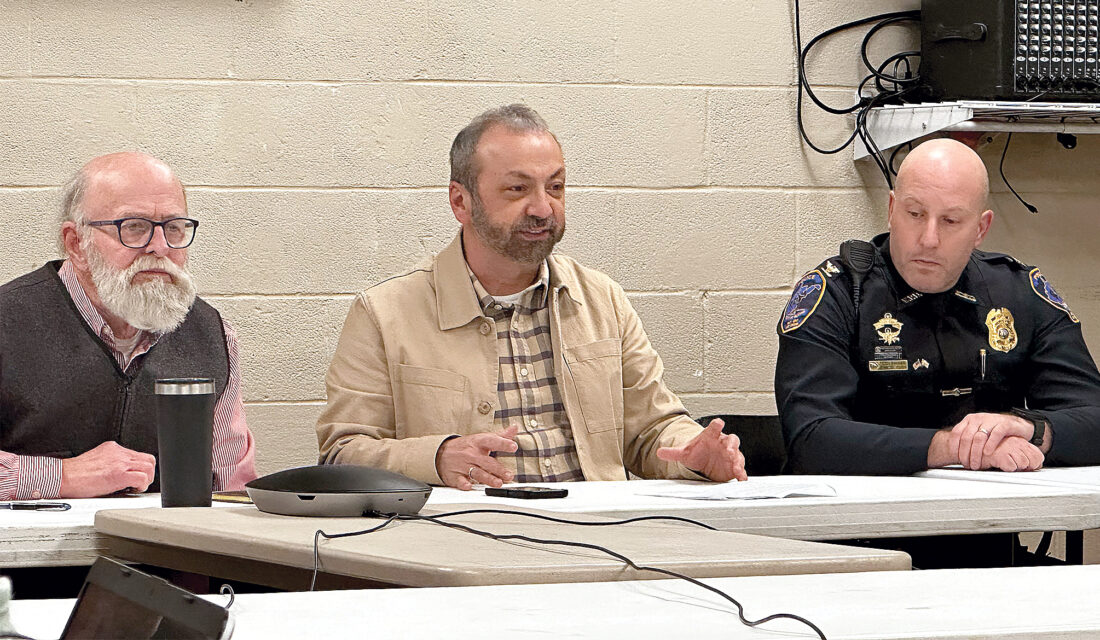
The Inter-Mountain photos by Taylor McKinnie Regional Task Force on Addiction, Homelessness and Mental Health committee member David Parker, left, Elkins Mayor Jerry Marco, center, and Elkins Police Chief Travis Bennett, right, during the Task Force’s annual public forum Thursday night.
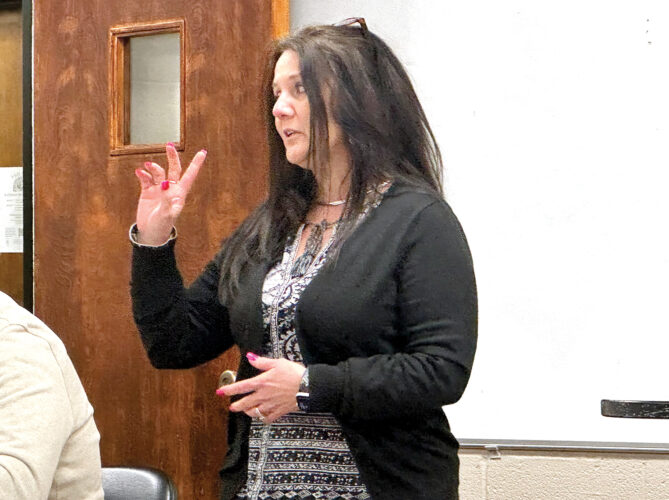
Ally’s Hope Director Shelby Burgess-Wilson explains to the forum audience what Ally’s Hope provides to the women who reside there.
ELKINS — The Regional Task Force on Addiction, Homelessness and Mental Health annual public forum on Thursday night saw city officials, task force members, keynote speakers and residents discuss drug addiction issues in the state, prevention tactics, sober living facilities and more.
The annual forum, held at the Phil Gainer Community Center, saw more than 25 members of the public turn up to learn more about what the Task Force has been doing and to hear from keynote speakers on the drug addiction issues throughout the state.
At the forum’s start, Task Force committee member David Parker introduced Joshua Barker, the Director of Substance Abuse Prevention and Recovery under the Office of the West Virginia Attorney General. Barker spoke on his position in the attorney general’s office, his journey as a recovering drug addict and what he believes needs to change in the state.
“When I went to have (neck) surgery… they handed me 45 Percocets and 16 Flexerils, and here I am a recovering drug addict… Now that doctor didn’t tell me anything about those opioids and what they could do to me,” Barker told the audience. “Of course, I know, but there was no education… Medical marijuana, they educate everybody that comes in there and purchases something in that dispensary. We should be doing that with opioids and everything that’s being dispensed in this state, and we don’t.”
Another speaker, Dr. Stephen Loyd, the Director of the Office of Drug Control Policy, who also struggled with addiction in the past, said he noticed major differences between himself, a doctor, and others addicted to drugs when it came to how they were treated during the recovery process.
“I didn’t lose my job. I didn’t have to detox on a jail cell floor,” Loyd said. “That’s really where I started to see the disparities in the care between the haves and the have-nots, and really it changed my life. It changed my career. I’m an internal medicine doctor by training… but when I went through this, I didn’t want to do anything, but addiction medicine.”
Loyd also stated that the disparities in how people receive care can also be found when it comes to a person’s race. He said about one in 10 white people who are addicted to drugs get help overall. However, the number of non-white people addicted to drugs who actually get help ranges from one in 20 to one in 30.
Elkins City Police Chief Travis Bennett informed the Task Force and the audience that the police department had not seen too many “real shifts” in the drug numbers over the last few years, but there has been a shift in the types of substances that officers are coming across.
“We still have a ton of meth out there,” Bennett said. “We took five ounces of meth and a gun from someone last night, but we do see more fentanyl… that’s kind of flip-flopped a little bit from what it was maybe just a couple years ago. We’ve also seen a shift in the routes into this area from what we’ve seen historically.”
Elkins Mayor Jerry Marco also spoke on what the Task Force has discussed and worked on regarding drug addiction prevention tactics, particularly regarding children in the area. Highlighting several local organizations, including the Old Brick Playhouse, 4-H clubs, Boy Scouts and Girl Scouts, the Isaac Walton League and more, Marco stressed the importance of children finding something to become passionate about so they don’t stray down a bad path.
“(The Task Force is) talking a lot about prevention. We’re very passionate about that,” Marco said. “It’s something I definitely want to get behind. We brought the Game Changer program to the schools last year… It’s been tremendous and kids are embracing it. We’re very excited about that, and it’s a drug prevention program… where the students are the peers. We’re doing what we can.”
The Task Force also discussed the progress that has been seen with the addition of the women’s sober-living home, Ally’s Hope, in Elkins. The facility opened in November of last year. Barker, who had visited the home earlier that day, said he was “impressed” by the facility and called it a “phenomenal place.”
Ally’s Hope Director Shelby Burgess-Wilson, who is also a member of the Task Force, was in attendance for the forum and came up to speak to the rest of audience about what happens at Ally’s Hope to help women with drug addictions.
Wilson explained that she created Ally’s Hope after seeing the sober-living facility where her daughter had stayed.
“My goal for this house, this whole time, has been I wanted it to be a home, when a mama drops her daughter off, they can feel good when they walk away and leave her there,” Wilson told the audience. “That’s been my whole vision about this house.”
As Wilson explained, the home can accommodate 10 women between the ages of 18 and 65. Those living in the home must agree to participate in a 12-step program and must already be 30 days clean before moving in. They must also participate in an Intensive Outpatient Program (IOP), therapy and church while living in the home, as well as find a job and pay a monthly residence fee to the house. Currently, Ally’s Hope houses four women.
“(The women) have to be accountable and they have to do their part, but we are there to make sure that, if they’re willing to do that, that we’re going to make a success for them and they’re doing that right now,” Wilson said.
“They’re doing a great job, and I hope that others can help fill me up. I need some more girls.”
The Regional Task Force on Addiction, Homelessness and Mental Health meets at the Phil Gainer Community Center every fourth Thursday of each month around 1 p.m. All meetings are open to the public, with the City of Elkins encouraging residents to attend and participate.
Local News

Crossover Day: W.Va. Senate breezes through agenda

City Crews Repair Sewer Line

Upshur man charged with felony escape

Senate GOP backs privatizing some child welfare services

Buckhannon man faces domestic, firearm charges