Tucker United members discuss data centers in Panhandle
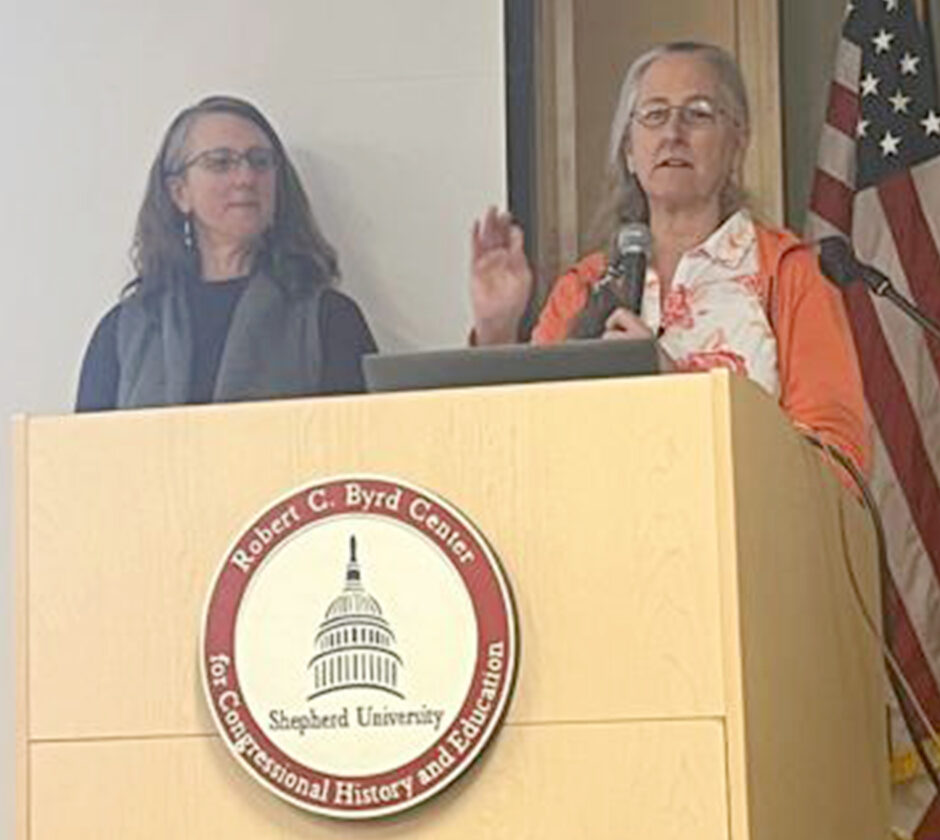
Photo by Toni Milbourne Beth Boehme, left, and Jamie Jacobs traveled from Tucker County to speak to Eastern Panhandle residents about data centers and power plants proposed for their county and other locations in the state.
SHEPHERDSTOWN — Representatives of Tucker United brought their concerns about large-scale data center development to Shepherd University this week, outlining what they described as a troubling lack of transparency surrounding a proposed project in Tucker County.
Beth Boehme and Jamie Jacobs spoke to a packed room of community members about Tucker United’s efforts to oppose a data center and accompanying electric/diesel power plant tied to what is being called the “Ridgeline Project.” According to the presenters, residents first learned of the proposal through a newspaper advertisement rather than direct outreach from the developer, Fundamental Data.
“That’s part of the problem,” Boehm said. “We don’t know who is coming to the area–just that it’s known as the Ridgeline Project.”
Throughout the presentation, the speakers emphasized what they see as unanswered questions from both the company and state officials. Among their concerns are no firm commitments on the number of jobs, whether positions would go to West Virginia residents, projected revenue estimates or detailed information about water usage and its potential impact on local supply, among many other concerns.
“In fact, they won’t fully commit to say that it’s going to be a data center, even though we know that the company is called Fundamental Data,” Jacobs said.
The speakers argued that a project of this scale would be “wildly inappropriate” for Tucker County, citing the region’s reliance on tourism and outdoor recreation. They drew comparisons to development pressures seen in the Eastern Panhandle, warning that industrial-scale infrastructure could clash with the county’s natural assets.
Data centers, the presenters noted, require substantial amounts of electricity and water while producing various forms of pollution, including noise, light, heat and potential air and water emissions.
“This proposed Tucker County project could be one of the largest data centers in the world,” Boehm said. “I don’t think they can give us enough money to compensate for what they could take out.”
The group also highlighted environmental and public health concerns, particularly potential effects on wildlife and aquatic ecosystems. They questioned the long-term economic benefits, arguing that operational employment at many data centers can be limited.
“Only 10 to 15 jobs at a data center,” Jacobs said, adding that construction jobs are not permanent.
A significant portion of the discussion centered on West Virginia House Bill 2014, passed last year. Tucker United characterized the legislation as a key factor shaping the debate, saying it reduces local oversight of data center developments.
“The big thing is the loss of local control that preempts counties and municipalities from enacting, adopting, implementing or even enforcing existing ordinances,” Jacobs said. “Nobody wants to lose control to Charleston.”
Under the law, Boehm said, data centers are not required to follow local zoning regulations or obtain certain permits and licenses traditionally handled at the county level. The presenters also criticized the state’s tax structure for such facilities, saying the project will be taxed at a salvage rate that may generate less local revenue than residents expect. They noted that some of that revenue is to be directed toward funds tied to broader state tax policy goals including potentially funding a personal income tax reduction fund being pushed by Gov. Patrick Morrisey’s efforts to eliminate the personal income tax.
Beyond economic and governance issues, Tucker United raised concerns about regulatory classifications for emissions from proposed power plants. Jacobs referenced the concept of “synthetic minor” permits.
“They pinky promise that they’re only going to emit below that level so they don’t have to be subject to additional restrictions,” she said.
Throughout the event, the speakers stressed that their opposition is not aimed at economic development itself but at what they see as unsuitable growth for the region.
“We want thoughtful economic growth that is appropriate for the region and this is not,” Boehm said.
They also pushed back against framing the issue along partisan lines.
“But the forces that be have been attempting to make this into an ‘us versus them’ argument,” Jacobs said. “We see it as a non-partisan issue.”
As debate over data centers continues across West Virginia, Tucker United says its focus remains on transparency, environmental stewardship and preserving local decision-making authority.
“The proposal for the Ridgeline power plant is really a reckless gamble with our future,” Boehm said.
Local News
Sheriff seeking information on BB gun incidents
ELKINS — Randolph County Sheriff Rob Elbon said his office is seeking the public’s assistance in helping ...

Custodian arrested, found in girls’ locker room
Elkins City Council to vote on landfill fund budget, more
ELKINS — Elkins City Council will meet for their bimonthly meeting tonight with votes to be held on FY 2026 ...
WVWC to receive more than $2M in funds
BUCKHANNON — An Upshur County college is set to receive more than $2 million in United States Department of ...

Repairing Two Water Main Breaks