Affordable Care Act marks 16 years
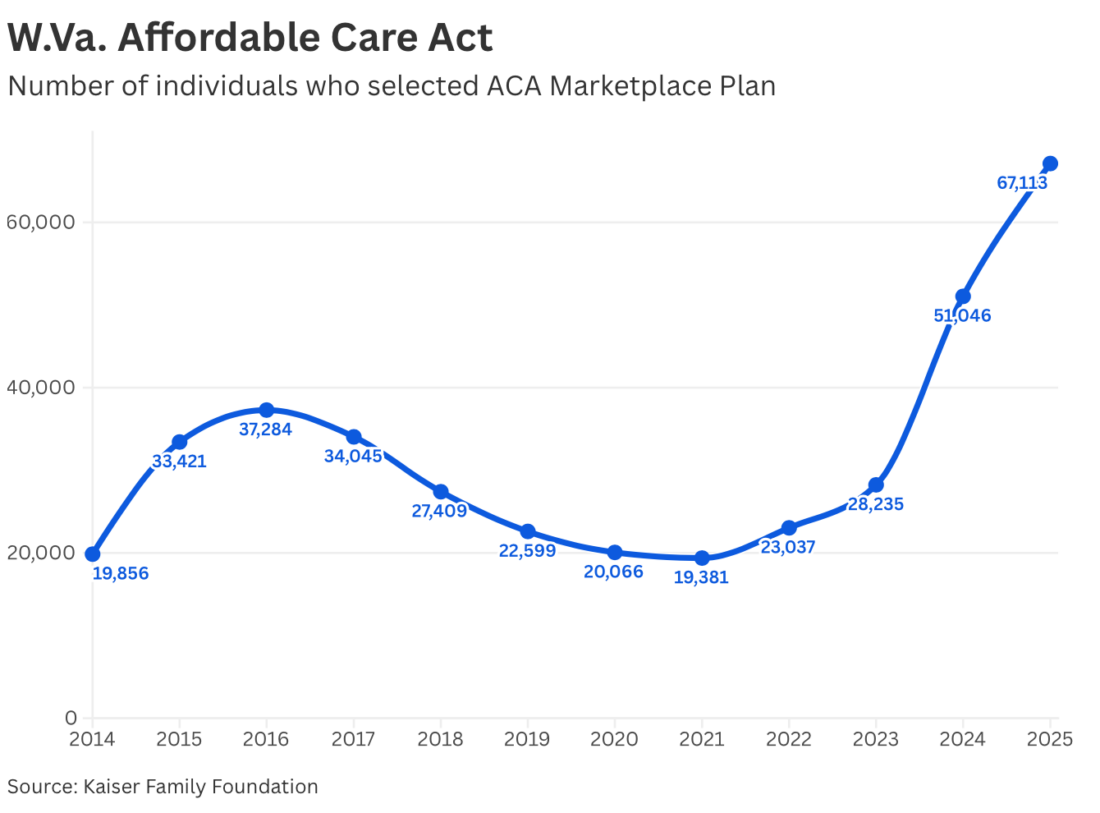
Graphic by Steven Allen Adams
CHARLESTON – Monday marked the 16th anniversary since the Patient Protection and Affordable Care Act went into effect, with more than 67,000 West Virginians receiving health insurance through its marketplace.
But advocates and supporters worry changes to the program could cause people to leave it.
The Patient Protection and Affordable Care Act, known commonly as the Affordable Care Act, was passed by Congress and signed into law by then-President Barack Obama on March 23, 2010, though most of its provisions did not begin until 2014.
The ACA made a number of health care reforms, including prohibiting health insurance companies from denying coverage for people with pre-existing medical conditions; allowing young adults to remain on their parent’s health insurance through age 26; and requiring coverage for essential health benefits, such as emergency room care, maternity care, mental health and prescription drugs.
“Before the Affordable Care Act … far too many West Virginians had no realistic path to affordable health coverage,” said Ellen Allen, executive director of West Virginians for Affordable Health Care. “Insurance companies could deny coverage because of pre-existing conditions, charge women more than men and impose lifetime limits that left families vulnerable in the middle of serious illness. The Affordable Care Act changed that.”
One of the law’s creations was the health insurance marketplace, through which individuals and small businesses purchase coverage plans. It also allowed states to expand their Medicaid programs to adults under age 65 with income up to 138% of the federal poverty level, or $21,597 annual income. Then-Gov. Earl Ray Tomblin announced in 2013 that West Virginia would participate in the Medicaid expansion program, which went into effect in 2014.
According to Allen, the number of uninsured West Virginians was at 18% prior to implementation of ACA and the expansion of Medicaid. According to the Kaiser Family Foundation, 19,856 West Virginians enrolled in the ACA marketplace in 2014. In 2025, the number reached 67,113 West Virginians – a 237% increase.
As of 2025, 40 states plus Washington, D.C., were participating in ACA’s Medicaid expansion. According to the Kaiser Family Foundation, West Virginia’s total Medicaid enrollment was 510,520, with expansion accounting for 33% of total enrollees – approximately 168,472 West Virginians last year.
“Through the creation of the Health Insurance Marketplace, stronger consumer protections, and the expansion of Medicaid, the law dramatically expanded access to coverage in our state,” Allen said. “Today, West Virginia’s uninsured rate has fallen to just 5.9 percent – a monumental achievement that reflects years of progress in connecting people with the care they need.”
But Allen and others have raised concerns since the passage last summer of President Donald Trump’s One Big Beautiful Bill Act, now called the Working Families Tax Cuts Act, and the end of COVID-era ACA expansion tax credits that allowed additional West Virginians to access health insurance options. Some estimates put the total financial impact to ACA and Medicaid at $1 trillion over a 10-year period, with the impact on West Virginia closer to $1 billion.
ACA subsidies expired at the end of 2025 after negotiations on a continuing resolution failed in the fall, causing a federal government shutdown that lasted from October to nearly the end of November. While a deal was made to fund the government, efforts to extend the ACA subsidies for another three years failed. According to the Centers for Medicare and Medicaid Services, 55,127 West Virginians were in the ACA marketplace as of Jan. 12, a nearly 18% decrease from 2025 enrollment.
The One Big Beautiful Bill Act made significant changes to Medicaid, including increased work requirements. The state Department of Human Services estimated that between 20,000 to 40,000 individuals not in the workforce may need to secure employment or engage in other qualifying activities to maintain their Medicaid eligibility.
Federal funding for rural hospitals is also reduced in the One Big Beautiful Bill Act by $137 billion over the next 10 years, with the Kaiser Family Foundation estimating a nearly $2.5 billion hit to rural hospitals in West Virginia over that same timeframe.
Other Medicaid changes in the One Big Beautiful Bill Act include requiring coverage renewal every six months and establishing a strict Payment Error Rate Measurement rule, which could result in financial penalties for states with rates higher than 3%. Del. Mike Pushkin, chairman of the West Virginia Democratic Party, blamed Trump and West Virginia’s congressional delegation.
“Donald Trump and West Virginia Republicans have unleashed a health care crisis in West Virginia,” said Pushkin, D-Kanawha. “While Republicans are focused on Trump’s gold gilded ballroom, extravagant parties, and his illegal war in Iran that is costing American lives and increasing the cost of gas and other basics, Democrats are fighting to lower health care costs for hardworking West Virginians.
“Voters across West Virginia are furious with this Republican health care crisis, which is why from now until November, West Virginia Democrats are all-in to ensure Trump and his Republican allies are held accountable at the ballot box for making health care and other necessities unaffordable for West Virginia families,” Pushkin continued.
The Rural Health Transformation program included in the One Big Beautiful Bill includes $50 billion over the next five years for states. West Virginia was awarded more than $199 million by CMS for year-one of the Rural Health Transformation program.
The state’s Rural Health Transformation application outlined seven core initiatives, including initiatives aimed at reducing costs for the state’s rural hospital system. These include expanding access to in-person and telehealth options, an EMS “treatment-in-place” program to reduce emergency room visits, increasing transportation options for residents needing access to care, modernizing technology and shifting to value-based care.
The West Virginia Legislature passed a bill during the recent session to give the Department of Health spending authority over the $199 million Rural Health Transformation award. In a press conference last week, Gov. Patrick Morrisey said the funding would be a game changer.
“We’re now in a position where we can finally access those federal dollars,” Morrisey said. “Everything depends upon having healthy workers, and I think our (Rural Health Transformation is) going to make a big difference for West Virginia, whether it’s telehealth or expanded access to primary and specialty care or, of course, developing and driving innovation and some of the commercializing opportunities we have for the new products that are out there. We think (Rural Health Transformation) could really be a difference maker in West Virginia; a needle mover, as I’m fond of saying.”
However, Allen said the damage done to ACA and Medicaid might be too late, reversing the gains made in insuring needy West Virginians over the last 16 years.
“As we mark this anniversary, we celebrate the Affordable Care Act for what it has made possible: historic reductions in the uninsured rate and a stronger foundation for healthier communities,” Allen said. “At the same time, we must remain vigilant and committed to protecting the coverage gains West Virginians have fought so hard to achieve. Affordable, accessible health care should not be a temporary milestone – it should be a lasting promise.”
Local News
Affordable Care Act marks 16 years

Capito expresses support for Trump elections bill, calls for Homeland Security funding

Man arrested after Elkins police chase

Adaland Mansion seeking volunteers
City Hall News
ELKINS — The garbage collection and bulk item pickup services are on a normal schedule for the entire month of ...