
EMS Budget Issue
Commission to vote on special fee

Trending
ELKINS -- The Randolph County Commission is letting the public know that it will vote on a Special Emergency Ambulance Service Fee Ordinance in two weeks.
The Ambulance Ordinance would add a 0.4% tax on state taxable sales in the county, in order to help fund the EMS, which officials have said is facing a $1 million budget shortfall. The Commission will vote on the ordinance at its next meeting on April 16.
"This is a 0.4% tax, and some examples are if someone spends $1,000, it would be four dollars," Commission President David Kesling said during this week's meeting. "I don't take the matter lightly about this, because I don't like imposing a fee on anyone in the county."
Randolph County Emergency Squad Director Kurt Gainer spoke at the meeting and fielded a host of questions from Kesling and Commissioner Cris Siler, who was also present.
Gainer started off by introducing the Commission to five EMS Board members -- Jim Sayers, Mike Mullins, Charles Shomo, Dave Bobes and Stanley Teets --who were in attendance.
"We are the only EMS agency in Randolph County and we run approximately 7,000 calls a year," Gainer said. "Of those calls, 6,500 are 911 emergency calls, and we cover the entire jurisdiction of about 1,000 square miles and provide mutual aid to eight counties around us as far as advanced life support and paramedic intercept."
Gainer added that the Randolph County EMS currently has 37 full-time employees at its three stations located in Elkins, Harman and Mill Creek, and that there are a total of 11 ambulances operating in the county.
"We have had some funding expense issues over the past year," Gainer said. "We've had a couple things get in our way a little bit, one is primarily the Medicare services, which is about 85% of our income. We saw the government shutdown, and all the federal funds with CMS ended up slowing a good bit and ended up drying up for a couple months."
Kesling told Gainer he had a couple questions about the $1 million shortfall that EMS is facing. "What would happen if the county does nothing to help?" Kesling asked. "And are you short on all of this money now, or is that how you expect to end the fiscal year?"
"That's what we see in the next fiscal year budget, fiscal year 27," Gainer replied. "We lost a proposal with Davis Medical Center this year within our facility transports and everything is 25% higher as far as equipment right now."
Gainer told the Commission that ambulances currently cost $200,000, double what they were in 2012.
"Ambulances have doubled and so has all of our equipment, drug medication, cardiac monitors, and as you guys have seen, our radio communication equipment is costing us $8,000 a clip," Gainer said.
"It's just incredible. New cots are $30,000, lift systems are $30,000, cardiac monitors are $30,000, so every time you see an ambulance going up and down the street, you're looking at up to $350,000 worth of metal."
Gainer told Kesling that if the county was unable to help with the situation, the EMS would have to reduce staffing or reduce service in the substations.
Kesling asked, "Other than the ordinance, what other ways did you guys think about increasing revenue?"
"Initially we looked at the levy route and some legislative mechanisms like amusement taxes and recreational fees," Gainer said. "I think between the Commission and the Authority Board, we've determined that a Special Ambulance Fee would be the most acceptable."
Kesling said that some of the comments he has heard from the public about the ambulance fee include "EMS would not be in this situation if they would have accepted the contract from Davis Medical" and "with how expensive it is to ride in an ambulance and they get all that money, why do they need (more)?"
Gainer said, "Initially we did all the transports from Davis Medical Center. As our hospital system changed, we used to do a lot of runs to Morgantown. Mon General and Ruby areas. As the hospital changed brands, a lot of their bed status went to Charleston and beyond…
"We put in a proposal against three or four competitors that they had found and we lost the proposal. So that's why other agencies are running inter-facility transports at this time."
When it comes to the cost of riding in an ambulance, Gainer said, "Eighty-five percent of our funding is from Medicare and Medicaid services. So insurance sets ambulance rates nationwide, so it doesn't matter if we bill someone $10,000 for an emergency call, every insurance goes back to that federal standard. The newest guidelines just came out and it shows a BLS transport, and that's basic life support, with EMTs and loading fee would be $415 for that call."
Kesling asked, "So people who think you get $10,000 every time you come out, you get $400 or $500?"
Gainer said, "We run probably 20% of our calls right now as non-transporting. So we don't get reimbursement from insurance companies if we don't transport to a medical facility. So when you see the ambulances on the car wrecks, the fender benders, the Friday night lights on standby for football games, the fall calls we go on to just help people back to their feet, that is a public service per say. So we eat the cost of the fuel, the manpower and equipment on that avenue.
"Even on an unresponsive diabetic, if you start an IV and hook them up on a monitor and they wake up with a good sugar, they sign off on it and don't go with us, so we eat the cost. And glucagon is $500 a shot right now."
Kesling asked, "How about the loss of funding from the city? How long had you received that funding and how much was that? And what about the $12 million the state is giving EMS, and how is that going to help you, and how much do you think you will get (from the lottery)?"
Gainer replied, "It was $50,000 (from the city) and we have got it for the last three years, I do believe…In the state of West Virginia there are 240 EMS squads. So dividing it up evenly across all the agencies, you're looking at less than $100,000."
Kesling said the state is partially to blame for many EMS services being in this type of situation.
"One thing I point to is the state Legislature for putting us in this situation," Kesling said. "For years, the County Commission Association, which I'm on the board of, has asked the state Legislature for help in finding new funding for emergency services. It was promising coming out of the Senate this year, but the Speaker of the House of Delegates refused to even bring it to the floor because it was an election year. So that puts it back on us and we are faced with the decision to either help fund you, find another source, or you're just going to have to start cutting services.
"I have an 82-year-old mother and I know if something happened to her I want you there. And for anybody in the county, we want ambulance services for them and we are responsible by state code to ensure we have services for the county," Kesling said.
"So again, this is a part where the legislature mandates all this stuff to us but they absolutely won't help you out at all… So unlike the state Legislature, I think we are going to do our part for county EMS."
The next Randolph County Commission meeting will be April 16 at 1:30 p.m.
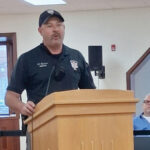
Randolph County Emergency Squad Director Kurt Gainer gave an informational presentation to the Randolph County Commission this week.