
New exhibit highlights West Virginia’s evolving story
Trending
MORGANTOWN -- After a recent afternoon discussion tracing West Virginia's place across generations of American history, visitors to West Virginia University's Downtown Library moved upstairs to experience that history firsthand.
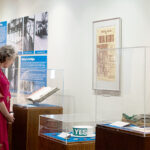
Located on the sixth floor, the West Virginia & Regional History Center's newest exhibit, "Mountaineers Are Always Free: West Virginia at 250," invites guests to step through the stories, people and movements that have shaped the Mountain State over the last two and a half centuries.
Opened in conjunction with WVU's West Virginia Day celebration and America's semiquincentennial, the exhibit serves as a retrospective look at the state's identity while drawing from archival collections preserved inside the university's historical holdings.
For Lori Hostuttler, director of the West Virginia & Regional History Center, the exhibit was designed to do more than revisit dates and milestones.
"This truly is a retrospective exhibit of West Virginia at 250," Hostuttler said. "We're looking back at sort of three different themes in West Virginia history."
Those themes guide visitors through the gallery space.
The first explores the power of place -- examining how West Virginia's landscape shaped its development across generations.
"Our land has served us as a frontier, as an economic driver, as a place of extreme scenic beauty and a place for tourism," Hostuttler said.
Through photographs, historical objects and archival materials, the exhibit presents West Virginia not simply as a location, but as a force that influenced settlement, industry and identity.
The second section shifts to the people of West Virginia, broadening the traditional narrative often associated with the state's origins.
Hostuttler said the exhibit intentionally highlights stories that are not always centered in historical conversations.
"We talk a little traditionally about the first settlers that came here, but we also talk about the Native American populations that were here before," she said.
Visitors also encounter stories tied to immigration and industrialization, documenting the communities that helped build the state.
"We look at some of the immigrant populations that came during the industrialization period -- Italians, Greek, Spanish, Belgian and many more ethnicities," Hostuttler said. "There's so much ethnic diversity that people don't realize is here."
Additional displays spotlight the experiences and contributions of Black West Virginians and women, creating space for perspectives that have often received less historical attention.
The exhibit's final section -- and the one lending its name to the overall experience -- focuses on freedom, democracy and unfinished revolutions.
Titled "Mountaineers Are Always Free," the section examines moments throughout state history where residents pushed for social, political and economic change.
"This is where we're looking at struggles for freedom and democracy, and for rights," Hostuttler said.
Featured topics include the West Virginia statehood movement, labor activism and the Mine Wars, women's suffrage, the civil rights movement and environmental advocacy.
One display even connects historical activism to contemporary history through a case examining the 2018 teachers' strike.
By placing these moments together, the exhibit emphasizes that history is not a single narrative but an ongoing conversation.
That message echoed themes introduced earlier in the day during the history panel discussion, where researchers reflected on statehood, labor, civil rights and the people whose stories continue shaping West Virginia.