
What to watch for as lanternflies spread
Trending
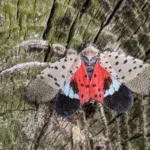
MORGANTOWN – A fast-spreading invasive insect that can damage crops and trees has been reported in 21 West Virginia counties, posing what a West Virginia University expert calls a "serious economic threat" to the state's agricultural industries.
The spotted lanternfly, an invasive pest native to Asia, was first detected in West Virginia in Berkeley County in 2019. Since then, it has been reported in Brooke, Grant, Hampshire, Hancock, Hardy, Harrison, Jefferson, Marion, Marshall, McDowell, Mercer, Mineral, Monongalia, Morgan, Ohio, Pendleton, Preston, Taylor, Wetzel and Wood counties.
As spotted lanternflies enter their highly visible summer nymph stage, Carlos Quesada, a WVU Extension entomology specialist, offers advice on how to identify the pest, reduce its numbers, and help prevent its spread.
"The spotted lanternfly lays eggs from September to December, which hatch from May to June, so you will see them in their nymph stage during the summer," said Carlos Quesada, entomology specialist, WVU Extension.
"The nymphs are black with white spots, and they eventually develop bright red patches as they near adulthood. While you should still squash them if you see them, there are other methods of control for this phase of the insect.
"Spotted lanternfly nymphs move up and down on the trunk of trees, making them easy to capture by trapping," Quesada said. "Trapping methods include wrapping the tree trunks with specialized sticky bands or by placing a spotted lanternfly circle trap. Circle traps are recommended over sticky bands for spotted lanternfly management because sticky bands can also capture nontarget organisms, including other insects and small vertebrates.
"Both nymph and adult spotted lanternflies feed by sucking sap from trees through a sharp, needle-like beak, which can result in leaf curl, wilt, tree dieback, and death of the tree. Tree dieback caused by a high infestation of spotted lanternflies has been observed on black walnut, willow, staghorn sumac, and maple trees. Adults often feed and lay eggs on tree-of-heaven, an invasive plant.
"Because it can feed on more than 70 different plant species, the spotted lanternfly is a serious economic threat to multiple agricultural industries including grapevines, hops, stone fruit trees, and hardwood trees," Quesada said. "Grapevines are among the crops most severely impacted by this pest. Spotted lanternflies do not bite, sting, or transmit disease to humans or pets.
"The spotted lanternfly also excretes honeydew, a sugary substance that attracts wasps and produces sooty mold fungus. Sooty mold doesn't affect plants directly but can reduce photosynthesis. Sooty mold can also be an aesthetic problem in structures.
"Understanding the biology, restricting human-mediated transport, and reporting sightings are the most critical actions society can take to manage invasive species such as the spotted lanternfly. If you are in a county where cases of this insect have not yet been confirmed, be sure to report any sightings to bugbusters@wvda.us."
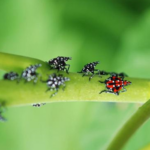
Submitted photo
Carlos Quesada, a WVU Extension entomology specialist, says spotted lanternflies can be identified in the nymph stage by their black and white spotted bodies.