
Exploring in the Dark
Barbour native is a world-class caver
Trending
HUNTSVILLE, Ala. -- A Barbour County native and record-breaking caver has received the 2026 Lew Bicking Award, one of the highest honors in American speleology.
In July, the National Speleological Society named Adam Weaver the recipient of the 2026 Lew Bicking Award. Presented annually, the award recognizes an individual or team for outstanding achievement in cave exploration, survey and expedition leadership. Bicking, who was from Baltimore, is known for his instrumental explorations into West Virginia’s Friar’s Hole Cave System, which stretches for more than 50 miles in Greenbrier and Pocahontas counties.
Weaver, who is originally from Philippi, has been a project caver for more than 15 years.
“I’ve often jokingly said it’s the only award worth winning in caving, because it’s the award for exploration,” Weaver told The Inter-Mountain Friday. “So, it’s the award for discovering caves, basically, and mapping them. Because that’s what we do. We map new caves never seen before.”
Weaver said he was surprised when he learned he won the award around March, and he received the award in July during the NSS’ annual National Convention in Corydon, Indiana. Weaver noted to The Inter-Mountain that he was “pretty sure” he, at 42 years old, is the youngest person alive to have the Lew Bicking Award. As he explained, the award is based on a caver or team’s collective body of work, not just a single accomplishment, so most recipients have been older.
Weaver has helped survey more than 100 miles of previously unknown cave passage across some of the most significant systems in North America, as well as dozens of smaller system he and his teams discovered, an NSS press release states. Among his many accomplishments, Weaver led an expedition in 2018 that reached the historic 200th mile of Jewel Cave, a national reserve in South Dakota. The following year, he set the record for the most cave discovered and mapped in a single day at 2.34 miles.
In 2022, during a single continuous push into the flood-prone depths of Ft. Stanton Cave in New Mexico, Weaver set two records that the NSS says still stand today. One record is “the most cave traversed in one trip” at 28.06 miles. The other record Weaver set is “the farthest point ever reached from a cave entrance.” He and his team traveled over 13 miles from daylight, placing them among the most remote locations any human has reached on foot, the NSS said.
When asked what the most interesting caving experience in his career has been, Weaver said he’s always looking for new challenges or the next big room in a cave.
“I was on a team once where we came out of a crawl way, crawling through a bunch of loose rock, and then stood up, and we stood up into a room that was 250 feet tall,” Weaver said. “So tall in that our lights could hit the ceiling so it seemed like you were outside. The room that’s that big, and it was a 3,000-foot-long room. So that’s pretty cool.”
Weaver has been equally tireless in protecting the fragile environments he explores, the NSS said. He founded the Cave Preservation Network to create partnerships with show caves and private landowners, raising thousands of dollars for cave protection while educating owners, staff and visitors.
Weaver has also led restoration projects alongside the Bureau of Land Management, the U.S. Forest Service and the National Park Service. He also serves as the vice president of the Black Hills Cave and Nature Conservancy in Rapid City, South Dakota, and he sits on the boards of several other cave conservancies. Weaver said the Black Hills Cave and Nature Conservancy mapped nine miles of new cave this year.
Weaver’s current project has been looking for caves in Greenland to find “the northern-most cave in the world.” He explained that he and his team have received funding to go to Greenland from The Explorer’s Club, a non-profit organization in New York City. In 2027, Weaver will take two trips to Greenland in order to search for the northern-most cave.
When asked what he wanted to say to West Virginians interested in caving, Weaver spoke about how wonderful a resource West Virginia’s “amazing caves” are.
“Some of the best caves in the United States are in West Virginia, and I lived my whole life there only having gone to Smoke Hole Caverns and Seneca Caverns,” Weaver said. “So you guys have a resource there and a sport that you can do, sort of, all year long, because winter doesn’t matter when you’re underground. Right there in your backyard.”
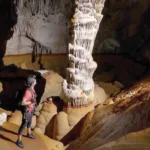
Weaver, during an exploration, looks up at a column, or a stalagnate, which forms when a stalagmite and a stalactite meet.