
Rocketman: Engineer accelerates to Starbase
Trending
Pro tip from West Virginia University alum Stephen Jacobs: If you're launching a spaceship, you need a level head.
"When the clock is counting down," Jacobs said, "it's like, OK, we have 10 minutes. Eight minutes. Five minutes. Two minutes. You feel the energy in the room rise. You get to 60 seconds and everyone is shaking. You get to 10 seconds, and we're waiting to hear 'ignition' and then 'liftoff,' so we know we got the engines going and it took off from the pad. And when the sound waves hit the building, the whole room starts to shake. You just ride it out. There's nothing you can do now that the rocket's leaving other than watch and make sure that things are still safe on the ground."
Jacobs is a WVU alum with degrees in Mechanical and Aerospace Engineering, and the rockets he's flying -- and catching -- belong to SpaceX, the spaceflight company founded by trillionaire Elon Musk.
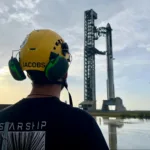
"I live in Starbase, Elon's company town at the very tip of southern Texas, and I'm a SpaceX launch operations engineer and flight controller," he said.
"In Starbase, all my neighbors are my coworkers. Everyone I see walking their dogs, watering their plants, doing their housework is someone I work with. Out my front door, I can look to the left and I'll see the factory and the office I work in and the 'rockets garden' in the distance. If I turn to the right, I can see the Starship launchpad. My commute is a five-minute walk past Elon's house."
On a typical day, Jacobs might work noon to 4 a.m., sleep through the morning, then wake up for a 7 p.m. to 7 a.m. shift.
He calls his job "challenging," "intense," and exactly what he trained for at the WVU Benjamin M. Statler College of Engineering and Mineral Resources, where Jacobs led the University Rover Challenge team to its first world championship in 2023.
Born and raised in Pegram, Tennessee, just outside Nashville, Jacobs saw the space shuttle Discovery launch from Cape Canaveral at the age of 8 or 9.
"That sold it for me," he said. "I wanted to be an astronaut."
Eventually, Jacobs realized colleges don't offer "astronautics" as a major, and he fixed his sights on aerospace engineering.
WVU stood out to him partly because "I wanted something new, somewhere far enough away that I couldn't get home easily on the weekend" and partly because of the University's "generous scholarship program," he said. And then there was the tour he took as a prospective student.
"WVU was the nicest place out of any of the universities I visited," he remembered. "Everyone was kind and inviting and welcoming."
But while Jacobs excelled in his coursework, by his sophomore year he was still searching for his niche.
"I was trying to find the right student org for me," he said. "I tried out the rocketry team, I talked to people on other engineering teams, and I talked to Dr. Yu Gu about maybe doing undergraduate research. My mom had seen a picture of him in a magazine because he had won the NASA Sample Return Robot Centennial Challenge with his robot Cataglyphis, so I went to his office and had a conversation with him."
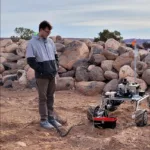
Gu, the MMAE Academy of Distinguished Alumni Professor within the WVU Department of Mechanical, Materials, and Aerospace Engineering, suggested Jacobs join the University Rover Challenge team, which designs and builds a robot capable of navigating the Martian landscape, then puts the robot through its paces in the Utah desert, competing against teams from around the world.
"I slowly started getting to know people, slowly started to pick up projects," Jacobs said. "I don't know what Dr. Gu saw in me, but the second semester I was on the URC team, he picked me as one of the leads for the drivetrain sub-team. And I had no clue what was going on. But my co-lead helped guide me through, and that's when I really started feeling like I belonged at the University and like I had a cool culture around me and a good community."
The team pulled plenty of all-nighters and cultivated a "failure is not an option" mentality that Jacobs called a natural fit for his personality.
Jacobs said the URC team's all-in attitude "translated very directly" to his work at SpaceX.
"Once the Starship rocket is designed, built, and tested, they bring it to the launch pad where I work, and we do the final checkouts. The last 24 to 36 hours of the rocket's lifecycle is at my workstation. There are a lot of ways things can go wrong, and my job if I'm on console for a launch is to see that things are going wrong soon enough that I can fix them. That can be hours, it can be minutes. And there are times when you have to take action within seconds to save a launch," he said.
"We have months of work, of planning and preparing and training, often followed by a week of very intense 12-hour shifts to get to launch. The satisfaction of doing something very hard very well is the reason I stay, and it goes all the way back to the robotics team, when we had a very special group of people who all liked working very diligently, were excited to be there, were on the same page about what our goals were, and really, really liked being challenged."
The Starship rocket Jacobs works with is revolutionary because it's designed for rapid reuse without any refurbishment. Unlike a conventional space shuttle that loses its boosters and its main tank on every launch, Starship doesn't need to be rebuilt for every flight.
"It's like a 737," Jacob said. "It comes in, lands at the airport, refuels, takes off in an hour. That's the idea with Starship. We launch, we catch the booster, we put it on the launch mount, and we refuel to launch again. Same thing with the ship -- we catch the ship on the tower, put it back on a new booster, launch it again. We've gotten to the point where we've caught boosters and re-flown. That is a very exciting process because you launch, and then seven minutes later, the booster is back at the pad, the same place you launched it from."
Jacobs and his team put a lot of preparation into those seven minutes.
"We have to verify that the pad is healthy, the tower is healthy, all the mechanisms are healthy so we can catch this thing. And then, because high-pressure gases like liquid oxygen and liquid methane are still stored in the booster, how do we make it safe so we can approach it later? It's screaming hot and sometimes on fire," he said.
It's Jacobs' responsibility to develop the "con ops," or concept of operations, for lifting Starship from the transport stand to the launch mount prior to flight, and then back down to the launch mount and safely off again within the next 12 hours after a successful catch, so it can be sent back to production for inspection.
"Sims," or simulations, are how he stays ready for anything.
"Prior to launch, we'll sit down at a computer with the crew. We say, 'Okay, we're going to start today at the beginning propellant load and we're going to simulate through launch.' Or we say, 'We're going to start at 60 seconds prior to launch, and we're going to simulate through the end of the mission.' In the meantime, the sim supervisor is injecting failures, like breaking a valve or killing a sensor, so you have to figure out what you could do about it if this were real life."
It's an approach he's thrived on since his days on the URC, when Jacobs set a goal for anyone who wanted to operate the robot in the competition to put in 100 hours of practice.
"I felt, if you're not comfortable with the robot and the controller, if you don't have an innate feeling for what it's going to do and why, then you won't do a good job when the competition comes around."
He added, "The other part of it was, if several different operators put in 100 hours of training, that means we ran our robot for 300 or 400 hours. We gave ourselves a chance to find all these problems that didn't show up immediately."
The hours of prep paid for themselves as soon as WVU reached Utah. After the team members flew and drove across the country to get there, they had to disassemble, ship, and reassemble their entire robot on the porch of their Airbnb, with missing parts and tools.
And things didn't calm down during the competition itself, when, during each of the four stages, they had roughly 10 minutes to set up their base station and communication equipment, power on the rover, do final checkouts, and debug malfunctions -- all on a pop-up table in a U-Haul trailer in the middle of the desert.
"In that situation," Jacobs said, "if you've done it a thousand times, you can calm down and focus. If you haven't, you have no hope, and the team is going to fall apart. We got better and better, smarter and smarter, we strived for quality over novelty, and we won."
acobs' "drive for quality" in his demanding role means making sacrifices and embracing some hardship, he acknowledged. To find balance, he leans on his family and his church community. And he runs. Turn left out his front door, Jacobs said, and in two miles he'll dead-end at the Gulf -- "10 miles of beautiful beachfront to go and run on."
But he's not interested in escaping the job for too long.
"I definitely feel some awe around the enormity of the rocket and our belief that this is a huge stepping stone in space hardware development that could lower the cost of launch by a couple orders of magnitude," he said. "If we can have a fully reusable first- and second-stage rocket the size of Starship, we can have that sci-fi future of enormous space stations and space hotels, bases on the moon and Mars.
"That's all extremely exciting. I think for me, though, there's just a lot of joy in the job well done. Especially when it's hard."
Submitted photo
Stephen Jacobs is shown with his team’s robot at the 2022 Rover Challenge.