
Harman arson case will move forward to grand jury
Trending
ELKINS -- A grand jury will hear the case involving a Randolph County man accused of setting an illegal fire as an "offering to God.”
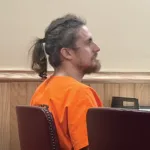
Emanuel Arthur Huffman, 36, is charged with one count of arson – setting fire on lands, a felony. He is currently being held at the Tygart Valley Regional Jail on a $30,000 cash-only bond.
Huffman appeared in Randolph County Magistrate Court for a preliminary hearing, during which Magistrate Tracy Harper found probable cause for the case to go before a Randolph County grand jury for consideration.
At the hearing’s start, Assistant Prosecutor Leckta Poling called investigating officer Cpl. Brian Roy with the Randolph County Sheriff’s Office to testify before the court.
Roy told the court that, on May 16, officers received a call from the Harman Volunteer Fire Department requesting assistance for a fire at a camp site in Harman. Firefighters stated they were having issues with a subject as they were putting out the fire. Upon arrival, the subject, identified as Huffman, had walked away from the scene. As a trooper spoke to Huffman, Roy found a gas can laying on the ground with burn marks leading up to it and he noted a “very strong” smell of gasoline. Roy said he could also see how the fire spread from one campground, over the property line and onto another campground. Witnesses told police they heard an explosion when the fire broke out and firefighters pointed to Huffman’s nearby residence when telling police about the incident.
Roy told the court he was later informed of content on Huffman’s public Facebook page, which included posts that said Huffman had started the fire, as well as pictures and videos of the fire and of the fire fighters on scene. In one post, Huffman reportedly wrote, “The fire is lit come and give offerings to the fire let go of what is no good 4 u bring it burn it live a new life baptism by fire come on in the waters fine [sic].” Huffman reportedly made similar comments about starting the fire to two other officers. Roy stated that they had no other suspects for the fire. When Poling asked Roy if there was any indication that this was an accidental fire, he said no.
In cross-examination, Huffman’s attorney, Harry Smith III, questioned if Roy had spoken to the owner of the property, Lake Huffman, who is Emanuel Huffman’s father. Roy said he did not. When Smith asked if Roy knew whether or not the starting point of the fire was regularly used as a burn site, Roy said it did not look like a burn site because of the grass and how close it was to the river bank.
Smith also brought up the post Emanuel Huffman made saying “The fire is lit…[sic].” He asked Roy how he interpreted that post, and when Roy said he believed it to mean that Emanuel Huffman started the fire, Smith stated “there was no question he started the fire.” Smith then asked what Roy thought the purpose of the fire was, based on the post. Roy said he did not consider the purpose.
Smith stated that,for Emanuel Huffman to be charged with one count of arson – setting fire on lands, his actions must have been done “willfully, unlawfully and maliciously,” per West Virginia State Code. Roy said that he believed it was done maliciously as Emanuel Huffman reportedly tried to stop the firefighters from putting out the fire that had spread onto the other property.
Smith questioned how Emanuel Huffman had tried to stop the firefighters. Roy said that Emanuel Huffman reportedly ran up and began yelling at the firefighters, telling them to stop. Smith then asked how it was unlawful for Emanuel Huffman to start a fire on property he was permitted to do so on, to which Roy repeated that the fire spread onto another property, about 60 feet past the property line.
Smith and Roy then went over a series of photos Roy took of the scene the day of the fire. The photos showed the burn marks past the Huffman property line. Smith asked if the bulk of the fire was on the Huffman property, and Roy said yes, about two thirds or more of the fire was on the Huffman property. Smith then asked if Roy believed it was Emanuel Huffman’s intention to set a fire on the neighboring property. Roy stated he wouldn’t have thought so had Emanuel Huffman not reportedly tried to interfere with the firefighters. Roy noted that fire departments do not like people getting in the way, and they can be delayed in their response if someone is too close and making them feel threatened.
In a series of follow-up questions, Poling asked Roy if the area where the fire started was free from any trees, grass, straw, leaves, etc. Roy said the fire was near a riverbank, but there was still vegetation close by and the fire was not clear of trees. Poling then asked if the statute Emanuel Huffman was charged under said anything about it being permitted to burn on your own land. Roy said the statute does not say that. Poling also noted that the statute does mention it is a felony if the fire spreads onto other property, to which Roy agreed. Smith countered that it was legal to burn on your own property, and Roy said that was true, but the fire starter is responsible for maintaining the fire.
For the defense, Smith called Lake Huffman to testify before the court. In his testimony, Lake Huffman said he owned the campground where the fire was set and that Emanuel Huffman lived on that property. Lake Huffman told the court that the spot the fire was started, by the edge of the river, has been a usual burn spot for him since 1982. He explained that they usually burn brush in that location three or four times a year. When Smith asked if he knew that Emanuel Huffman had used it as a burn spot in the past, to which Lake Huffman said yes, and that Emanuel Huffman had his permission to burn there. Lake Huffman also said that he has also used gasoline and a burn trail for burning brush in the past.
In her cross examination, Poling asked Lake Huffman how he taught Emanuel Huffman how to burn brush. Lake Huffman said he taught Emanuel Huffman to use a burn trail. Poling asked if they usually had buckets close by in case the fire got out of hand. Lake Huffman said the fire was near the river. When Poling pushed him on this, Lake Huffman repeated the fire was on his property by the river. When Poling asked if Lake Huffman knew that you can’t let fire go onto someone else’s property, Lake Huffman said he knew that, but he was insistent that this fire did not spread onto the neighbor’s property.
Before Harper made her ruling, the court discussed bond revocation for Emanuel Huffman. Poling told the court that Emanuel Huffman was originally charged and arraigned on May 16, and that his initial $30,000 cash-only bond required him to check in with the Community Corrections program three times a week. She stated that her files showed that Emanuel Huffman did not check in on May 20 and May 22, resulting in a capius warrant being put out for him. Poling said that Emanuel Huffman was eventually found and had to be extradited back to West Virginia.
In response, Smith said he could not contest the revocation as Emanuel Huffman had violated his bond. Harper then revoked Emanuel Huffman’s bond.