
Blood, Sweat and Hugs
WVU women's soccer, Izzo-Brown celebrate 30 years
Trending
MORGANTOWN – Nikki Izzo-Brown was 24 years old when West Virginia University tapped her to launch a brand-new women's soccer program.
Three decades later, Izzo-Brown has coached 46 players who turned pro.
Twenty-six of her players have received All-America honors.
And WVU women's soccer athletes have medaled at the Olympics and played in the FIFA Women's World Cup.
"When you're 24, you believe you can conquer the world," she said. "I look back and go, 'What the hell were they thinking? What the hell was I thinking?' When Ed Pastilong, who was director of athletics for WVU at the time, hired me, I'm sure he was like, 'This kid doesn't know what she doesn't know.' But he gave me the confidence and the tools to build a program at this level."
WVU took that bet on Izzo-Brown in 1995, when universities across the U.S. were investing in women's soccer, motivated by Title IX, a federal law mandating gender equality in federally funded education and athletics.
While WVU had a soccer club team for women at the time, Pastilong charged Izzo-Brown with putting together a competitive varsity team.
And she did -- the first group of women to play under her achieved a 10-7-2 record in their first season, finishing fifth in the Big East Conference despite predictions that they'd finish last. Two years after that, WVU made it to the Big East Tournament.
They did it, she recalled, without dedicated practice facilities, without an office, without the basics of athlete recruitment and housing in place.
"But my model for life was that success stops when you do and hard work can conquer all," she said. "I thought if I could work hard, I could figure it out. And WVU Athletics saw the vision and supported it. When we beat Stanford, they were No. 1 in the country. In the Big East, we beat Notre Dame, who were national champions. Every player, every staff member, every athlete has given it their all, and they are the pillars of our success."
In 1997, Nikki Goodenow transferred to WVU from South Carolina to become part of that first varsity team after a chance encounter with Izzo-Brown during a weekend trip to Morgantown to visit a friend.
"We crossed paths with her and had a conversation in passing, and afterward, I said to my friend, 'That's your coach? That's great!' I loved her energy. Even in that little bit of interaction, I could tell how much she cared about the kids," Goodenow said.
Inspired by the chance meeting, Goodenow -- now executive director for WVU Strategic Partnerships and Licensing -- packed her bags and signed up to join a brand-new team that practiced in the football stadium.
"Title IX is what opened the doors," she said. "But the resources the players have today are about the success of the program and the foundation Nikki laid. When she was hired, I don't think WVU really knew what they were getting with her. And that first team -- we weren't great. But when she started the program, it was like, 'Boom! We're going in the Big East.' She threw us in the deep end. She'd say, 'It doesn't take talent to hustle.' So we had to be fit and we had to work hard. I can still feel the pain in my calves from the one time when I didn't stretch after running Law School Hill."
Goodenow played for Izzo-Brown throughout her junior and senior years, then signed on to work with her as an assistant coach for what ended up being nine victorious seasons.
"I've seen her evolve so much as a leader and coach, as her players get better and better. These days, she gets players who come here to play soccer and prioritize it," she said.
"What people don't understand about Nikki, though, is that no matter a player's potential, she is truly behind these kids and wants to see them succeed in life. Sometimes, when I was a young coach, we'd have some kids that weren't performing well, and I'd ask, 'Why are we still spinning our wheels on these kids? We're beating our heads right now.'
"She'd say, 'We've got to get them to graduate. We've got to stand by and give them opportunities for down the road.'"
There's one thing that hasn't changed since the '90s.
"I feel I'm just as motivated as I was then," Izzo-Brown said. "When I'm not, it'll be time for me to step away."
Back in the early days, the new coach and her players "were all so young together," she remembered.
"I had to establish myself and lead, so I was the captain. As things evolved, I became Aunt Nikki. I love these kids. I hope the aunt, the mom, is who I still am now. My hope is that my players keep me young at heart. I don't want to be the grandma, or I'm out."
Tough love and straight talk are Izzo-Brown's brand -- but her personal relationships with student-athletes extend long beyond Commencement, and she's known for the pleasure she takes in attending the baby showers and weddings of former players.
She creates spaces where women are comfortable and powerful -- and comfortable being powerful.
"We feel strongly at WVU that we're developing great leaders," she said. "I feel very strongly that we're planting the seed for women to go on and rule the world. Because we've educated them and given them a toolbox, because we've been role models, they have the confidence to do what they want.
"And it's no hidden secret," she continued. "Women who play sports increase their competency to be successful, to run businesses, be CEOs, be doctors, be part of a team. Sport itself teaches you that. So it's very important to me that my players have the drive, the relentless attitude, and the confidence to feel that they can accomplish anything. The passion I have for impacting young lives is my power, I think."
Abbey Olexa, a WVU economics major from Pine Beach, New Jersey, who intends to play professional soccer, has been in the game her "whole life," she said. She was only an eighth grader the first time she met Izzo-Brown at a camp where college coaches and national scouts assess young talent.
"Izzo was so warm," Olexa remembered. "She wanted to know about me not just as a player but as a person. I could see that she cared about me and she cared about the people around her, not just for what they could give her team but for how she can help them grow into the people that she wants to see them become."
Olexa wanted to become the person Izzo-Brown saw in her, so when it came time for college, she headed to WVU.
But an ACL injury her junior year of high school meant she'd been out of training and practice for months by the time she arrived in Morgantown as a freshman.
"It was very hard, coming back from that. I was thrown right into the intense environment and I was quiet, a shell of myself. I couldn't express how I wanted to feel, and I was afraid to take up space. But being around Izzo and building that relationship, going through the highs and lows with her, has made me into the person and player I am today," she said.
Since Olexa started training with the team, she has improved the speed of her shot release and can now fire off a shot within a step while turning a defender, she said -- compared to three steps before Izzo-Brown got involved.
When she looks back at her time as a WVU soccer player, one victory stands out.
"There was the game when we beat Penn State for the first time in nine years. That was super exciting. We had so many fans there, which was awesome to see and the energy was amazing."
The first time Izzo-Brown's own foot made contact with a soccer ball, she was probably around 6 years old, she figures.
"I was a little Bumblebee. My older brother had been introduced to soccer, and whatever he did, I had to do. So I wanted to play. And I loved that it was a sport where I could be physical, competitive, aggressive. But the beauty of playing as part of the team was also very attractive to me back then. As I got older, it became about the tactics of the game, and my ability, if I was technical and tactical and mentally and physically fit, to make an impact."
She played through high school and was an All-American player in college.
Back in those days, she remembered, "There were only male jerseys. My whole career, I played in a short-sleeve jersey that looked like a long-sleeve jersey on me."
After earning her MBA at West Virginia Wesleyan College, she served as an assistant coach there before WVU brought her on board.
"When I first talked to recruits, I'd tell them, 'Listen, I'm developing you to be a lawyer, a nurse, a mom, a teacher.' Then pro sports started happening for women. Now I can say, 'I'm going to develop you as a pro soccer player and whatever else you want to be.' That evolution of the game, women having the ability to make a living playing the sport they love, has been incredible for me to watch over three decades."
Izzo-Brown has watched women's soccer evolve on the field at Dick Dlesk Soccer Stadium in Morgantown.
She watched evolution in action when she took the Mountaineers to the NCAA Tournament -- 24 times and counting as of 2026.
And she sees the sport's progress when she takes her players to World Cup matches.
But it never tastes sweeter than when she goes to watch her own former players play as pros.
She does that as much as she can -- and tries never to miss a graduation.
"Graduations are always important, especially for the first-generation college students, who may have had a harder path," she said.
"I have high standards for my players' education. And I drive the bus. I drive the culture here, and as much as we've got to win on the field, we've got to win in the classroom, too. So these girls know, when they're not performing well academically, they're getting a text from me. I make sure that they need to do what they need to do academically. Or they will wake the giant."
Kadeisha Buchanan -- Olympic gold medalist, Chelsea F.C. pro player, and 2026 WVU Sports Hall of Fame inductee -- can testify to that.
A Mountaineer who led WVU to the 2016 Women's College Cup and numerous Big 12 Championships during her student days, Buchanan said, "What's unique about this school is not only what's on the soccer field, but also making sure that you get an education. Izzo turned it into one of the best Division I schools there is."
She added, "Izzo just became my second mom instantly. I think she does a really good job at assessing everyone's individual needs. Her heart and her energy, I felt it from the beginning. Even over my four years here, it never let up, so she was just a really genuine person. I give lots of credit to West Virginia. They did a lot of the behind-the-scenes work to make sure that I was able to play for my national team, to go to the Olympics, to do what I want."
Fellow Olympic gold medalist and WVU Sports Hall of Fame inductee Ashley Lawrence is another woman who became who she wanted to be with Izzo-Brown's help.
Like her teammate Buchanan, Lawrence was a star at WVU who has now shone as a fullback for teams including Team Canada.
And like Buchanan, the OL Lyonnes player found that when she showed up in Morgantown, "The West Virginia community just welcomed me with open arms. It was exactly what I expected. It was a family-oriented environment. I think that just speaks volumes of Izzo and her leadership."
Motivated. Passionate. Direct. A little crazy.
That's how Izzo-Brown hopes her players remember her.
"When I was young, I was always looking toward the next recruit, the next game, the next team. I didn't live in the moment much. I'm not going to put another 30 years in, I can guarantee that, so now I try to enjoy everybody and every opportunity I have," she said.
"And I'm very grateful. This job and the responsibilities that come with it, I don't take lightly. These 30 years of women's soccer at WVU are about every single person who has given blood, sweat, and tears to this program. Our people are how we win championships, how we win the day, and how we make the University and the state proud of us."

WVU photo
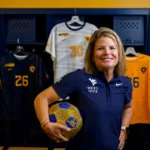
Izzo-Brown is a role model for women who believe they can do anything.
WVU photo
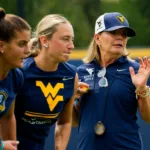
Izzo-Brown’s firest WVU team finished fifth in the Big East Confernce despite predictions that they’d finish last.