
Trans-Allegheny Lunatic Asylum’s Stalnaker speaks
Trending
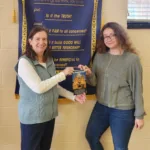
Trans-Allegheny Lunatic Asylums tour guide Whitney Stalnaker addressed the Rotary Club of Elkins, giving the group the history and current status of the facility.
Construction of the Trans-Allegheny Lunatic Asylum (TALA), more commonly known as the Weston State Hospital, was begun prior to the establishment of the State of West Virginia. Starting in 1858, it took twenty-three years to complete the building. TALA is the largest hand cut sandstone building in the United States and second only in size to the Kremlin in Moscow. There are 9 acres of floor space encompassing 242,000 square feet; the building is just short of being a quarter mile long.
Thomas Story Kirkbride, an early reformer in mental health care, designed the building. During the 1850's, there was basically no such thing as mental health care. Kirkbride and other reformers toured the places where the mental ill were being kept. "What they were finding were very, very dismal conditions," said Stalnaker. "If you had a mental condition of some kind, you were more likely to be thrown in jail or locked away in an attic or a basement somewhere because mental illness was terribly misunderstood. It started out being believed to be demonic possession, but we had evolved a little bit away from that by the 1850's. A lot of people still feared the mentally ill."
Kirkbride approached state governments to provide resources for the mentally ill, pointing out the failure to provide care for those who were in need. "From there, you have these asylums being built. That's where there's the big craze all throughout the U.S. of building these large state-sponsored asylums. During that time period, about 300 were built, of those about 70 were built on the very specific plan that Dr. Kirkbride came up with," commented Stalnaker.
The Kirkbride plan emphasized the patient environment, strongly believing that patients had done nothing wrong and shouldn't be made to feel they were being punished. Kirkbride buildings embraced lots of fresh air and sunshine for the patients. There are 920 windows in the main facility; there are also windows in the seclusion rooms that were intended for the more out of control patients. "Kirkbride said even those patients deserved natural light," added Stalnaker.
Fresh air flow was very important in the Kirkbride design. TALA has very high ceilings and open transoms above doors. Socialization among the patients was another key component of Dr. Kirkbride's philosophy, ensuring patients could live as normal a life as possible. The bars on the windows were also situated in such a way that the patients would not look out and have the bars right in front of their faces, unlike a prison.
When it was opened, the TALA was extremely well decorated and furnished and patients were also encouraged to go outside. "We raised all of our own food and livestock that was butchered on site. They were getting three very fresh meals every day, probably a lot better than what they had come from," said Stalnaker.
There's a misconception that the residents of Weston did not want the asylum built there. "That's not the case at all because of the jobs that it would provide. When the State was looking at different areas to build the building, the Town of Weston whitewashed all of their fences and literally threw a parade," said Stalnaker. "They really did want that building. At the time, the glass factory was the only major employer in the area and the hospital promised to bring 500 to 700 jobs to the area."
The TALA was a very advanced building for its time; it was the first building in the area to have electricity and running water. It was also equipped with indoor plumbing. "All of these things made for a pretty decent patient experience early on," commented Stalnaker.
The 1940's - 1960's saw many problems for the asylums, when they stopped working the way they were intended. Severe overcrowding became a huge problem during that time period. Dr. Kirkbride only intended that the asylum should only hold approximately 250 patients; in that time period, there were between 2400 – 2600 patients. "At the time, it was no exaggeration, to say that we had patients everywhere we could keep them. Sometimes, they literally had to share a bed by sleeping in 8-hour shifts, altering with each other." By the late 1960's, the federal government began the process of deinstitutionalization and systematic closure of the state hospitals. At its most crowded, the hospital had a staff to patient ratio of one nurse for every sixty-four patients. The hospital closed in 1994 after having received its 6-month closure notice in 1989. "Somehow, we held on for five more years," commented Stalnaker.
During the 1970's and 1980's, when it became apparent that there would be a major change in the care of the mentally ill, there was a move to prepare the patients for moving to a new facility or situation. Various buildings were shut down; patient populations were consolidated and reduced. "We were focused on getting patients ready to be released, getting them used to the idea that this hospital that many of them called home for years and years and years isn't necessarily going to be here," said Stalnaker. "The efforts ranged a lot from hospital to hospital. From what I'm told, we did a fairly good job of trying to make sure the patients were set up in the community before we closed." As an effect of the closures and the inability to relocate all of the patients, there was a national uptick in the unhoused population and well as the prison population. The William R. Sharpe Jr. Hospital was the replacement or TALA.
In 2007, the Jordan family from Morgantown purchased the property and opened it for tours. "Their idea behind opening it up for tour is to use the money generated through tourism to preserve and maintain the main building," said Stalnaker. "Our idea is to use tourism to make sure this building sticks around. It is a testament to a lot of different areas of history, obviously the history of mental health care but West Virginia history as well. There are a lot of deep ties to the area in terms of Civil War history as well as more modern history," said Stalnaker. "We're a little biased but we think it's pretty important, if for nothing else for the patients who had to go through all these darker times as we were on our way to better understanding mental health care."
Six major areas of the hospital property have been restored, thanks to the small restoration team. The team works during the off season (November through March) when the TALA is closed to tourists. Beginning in November, the team will focus on the restoration of another section of the hospital and work to enhance the onsite museums including the ongoing cataloging of artifacts in their possession.
"We are super lucky that everybody is very interested in this building for various reasons. Folks come to us who want to learn about the history, they want to learn about the paranormal, they want us to scare them in our haunted house. We have literally thousands of people every year who come to us," concluded Stalnaker.
More information about Trans-Allegheny Lunatic Asylum, including a full listing of historic and paranormal tours, can be found at www.talawv.com or by calling 304.269.5070.
Rotary is a global network of 1.2 million neighbors, friends, leaders and problem-solvers who see a world where people unite and take action to create lasting change - across the globe, in their communities, and in themselves. Visit www.Rotary.org to learn more about Rotary International, visit the club's Facebook page - Rotary Club of Elkins – or contact 2026-2027 club president Karen Wilmoth at wilmothk@gmail.com for more information about the Rotary Club of Elkins.