
More accolades for WVU’s Bishop
Trending
MORGANTOWN -- It really doesn't happen this way very often, not with consensus All-Americans.
They are the blue bloods of college football. They don't sneak up on you and have their name come from the clouds to the post-season All-American teams, but Beanie Bishop has done just that.
When he came through the transfer portal to West Virginia from Minnesota, he was picked up because the Mountaineers had big holes in the secondary they thought he could fill. They weren't asking for an All-American, just a competent defender.
He wasn't a star at Minnesota, and out of high school he first wound up at Western Kentucky.
Well, on Thursday, Beanie Bishop became the 13th player in WVU history to earn consensus All-American status.
"Beanie has had an outstanding season and is very deserving of Consensus All-America honors," WVU coach Neal Brown said in a school release as he began preparations for the Duke's Mayo Bowl meeting with North Carolina on Dec. 27 in Charlotte. "Everyone associated with the Mountaineer football program is proud of him and what he has accomplished this year. He has been an excellent leader and great representative for Mountaineer Football, the University and the state."
To earn Consensus All-America distinction, a player must garner a majority of the first team All-America recognition from the five All-America teams recognized by the NCAA, including the Associated Press, American Football Coaches Association, Walter Camp Football Foundation, Football Writers Association of America and The Sporting News.
Players who earn at least three first-team All-America team honors automatically qualify for consensus honors. If the spots at the specific position aren't filled, then the players with at least two first-team selections will be considered and then the second team selections will be used as the tiebreaker.
In the case of a true tie, all players are listed. A player who earns five first-team spots will be named a unanimous All-American.
Bishop, out of Louisville, was a first-team selection on the All-Big 12 defensive team and was a finalist for the Chuck Bednarik Award. He led the nation in passes defended with 24 and pass breakups with 20, forcing 17 incompletions.
He needs two more breakups to become WVU's single-season leader with 22. The record of 21 was set in 2003 by Brian King.
After the victory over Central Florida, when he was named the Big 12 Defensive Player of the Week along with Co-Newcomer of the Week as he had a pair of interceptions, a pass breakup and four tackles in a 41-28 win, Neal Brown offered up this praise.
"He's been one of the positive stories out of the portal. We had a distinct need and wanted somebody that was a veteran, had leadership and can cover and so far, all three of those areas have been a check."
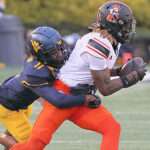
It was in that game in which he made one of the season's most spectacular defensive plays. In coverage on a shot deep down field, the pass was falling incomplete when the receiver inadvertently kicked the ball into the air. Alertly Bishop turned and grabbed it for his first of two interceptions.
WVU scored touchdowns after both.
The list of the other 12 consensus All-Americans is distinguished, as one might expect, carrying with it a lot of WVU football history.
Alphabetically it begins with the man considered the best cornerback ever to play at WVU, Aaron Beasley, who was honored in 1995. A junior that season, Beasley led the nation with 10 interceptions.
Next was tackle Bruce Bosley off the 1955 team. He played in the 1954 Sugar Bowl, helped the Mountaineers to a 31-7 record while there with Sam Huff and went on to a 13-year NFL career.
Center Mike Compton from 1992 became a third-round pick of the Detroit Lions, where he played eight years before moving to the New England Patriots, where he won two Super Bowl rings.
Canute Curtis, a pass rushing demon from 1996, anchored the nation's No. 1 defense that season and was a finalist for all the top defensive awards that year.
Brian Jozwiak, a giant of a man and a giant of a player, was Don Nehlen's second consensus All-American in 1985 and was a first-round NFL draft pick whose career was sidelined by injury after three years.
Dan Mozes is the second center, with Compton, to earn consensus honors in 2006 when he also won the Rimington Award, symbolic of the nation's top center.
Ira Errett "Rat" Rodgers was WVU's first consensus All-American, earning the honor in 1919. That got him started on the road to his place in the College Football Hall of Fame.
In 1994, Todd Sauerbrun earned consensus All-American honors and to this day he remains one of the greatest punters in college football history. That season he established an NCAA punting record by averaging 48.4 yards per kick and had one punt of 90 yards against Nebraska.
Steve Slaton, who teamed up with Pat White as one of the greatest offensive duos in college football history, was a consensus All-American in 2006 as he rushed for 1,744 yards, a school record, and 16 touchdowns.
Just three years ago Darius Stills, a defensive lineman from Fairmont, became the last consensus All-American before Bishop as he earned Big 12 Defensive Lineman of the Year honors.
And finally, there were two linebackers who qualify as true WVU legends, Darryl Talley who was Nehlen's first consensus All-American in 1992 before embarking on a long NFL career in Buffalo that took him to four Super Bowls, and Grant Wiley from the 2003 team which surpassed Talley's record for career tackles at 492.