
Confident White another weapon for Mountaineers
Trending
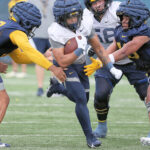
MORGANTOWN -- Let's talk about touchdowns and about Jahiem White, West Virginia's captivatingly talented sophomore running back, who came out of nowhere last season to establish himself as one of the most exciting ball carriers in the nation.
After a slow start due to injury, White turned nearly every game he played from there on into a highlight reel that blended speed with power, balance and maneuverability that often left defenders grasping at air as he breezed by.
But, as he did it, he ran himself into some tricky territory, for in this day and age where the word ME too often replaces WE, it is a fine line between being confident and cocky … and confidence is necessary for greatness while cockiness becomes boorish.
White arrived on the WVU campus brimming with confidence. He was good and he knew it … so did Neal Brown and probably his defensive staff more than the offensive staff, for the defensive staff could find no way to stop him in practice before his talents were unveiled in mid-season.
And even now, as this spring comes to an end, he admits to such confidence.
"Me coming in and playing how I played last year wasn't really a surprise," he said during a Tuesday interview session. "It was just a matter of time and when I got on the field I showed my talent."
To some that may sound cocky, but to those who know White, they know that it is him simply speaking the truth. Was Ali cocky when he crowed "I am the greatest"?
We felt that White was advanced enough in his thinking and understanding of how an athlete's perception is important that he could explain the difference between confidence and cockiness, so we asked his definition of each.
"Being confident, you know, is that you know you can play ball so you just go out there and play ball. Being cocky is like …. you know you got it, but … eh, I can't explain it because I don't get into all that," he said.
It is really more difficult to explain, especially in today's atmosphere where first downs are celebrated almost as joyously as touchdowns, where sacks become occasions to dance. It reached such a stage that it is not unusual and actually becoming more commonplace to see taunting penalties assessed in many games.
Are these celebrations cockiness? Are they showmanship? Just where do they come from?
"That's just being in the moment after scoring touchdowns, getting first downs. That's just like your little celebrations of how you are feeling at that time," White said.
To him it is neither taunting nor showing off, just letting the emotions of the moment flow.
Basically, that's true, but these highly choreographed productions aren't spontaneous at all. In fact, they may take as much time putting together as is the play upon which a touchdown is scored.
But with White, any of his celebrations, and he does some, are truly being in the moment, as he explained to Mike Casazza of 247Sports during the press conference when Casazza observed that there was no celebration from White when he scored his biggest touchdown of the year on a pass reception from Garrett Greene in the final seconds to beat Baylor.
Why no animation or celebration?
"I was a little shocked -- well, no, not shocked that I caught the ball -- but I was shocked at that moment," he said. "I wasn't going to really celebrate because we had that game with Houston and they had that Hail Mary, and I didn't want to get my hopes up."
You might recall that after WVU scored with 23 seconds left on a pass from Greene to Hudson Clement that seemed to win the game, Greene was hit with an unsportsmanlike conduct penalty for removing his helmet in celebration in the end zone, which cost WVU 15 yards on the ensuing kickoff that put Houston in position to move quickly into range of the Hail Mary.
So it was that White was restrained at a moment when no one would have complained had he let himself go.
There was a time, of course, when football players or basketball players were taught to "act like you've been there before" when they did something special. You put on the uniform and it was expected that you do special things … but that was back in the pre-TV, pre-replay days, back before social media that not only jumped all over you for every mistake but spread across the universe your latest touchdown celebration innovation.
Where did it all start, though?
Many believe it was with Michigan's Desmond Howard with his Heisman Trophy pose after his 93-yard punt return against rival Ohio State, which we get to shortly.
But, according to Wikipedia, it probably began the day in 1965 when wide receiver Homer Jones of the New York Giants spiked the ball in the end zone after a touchdown pass.
Four years later, in 1969, Elmo Wright, a junior receiver at the University of Houston, began celebrating his touchdowns with an end zone dance. Two years later, as a rookie for the Kansas City Chiefs, he pulled the dance out to celebrate in what was the NFL's first touchdown dance.
The celebrations grew from there with such names as Billy "White Shoes" Johnson and Ickey Woods becoming as famous for their dancing in the end zone as Fred Astaire or Gene Kelly were in the movies.
It was in 1991 when Howard's Heisman pose, however, created something that is still followed today.
On the 30th anniversary of that moment, Howard explained how it just sort of happened, giving strength to White's explanation that such celebrations come from just being in the moment.
"You know," Howard said on that anniversary, "it was such an odd thing for me to do personally, simply because of how I celebrated touchdowns throughout that season. I scored 27 touchdowns and I never did anything except what we called 'a Barry Sanders'; I handed the ball to the official. I always then turned around and celebrated with my teammates."
If Jahiem White has his way, there will be more celebrations from him this year than last year. While he proved himself to be a dynamic player, rushing for 657 yards and catching the ball for 119 more once he got to be playing regularly, averaging more than 8 yards per touch, he scored only six touchdowns.
His main goal this spring, therefore, he said was to find ways "to get into the end zone more. That's really it."