
Princeton’s Brad Mossor wins the Kennedy Award
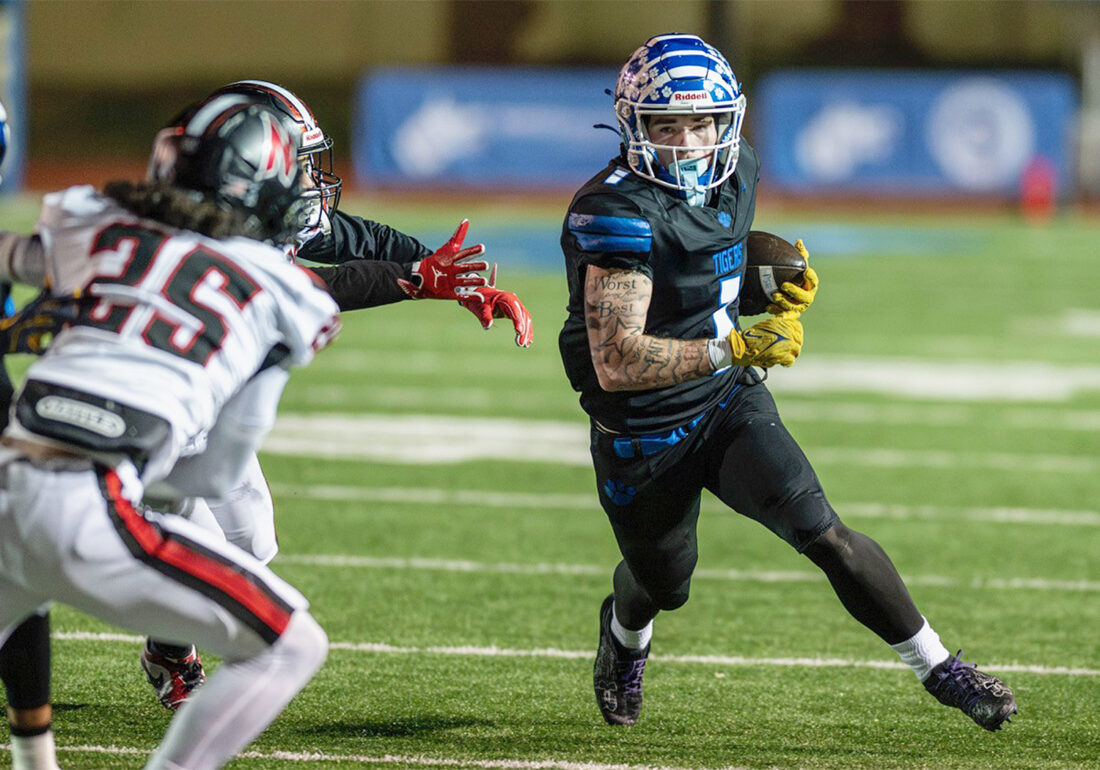
Photo courtesy of Heather Belcher /Play Sheet Sports Princeton’s Brad Mossor carries the ball against Nitro in the Class AAA state title game.
PRINCETON — Mike Mossor had a long, ongoing debate with his son Brad about who the better athlete was.
Mike, who earned first team all-state honors in basketball in 1993 and ’94 and helped lead Doddridge County to the Class A basketball title in ’94 after finishing runner-up in ’93, has eerily similar credentials to his son. Brad just did it in a different sport, finishing as the state runner-up in ’23 and a state champion in 2025 with a pair of first team all-state selections as a junior and senior.
The younger Mossor will finally get the last laugh when the two sit down for Christmas dinner.
Brad, a senior receiver who led Princeton to its first football state championship in its 102nd season, has been named the 77th Kennedy Award winner by the West Virginia Sports Writers Association.
The Kennedy Award, named after Wheeling native and Downtown Athletic Club (the original sponsor of the Hesiman Trophy) member Harrison H. Kennedy, is presented annually to the best high school football player in the state of West Virginia by the WVSWA.
Mossor becomes only the fourth player to win the award while playing primarily as a wide receiver, joining former teammate Dom Collins (2023), Martinsburg’s Brandon Barrett (2002 and ’03) and Dupont’s Randy Moss (1994). He also becomes only the second Princeton Tiger to win the award following Collins and joins his former teammate as the only players in state history to win both the Randy Moss and the Kennedy Awards.
“It’s a dream come true,” Mossor said. “You telling me that puts emotions in my heart. I can’t show it on camera but it’s a lot of hard work and I’m just glad it paid off.”
While the bulk of Mossor’s yardage and snaps came at receiver, he established himself as the state’s best player with game-changing plays in every phase. He caught 93 passes for 1,508 yards and 13 touchdowns, rushed 123 times for 896 yards and 28 touchdowns and returned three punts, two interceptions and one kickoff for a touchdown.
He totaled 47 touchdowns on the year, adding a touchdown pass for good measure.
Most of his skillset had already been explored a year ago when he finished top three in voting for the Fulton Walker and Randy Moss awards but his ability as a runner was a newfound one.
His 28 rushing touchdowns broke the school’s single season record, erasing the mark established by West Virginia University Hall of Fame inductee Jimmy Walthall in 1943.
“I think me changing, getting older and my mindset changed,” Mossor said. “My body changed and I was also 160 pounds my sophomore year. Me just changing between my sophomore and senior year helped out.”
Mossor’s emergence as a runner played a key role in getting him involved and aiding the team. When Nate Tanner took over as the head coach in the spring, Penn St. signee Daniel Jennings, R.J. Coatney and Landon Dillon were the top three running backs on the depth chart.
Jennings graduated early and enrolled at Penn State, Coatney suffered an ankle injury in August that cost him half of the regular season and Dillon was knocked out due to an injury as well. Given the running back situation and opposing teams’ tendencies to bracket Mossor as a receiver, Tanner sprinkled him in as a runner.
“I liked it,” Mossor said. “Me growing up watching (former WVU standout) Tavon Austin, I wanted to do what he did. I think what I did was kind of crazy.”
When the playoffs began he was more heavily utilized as a runner, rushing 65 times for 514 yards and 11 touchdowns in four postseason games. The crown jewel of those performances came in the Tigers’ 36-35 victory over Nitro in the Class AAA state title game where Mossor ran for 115 yards and four touchdowns as well as two 2-point conversions.
“I saw him obviously when we played him but on other film too,” Princeton head coach and former Parkersburg South head coach Nate Tanner said. “What he can do with the ball in his hands in the return game, on offense as a receiver and defensively – I remember seeing him have some pick sixes against Greenbrier East last year. He’s just a guy that needs to ball in his hands. He’s a ball guy. However that was going to happen, it was going to make us successful.”
“I feel like him as a running back, he got a lot better as the year went on. Once he got into a rhythm being in the backfield too, it was just game over.”
Mossor became so comfortable in the backfield that on the biggest offensive snap of the season – Princeton’s final 2-point conversion that put it up 36-29 – he called for the ball as a runner. That score ultimately decided the game with Nitro unsuccessfully attempting its own go-ahead conversion on the following drive.
“We were in the huddle and we were going for two and I think I had just scored,” Mossor said. “We were in the huddle talking about it and we were going to give it to (Alex Cox) and I was like, ‘Coach Tanner, no. Give me the ball. We’re in the state championship. If all else fails it’s on me. Give me the ball.’ He gathered for a second and was like, ‘You do know they know where the ball is going to?’ and I was like, ‘Have they stopped it?’
“It was a wingback reverse out of the single wing,” Tanner said. “The trust that had been built at that moment came from all the experiences we had together. I think the relationship that has an insurmountable amount of trust, the only way you get that is through time. In that moment, a high pressure situation and the game is on the line, I was probably just, I don’t know, maybe outsmarting myself in the moment. The play I was going to call, we hadn’t ran it at all in any game but we had practiced it every week.
“It was a counter to superpower which we had ran with Brad throughout the year when we got inside the 5 and the 3. In that moment I told them what we were going to run and Brad, he said, ‘Coach, no, no, no, no. Just give me the rock.’ I told him and everybody on the team, ‘They know what’s coming. They’re going to dial it up. Alright, let’s do it.'”
Mossor is the first player to win the Kennedy under Tanner who coached at Parkersburg South from 2019-24 where he led the Patriots to a semifinal and title game appearance. Prior to Mossor the highest placing Kennedy candidate Tanner had coached was South quarterback Brandon Penn who finished second in the 2019 race.
Much like Mossor, Penn was a versatile player, excelling as a dual-threat quarterback, defensive back and special teams player.
“I talked about Brad where he’s a ball guy, you get the ball to him however you can. Where he can high point balls you can throw it to him and he’s fast, He can stretch the ball vertically and he’s very elusive. Brandon was a kid that played with a lot of violence and anger too we used him in the run game and he had a cannon. He could throw it 65, 70 yards down the field. Defensively he was very physical so we had him playing safety where he could run the alley and make plays and Brad was similar on defense. I think he took a step defensively this year.”
Mossor, who maintains a close relationship with Collins, leaned on the former Kennedy winner’s advice and example, springboarding his own successful campaign.
“Probably starting in the weight room,” Mossor said. “Doing what he did and being more explosive – he’s probably one of the most explosive people you’ll see speed wise. So I tried to take that from him and translate it into my game.”
Wheeling Park running back and Curt Warner award-winner Brennan Wack finished second in voting while Morgantown sophomore and J.R. House award-winner Maddox Twigg finished third.
Local Sports
TVMS JV girls claim victory over Pendleton County, 36-21
MILL CREEK — The Tygarts Valley Middle School girls basketball squad split games against Pendleton County Monday ...

A Matter of Execution

Princeton’s Brad Mossor wins the Kennedy Award

WVU needs to add linemen, running backs in the portal
Pirates agree to deal with All-Star Ryan O’Hearn
PITTSBURGH (AP) — The Pittsburgh Pirates took another step toward being a contender in 2026, agreeing to a $29 ...
Bulldogs drop tilt to No. 4 Rebels in home debut
MILL CREEK — Isaac Hodges and Seth Cronin combined for 47 points to lead Class A, No. 4 Ritchie County to a ...