
Randy Mazey’s vision of what WVU baseball could become
Trending
MORGANTOWN -- This is the tale that hasn't been told about the West Virginia University baseball season that took it to the College World Series in Omaha for the first time ever; that ended with three All-American players in pitchers Maxx Yehl and Chasen Cole along with catcher/second baseman Gavin Kelly, and which honored Steve Sabins with a National Coach of the Year Award.
This is a look not into the Mountaineers' dugout or clubhouse, but instead into the stands and up onto "Randy's Ridge," perched high above the Kendrick Family Ballpark and that is named for the man who got the ball rolling back when it appeared baseball was on the edge of a different kind of cliff.
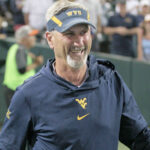
This is the untold story of the past two years for the former WVU coach Randy Mazey, who had a vision of what Mountaineer baseball could become when he arrived in 2013.
He checked his ego at the door, came not to build himself a program nor to build his own legend, but established something far bigger than himself, than JJ Wetherholt or Alek Manoah, than even Sabins who took it over without a hitch and moved it forward.
Mazey compiled a 372-274 record, leading the Mountaineers to four NCAA Regionals and their first-ever NCAA Super Regional in 2024 and then, two years back with everything moving in the right direction, stepped aside and ended a career that started as a player at Clemson, took him into the major league draft in the 28th round, saw him play two minor league seasons, then become a coach and took an early retirement with an 18-year record of 558-434-2.
And when he left he did it not because there was nothing remaining to accomplish; not because of feeling the stress of coaching; not because the collegiate game had gone to revenue sharing and NIL but for the right reasons.
He had a life to live with his family.
"Part of the reason I retired was I wanted to watch my kids do their things," he said the other day when asked to look back on the first two years of retirement. "In our profession you miss most of what they do because you're always doing what you do. I didn't want to be the guy who waited until they were finished and when I retired and looked back and said 'God, I never got to see them play or do their thing.
"I wanted to do that and there's not a contract in the world that's more important than my children."
He had a winning program, a growing program and a big salary, but he knew there was more to life than that.
And so he joined those fans he'd lured to the ballpark, that he worked so hard to see become a reality, fans who had cheered him and, yes, booed him.
He didn't leave for another job, just for another life.
"There's a lot stress in this profession as a coach, but there's a lot of stress as a parent, too. You want so bad for your kids to do well and you know what they are capable of doing. You want them to have that chance to prove what they can do," he said.
And so, he made up his mind two years ago that he would grab an early retirement, a move that probably came a year earlier than he really wanted as Sabins was being zeroed in on to coach Cincinnati and he and the administration wanted to make the transition to Sabins.
A deal was reached that satisfied everyone and Sabins took over in the 2025 season.
His first season he watched his son, Weston, who had fought back from a frightening head injury he suffered while playing game he loved, play his senior year at Morgantown High, then come to WVU to play for the Mountaineers.
He quickly learned that being a baseball parent carried stresses that far exceeded what he expected.
"I was more nervous the game my son started this year than any game I ever coached my entire life because you want it so bad for them that you transfer the stress to yourself," he said.
That start came in the season's second game at Georgia Southern and Weston, who had been so close to his father that he had grown up in a dugout as a batboy for him almost from the time he was first able to drag the bat from the batter's box back to the dugout, saw him get his only hit of the season.
Mazey's first year away from coaching WVU he traveled a lot with the family, which includes his wife, Amanda, and daughter, Sierra, while his former team under Sabins won a school record 44 games and advanced to through the Clemson Regional to a Super Regional at North Carolina before being eliminated in the Super Regional.
He was a faithful fan at Morgantown High's games throughout Weston's senior year.
"Just to see his leadership qualities … you know, he's a gamer. Physically he's smaller than most guys and he's not the guy you look at on the field and say he's the biggest, strongest guy, but watching him over time he's been in dugouts a lot and knows how to win and when the game is on the line he's going to perform better and impact the outcome," Mazey said.
It's one thing to coach someone else's kid and quite another experience when you are watching your own play.
"You try to say you love them all the same and parents hate to admit it when you are watching a game where their son or daughter is in there there's one child out there they love more than all the others," he said. "You want it so bad for them that it takes on a whole different meaning when you are watching your own children."
It was a bit different as he watched WVU play -- both last year and this season -- for he had coached and recruited so many of the players and they, too, carried a different kind of relationship to him.
It had to be difficult for Weston to serve mostly as a pinch runner his freshman year and hard for Mazey to watch that, although Weston never let that get to him.
"It's always been his dream to be in the College World Series and wear a Mountaineer uniform and to do both things in the same season he was excited. He loves the Mountaineers. When he committed here he said he wanted to represent this entire state and by putting on the uniform he can do that," Mazey said.
"He's happy as he can be. He has spent a lot of time in a Mountaineer uniform and in our dugouts and watched this program unfold as much as anyone has."
For Mazey, though, there was another aspect to this season, seeing the man who was his choice to succeed him, Sabins, keep moving the team forward.
Never once did Mazey question his decision or offer anything but support for Sabins and where he was headed.
"I said all along when I got here that it wasn't about me taking this program to the College World Series," he said. "It was about the players and the administration and the university and the fans and the people in the state getting to experience what I knew was the highest level of college baseball, so it was just really exciting for to watch this team, the fans and the state to experience it.
"That's what it was about from Day 1. It wasn't about me going back to the World Series. I was about them going to it, so the fact that I wasn't in the dugout when that happened really makes no difference to me at all because I was in it for everybody else instead of myself."
Mazey became part of the craze that Mountaineer baseball and its fandom had become.
He sat there with the fans, went up onto 'Randy's Ridge', named for him because when he got ejected from a game in which he was coaching, he went up there in uniform to watch how it played out. He watched the team and rooted for the team and chatted with the fans.
He saw up close and personal what he had created, although he refuses to take credit for it.
"It was a proud moment. It was what you dreamed of when you got here 14 years ago. This was the way I wanted the program to end up and absolutely, positively 100% knew West Virginia was capable of doing what we've done," he said. "It just took a little while to do it.
"Having no transfer portal or NIL when we started the slowed the process a little bit, but when that came it speeded right back up. It was tremendous run and the players from my first team and the coaches on my first team should be as proud as anybody because everyone who ever wore this uniform or sat at Hawley Field or listened on the radio has had a hand in this.
"I never considered these 'my teams.' These weren't 'my players,' these weren't 'my teams.' These were West Virginia's teams. I was just the coach trying to teach them how to get there. I never once thought this was 'my team' or that I was the guy that did this. There were a lot of people who had a hand in this and I was just one spoke in the wheel to help make it happen."
Did Randy Mazey miss coaching? Parts of it, he said.
"I miss interacting with the players but over the course of my career I realized I didn't want to spend my time teaching kids how to steal second base or hit curveballs. I wanted to teach them how to be good people and leaders and good teammates and I gravitated toward that toward the end of my career," he said.
"I absolutely do miss that part of it, watching kids grow. Everybody else can teach them the baseball things. I really enjoyed teaching them the life lessons. I'm a relationship guy and I'll follow these kids I coached the rest of their lives. I've been to more former players' weddings the past two years than I had in my whole life because now I have the opportunity to do that.
"I like watching them become fathers and husbands. That's where I get my satisfaction."
And the best part of it came in Omaha.
"I had guys come up to me in Omaha and hug me and cry and say this a dream of theirs and they never thought this day would come. That really meant a lot to me," he said.