Return to ‘Almost Heaven’ 50 years later
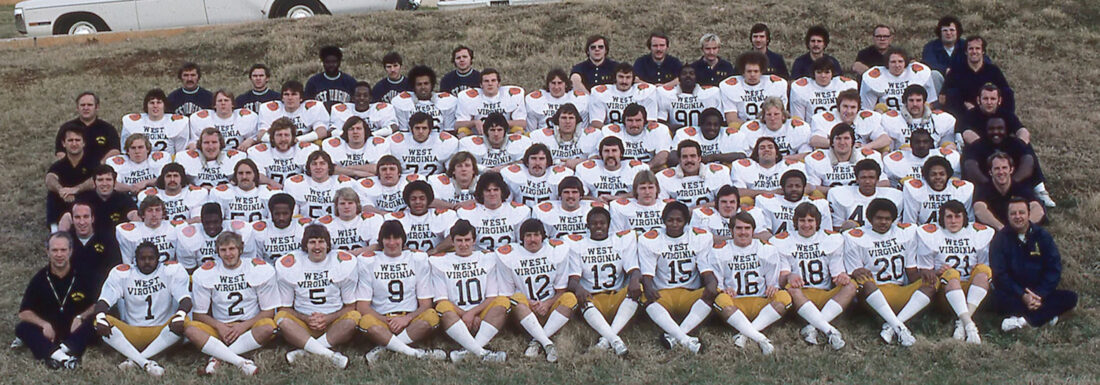
Submitted photos The 1975 WVU football team is shown prior to their Peach Bowl victory.
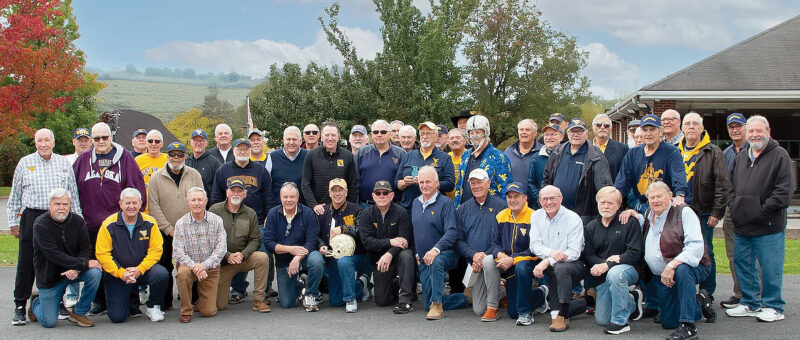
The 1975 WVU football team recently gathered to celebrate their victory in the Peach Bowl.
EDITOR’S NOTE: John Antonik is the quintessential historian for all things West Virginia University sports. He has penned five books on Mountaineer athletics, with his latest being “Almost Heaven: How Bobby Bowden’s Ten Years at West Virginia University Helped Him Become One of the Winningest Coaches in College Football History.”
With the 50th anniversary of the WVU football team’s 1975 Peach Bowl victory around the corner, we asked Antonik to dive into his book, as well as a reunion of Bowden-era teammates and staffers that took place in Morgantown in October (2025).
In the Peach Bowl matchup, the Mountaineers eked out a win, 13-10, over North Carolina State. It is also notable that both teams were led by future legendary coaches: Bowden for WVU and Lou Holtz for NC State. Both left for other coaching opportunities after the Peach Bowl game; Bowden to Florida State and Holtz to the New York Jets.
Antonik also serves as the senior director of athletics content for the Department of Intercollegiate Athletics at WVU. Read on as Antonik gives the “Where Are They Now?” treatment to these Bowden-era Mountaineers.
This was one team reunion I decided to sit out, not because I didn’t want visit with the returning players and listen to all of their stories (and lies), but rather because I didn’t want to give off the impression that I was there peddling books.
Roughly two years ago, Parkersburg, West Virginia, resident Bob Pitrolo, a student manager who worked for longtime WVU equipment custodian Carl Roberts during the mid-1970s, requested a meeting with the Mountaineer Athletic Club. He was part of a group of former players and coaches that wanted to plan a 50-year reunion for the 1975 Peach Bowl championship team in the fall of 2025, and having been involved in other reunions in the past, Pitrolo understood that a lot of advance time was required to track everyone down.
After all, a football team of approximately 100 players, coaches and staffers from different parts of the country can disperse far and wide after 50 years.
Pitrolo, Bowden-era assistant coach Paul Moran and some others I don’t recall, were part of the initial planning meeting with the Mountaineer Athletic Club’s Kyle Poland, then overseeing the WVU Varsity Club.
My tangential involvement with them came later when the group suggested that I write a book about Hall of Fame coach Bobby Bowden’s time at WVU.
Of course, Bowden’s Hall of Fame credentials were solidified during his 34 years coaching at Florida State, where he won two national championships in 1993 and 1999. He was the oldest coach in NCAA history to win a first one (age 64) and is still the oldest to ever win one (age 70).
But during his six-year head coaching tenure at WVU, Bobby was still figuring things out.
What the Peach Bowl reunion planners didn’t know was that a completed, 100,000-word manuscript on Bowden’s decade spent at WVU, four as coach Jim Carlen’s offensive coordinator from 1966-69 and six as head coach from 1970-75, was sitting in my shared drive where it was likely to remain until its erasure by the WVU IT department once my WVU working days were over.
There was one big reason the manuscript had remained idle in cyberspace for so long.
I just wasn’t sure of the marketability of a book covering a subject that took place five decades ago and was made up of septuagenarian players now entering their golden years. Unfortunately, many of them are no longer with us.
Nevertheless, around the same time the Peach Bowl reunion planners were finalizing their plans, Than Saffel, a collaborator on a couple of other WVU sports books, was named WVU Press’ new director.
Saffel had noticed one of our books sitting in a baby stroller at the West Virginia State Fair last fall and sent me an email out of the blue with the subject tag: “Let’s Talk About Another Book.”
“As a matter of fact, Than …” my reply began with a portion of the manuscript attached, which after reading, he was on board to publish.
Only some minor updating was required to make it current, and it today exists as “Almost Heaven: How Bobby Bowden’s Ten Years at West Virginia University Helped Him Become One of the Winningest Coaches in College Football History.”
“Almost Heaven,” of course, is word-play on Bowden’s deeply religious faith — a phrase that has become synonymous with the Mountain State — and Bobby falling just short of greatness at WVU.
That was to come later.
The book was published in September in time for the reunion, and thanks to WVU deputy athletics director Matt Wells and WVU Varsity Club director Kevin Johnston, it turned into a convenient reunion gift for everyone returning to campus during Homecoming weekend on Saturday, Oct. 25, when the football team played TCU.
Reunion planners, recognizing the growing number of deceased players, coaches and staffers, and cognizant of how close all Bobby Bowden-era WVU players have remained through the years, decided to include everyone from 1970-75.
Nearly 100 of them returned to campus for the weekend, which kicked off on Friday night for the players at Kegler’s Sports Bar.
About 35 of them played on Bowden’s 1975 Peach Bowl team.
This was the event I decided to skip.
“There were guys at this that I haven’t seen since we walked off the field that afternoon at Fulton County Stadium 50 years ago,” linebacker Steve Dunlap admitted.
Quarterback Dan Kendra, the 1975 Peach Bowl offensive MVP, was unable to attend because the high school football team he was coaching was still alive in the Pennsylvania playoffs, but he did send Pitrolo his regrets via email.
“TO ALL!” he began, “I hope you all have a great weekend! I wish I could be there with all of you, but I’m still coaching in high school, and we have a game Friday night, and then we scout Saturday night for a team we play the following weekend in Districts! Have a drink on me, and hopefully the Mountaineers can pull off the upset! Love you, MY BROTHERS!”
Kendra and Danny Williams were the team’s dual quarterbacks that year, a practice Bowden continued at Florida State when Jimmy Jordan and Wally Woodham led the Seminoles to the 1980 Orange Bowl.
Bowden had learned not to get caught without any quarterbacks when he was at WVU in 1974 and went through three different starters before settling on true freshman Kendra at the end of the season.
That was one of only two losing campaigns during Bowden’s storied coaching career, and it was the only time a likeness of him could be seen hanging from the trees in Woodburn Circle. Many years later, one of his Mountaineer players was visiting Bowden in Florida and remarked that he didn’t see him hanging from any trees in Tallahassee.
“If you notice, I don’t have any of those for them to hang me in down here,” the coach replied.
After receiving his book, Danny Williams, now a professor of radiology at Wake Forest’s School of Medicine, sent me a hand-written note dated Nov. 6, 2025. A death in the family limited him to just attending the Saturday morning tailgate party, he wrote, but he did include photocopies of a picture of him with Bowden and another of him awaiting a snap from backup center Greg Dorn during the ’75 Pitt game.
Williams concluded his brief message, “Sincerely, Dan Williams (or Danny, whichever).”
Speaking of Dorn, his first name was apparently too difficult for Bowden to remember, the coach frequently calling him “Phil,” so afterward, Bowden’s solution was to simply call everyone “Buddy.” It was a practice he continued for the remainder of his life.
Dorn, by the way, became a biology teacher and football coach at Derry Area High School until his untimely death in 2009.
Of the starting offensive linemen on the ’75 Peach Bowl team, only split tackle Tom Brandner and tight guard Steve Earley are still living. Both attended the reunion. Brandner came in from Leicester, North Carolina, just north of Asheville, while Earley is now residing in the Parkersburg area.
Center Al Gluchoski died in Chester, Illinois, in 2013, split guard Bob Kaminski passed away in Beckley in 2017, and tight tackle Dave Van Halanger died in Keller, Texas, in 2023. Backup split guard Wayne Gatewood, who played most of the Peach Bowl when Brandner got sick because of food poisoning, died in Columbus, Ohio, in 2013.
The words “split” and “tight” reflected the veer offense that Bowden used at West Virginia in the mid-1970s.
The Mountaineer offensive line was considered big for that time period and was probably the main reason for the team’s success in ’75. West Virginia averaged an impressive 251.5 yards per game on the ground because of them.
The primary beneficiaries of WVU’s brute strength up front were tailbacks Artie Owens and Dwyane Woods, and fullbacks Heywood Smith and Ron Lee.
Owens and Woods returned to Morgantown for the team reunion.
Artie traveled in from the Allentown, Pennsylvania, area where he once starred at Stroudsburg High, located about 40 miles north of the city. He was part of a prep All-America grid squad that included Ohio State’s Archie Griffin, Indiana basketball star Quinn Buckner and Oklahoma’s Tinker Owens, so naturally, he was considered one of Bowden’s big-name recruits of that era.
Assistant coach George “Duke” Henshaw called him “a difference maker.”
In 1975, Owens produced 100-yard rushing games against Temple, Cal, SMU, Virginia Tech, Kent State and Pitt, all victories, and was 4 yards shy of the century mark in the Peach Bowl win over NC State. His touchdown reception with four seconds to go in the first half turned the game around in West Virginia’s favor.
Sometime during his junior season the year prior, Owens received the catchy nickname “King Arthur” by a Pittsburgh sportswriter, and it stuck.
Dwyane Woods – yes, the Y comes before the A, although his name was frequently misspelled in printed materials when he was a Mountaineer player – grew up in Bluefield and now lives in Columbus, Ohio. His six rushing touchdowns were second to Lee’s 10 in 1975.
Lee, from Bellaire, Ohio, is said to be living in Columbus, while Smith is residing in Dunbar, West Virginia.
Starting split end Scott MacDonald, a Frank Cignetti discovery while playing on the Mountaineer basketball team, traveled back to Morgantown from Batavia, Illinois, about 40 miles west of Chicago. It was MacDonald who caught the deflected pass that turned into a 50-yard touchdown to provide the deciding score in West Virginia’s 13-10 Peach Bowl victory over N.C. State.
“I knew there was a guy that had an angle on me, and I didn’t envision making the end zone,” MacDonald once recalled. “I was thinking, ‘Just run as fast as you can and as far as you can.'”
He made it, and Chuck Klausing’s stout Mountaineer defense made it stand up!
Facebook friend Anne McCloskey Stanton, a WVU student back in the mid-70s now living in Raleigh, North Carolina, sent me a care package full of Mountaineer football ephemera for our athletic department archives last summer that included a number of yellowed, tattered clippings of MacDonald, her secret college crush. In young Anne’s eyes, MacDonald’s rugged good looks and muscular 6-foot-6 frame made him much better heartthrob material than David Cassidy.
Starting flanker Tommy Bowden, now living in Destin, Florida, returned to Morgantown with his younger brother Terry, a freshman running back that season. I am told both spent a good portion of the evening getting their pictures taken with those excited to reconnect with their well-known teammates.
Both enjoyed long coaching careers, while Tommy still does a little television work for the ACC Network.
The team’s other offensive starter, tight end Randy Swinson, who made that big sideline catch to put Bill McKenzie in position to kick the game winning field goal against Pitt, died in Washington, D.C., shortly after the team’s 2016 reunion when Bowden was being inducted into the WVU Sports Hall of Fame.
Among the defensive starters, left cornerback Chuck Braswell and right cornerback Johnny Schell are no longer with us. Braswell died in 2009 near his native Clairton, Pennsylvania, while Schell died in Athens, Georgia, in 2020.
Right linebacker Ray Marshall, the Peach Bowl’s defensive MVP whose big sack of Wolfpack quarterback Dave Buckey late in the game helped preserve West Virginia’s three-point victory, was among the handful of players whose whereabouts remain unknown.
The last people heard, Marshall was an attorney working and living somewhere in North Carolina.
Right tackle Rich Lukowski is said to be living in Las Vegas, while free safety Mark Burke is believed to be back in his native Marietta, Ohio.
Left defensive end Andy Peters earns the award for the longest distance traveled for the team reunion. A 2015 inductee into the John Chambers College of Business and Economics Roll of Distinguished Alumni, Peters has enjoyed a distinguished career in safety management that has taken him to different parts of the country, most recently to Huntington Beach, California.
Through the years, Andy has remained connected with his alma mater and frequently returns for practices and games, as does right defensive end Gary Lombard, who came back to the area a few years ago and now lives on a farm outside of Morgantown.
Dunlap, WVU’s starting left linebacker, wrapped up a distinguished coaching career in 2012 after stops at Navy, West Virginia, Syracuse, North Carolina State, Marshall and back to WVU.
These days, he splits time between Morgantown and his fishing cabin in Canada.
We always enjoy reading left tackle Chuck Smith’s periodic Facebook posts as a retiree living in the Monongahela, Pennsylvania, area where he grew up, and he managed to make the short drive down Route 119 to Morgantown to visit with old teammates.
Chuck once told me a great story about finding a pair of broken glasses on the field during the melee that ensued following the Pitt victory, and how he interrupted celebrating to reach down and pick up the glasses to give them back to an inebriated student.
“Thank you! This is the greatest day of my life,” the drunk kid told Smith.
Teammates always gave Chuck the side-eye at reunions whenever he would tell this story until someone produced a highlight video that clearly showed a big No. 78 bending down to pick up something on the field while everyone else was celebrating hysterically.
“I gave the kid his glasses!” Smith would tell them.
Communities
Return to ‘Almost Heaven’ 50 years later
Capito applauds rural health care investment
Community Calendar
EDITOR’S NOTE: The Community Calendar is reserved for nonprofit, civic organizations. Unless otherwise noted, ...
Community Calendar
EDITOR’S NOTE: The Community Calendar is reserved for nonprofit, civic organizations. Unless otherwise noted, ...

Nurse plans to serve her country