
Rotary welcomes Health Department guest speakers
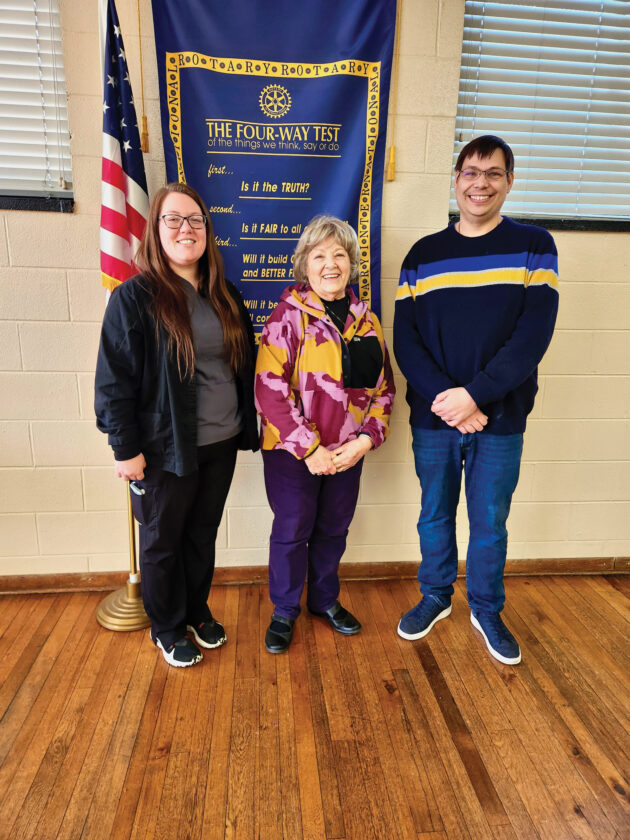
Submitted photo Randolph-Elkins Health Department staff members Kassie Swecker, left, and Bonnie Woodrum, center, are joined by Elkins Rotary Club President Phillips Kolsun. Swecker and Woodrum provided information about ongoing health concerns in the community as well as the services provided by the Department.
Infectious Disease Specialist Bonnie Woodrum and Public Health Nurse Kassie Swecker of the Randolph-Elkins Health Department addressed the Rotary Club of Elkins, giving the group information about ongoing health concerns in the community as well as the services provided by the Department.
In 2024, a statewide risk assessment was done, identifying biological infections as a top hazard for our area of the state.
“So many things are vaccine preventable, yet we have an army of people who want to decrease the requirements, the information, the preventative information about vaccine preventable illnesses,” said Woodrum. “The measles outbreak has had nearly 2,300 cases nationwide, but West Virginia’s had none because we have a 95-100% vaccination record for our children.”
In addition to the measles outbreak, there have been pertussis (whopping cough) outbreaks, including three cases in children under the age of 4 in Randolph County.
The health department provides vaccines across the lifespan from infants through elderly individuals. Most children visit a local pediatrician but those without a physician or those seeking a vaccine not carried by their doctor may visit the health department and receive no-cost vaccines under the “Vaccine for Children” program geared toward children ages newborn through 18.
According to Swecker, it is important for adults to get vaccinated to protect themselves from serious illnesses, to prevent the spread of disease to vulnerable individuals, to minimize missed workdays and to help control healthcare costs. Some vaccines, such as the HPV vaccine aid in the prevention of certain cancers.
“Vaccines strengthen the immune system to fight infections without causing the illness itself, especially as immunity wanes or risks increase with age or lifestyle” said Swecker.
Vaccinations provide personal protection against disease by training the immune system to produce antibodies which, in turn, provide immunity against disease and help prevent severe illness, hospitalization or even death. Adults can carry diseases such as whooping cough (pertussis) which can be deadly for infants.
Vaccinations help create “herd immunity” to shield vulnerable populations such as infants, older adults and the immuno-compromised. Herd immunity is defined as creating an environment where enough individuals have immunity to a disease so that it no longer spreads easily.
Vaccinations can help prevent the worsening of chronic conditions. Infections such as flu or shingles can trigger dangerous complications in adults with pre-existing health conditions such as heart disease, asthma or diabetes.
They also significantly reduce the risk of hospitalization and death from infectious diseases such as the flu.
It is known that immunity from childhood vaccines can fade over time, requiring adults to have booster shots for common diseases such as tetanus, diphtheria and pertussis. Boosters should be received every ten years to maintain robust immunity against these serious infections.
The 2025-2026 flu season is underway with at least 15 million reported illnesses, 180,000 hospitalizations and 7,400 deaths to date. While the flu vaccine doesn’t have a 100% effectiveness rating, “data shows that getting vaccinated will still greatly prevent complications,” added Swecker.
Flu vaccine generally has a 40% – 70% protection rate because the flu strains change very quickly. Flu vaccines are designed based on what’s happening in the far east, matching those strains. “By the time flu get to us, sometimes it has mutated until it doesn’t quite match anymore but it’s still the best we’ve got,” commented Woodrum.
The health department currently recommends the following preventative vaccinations:
• Flu – annually
• COVID – annually
• HPV (Human Papillomavirus)- recommended from those ages 26 through 45. This vaccine can prevent certain cancers such as cervical, throat, anal and penial cancer.
• Tdap (Tetanus, Diphtheria, Pertussis) – a booster should be received every ten years to maintain protection against these diseases.
• Hepatitis B – recommended for all adults under the age of 60. This vaccine prevents the hepatitis infection that could lead to liver cancer.
• Shingles – recommended for adults 50 years of age and older. Everyone who’s had chicken pox carries the shingles virus and it can be activated without warning.
• RSV – a single does is recommended for all adults age 75 and older and for adults aged 50-74 with chronic health conditions.
“As we age, we all know that our immune system weakens. The immune system naturally weakens with age making older adults more susceptible to infections and complications,” concluded Swecker.
More information about the Randolph-Elkins Health Department, including services provided by the organization, can be found at https://www.randolphhealthwv.net or by calling 304.636.0369.
Rotary is a global network of 1.4 million neighbors, friends, leaders and problem-solvers who see a world where people unite and take action to create lasting change – across the globe, in their communities, and in themselves.
Visit www.Rotary.org to learn more about Rotary International, visit the club’s Facebook page — Rotary Club of Elkins — or contact 2025-2026 club president Phillips Kolsun at phillipskolsun@gmail.com for more information about the Rotary Club of Elkins.
Communities
Community Calendar
EDITOR’S NOTE: The Community Calendar is reserved for nonprofit, civic organizations. Unless otherwise noted, ...
IRS offers tax filing help for 2026 season
WASHINGTON — The Internal Revenue Service today opened the 2026 tax filing season and began accepting and ...
Community Calendar
EDITOR’S NOTE: The Community Calendar is reserved for nonprofit, civic organizations. Unless otherwise noted, ...

ERCC meets with law enforcement officials

Hebb named Center’s entertainment director
Community Calendar
EDITOR’S NOTE: The Community Calendar is reserved for nonprofit, civic organizations. Unless otherwise noted, ...