
House passes bill extending supervision of certain drug offenders
Trending
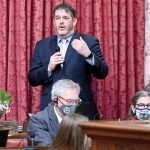
Photo Courtesy/WV Legislative Photography
Del. Mike Pushkin said experts in substance use disorder and treatment were left out of conversations on HB 2257.
CHARLESTON -- The West Virginia House of Delegates approved a bill Monday to increase supervision of people convicted of certain drug crimes, but the Democratic minority called the bill a step backwards.
House Bill 2257, relating to extended supervision for certain drug offenders, passed 76-17 with all present Democratic House members voting no except for Del. Lisa Zukoff, D-Marshall, who voted with the Republican majority.
HB 2257 would require the sentencing court dealing with someone convicted of a second offense for selling or transporting fentanyl into West Virginia to enter into a period of supervised release up to 10 years beginning when released from jail or prison.
"They would come out of whatever the sentence was, they would come into parole and once parole was completed, the period of extended supervision -- if it was a qualifying offense as listed out -- would be no less than six months," said House Judiciary Committee Chairman Moore Capito, R-Kanawha.
The bill would require county probation officers to manage the supervision program, with the person on probation paying up to $50 per month for the program. Judges would be allowed to revoke the supervised probation and send the person back to jail for no longer than the period of supervised probation.
According to the National Institute on Drug Abuse, fentanyl is a synthetic opioid more powerful than morphine used to treat extreme pain. Illegally manufactured fentanyl is often combined with heroin, but too much fentanyl can cause fatal overdoses.
According to the state Department of Health and Human Resources' Data Dashboard, 992 fentanyl overdose deaths occurred in 2020, accounting for nearly 75 percent of drug overdose deaths that year. House Government Organization Committee Chairman Brandon Steele, R-Raleigh, said HB 2257 will help get mid-level drug dealers off the streets.
"This is targeted at a repeat drug offender," Steele said. "These types of offenders are coming from Columbus. They're coming from Detroit, from Charlotte; they're coming from all over to bring this into West Virginia. This is a tool that is going to help us save some lives."
Del. Jonathan Pinson, R-Mason, is a former trooper with the West Virginia State Police. Pinson recounted his time as a law enforcement officer conducting undercover drug purchases.
"Often times when we're making these buys, we'll buy several from the same individual to prove this is something they do on a routine basis so we can present that to a jury when it goes to trial," Pinson said. "These are individuals who are killing West Virginians … We hear a lot that we need to consider the offender. I would argue we need to consider the offended."
Del. Mike Pushkin, D-Kanawha, reminded members that groups affiliated with the West Virginia Association of Alcohol and Drug Abuse Counselors were at the State Capitol Building on Monday. He criticized drafters of HB 2257 for not seeking their input before crafting the bill.
"Instead, we go after another kneejerk reaction because we're mad and we want to do something," Pushkin said. "I'm mad and I want to do something, but for once can we actually think about it and do the right thing that's actually going to work? If this passes and makes it through both bodies … unfortunately I don't think it's going to have the effect that everyone wants."
Del. Barbara Evans Fleischauer, D- Monongalia also questioned the potential cost of HB 2257. The bill had no fiscal note, but Fleischauer said it was bound to increase costs for county probation departments.
"This solution is not a solution. This bill does not solve the problem," Fleischauer said. "This is going to be a big investment. We're investing big-time in West Virginia on incarceration. That's what taxpayers are paying for. That doesn't solve the problem. Treatment does. Housing does. Jobs do, that's what we should be putting our emphasis on."
"I think we're taking the problem head-on. I think we're being innovative and creative in how we do that," Capito said. "Will these instances increase so much that we have to hire more county probation officers? Maybe … but what's the cost to the child who no longer has a mother? What's the cost to the child who no longer has a father? What's the cost to the State of West Virginia when we have people dying every single day?"