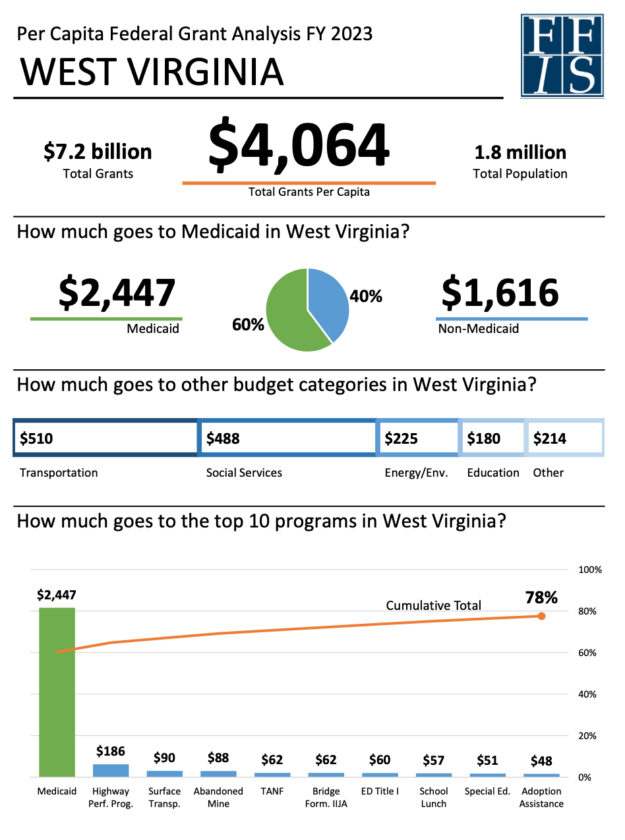
WV received $7.2B in federal grants
CHARLESTON — State and congressional leaders in West Virginia were monitoring a temporary federal freeze in grants and aid that could have had short-term and lasting effects on the state general revenue budget.
President Donald Trump’s budget office on Wednesday afternoon rescinded a memo freezing spending on federal grants.
The two-page memo released Monday night ordered all federal agencies to freeze financial assistance similar to an executive order issued last week putting a temporary pause on disbursements from the Infrastructure Investment and Jobs Act and the Inflation Reduction Act.
The freeze was supposed to go into effect Tuesday at 5 p.m. but the Associated Press reported that U.S. District Judge Loren L. AliKhan issued an administrative stay, pausing the federal freeze until next Monday, Feb. 3.
According to the memo signed by OMB Acting Director Matthew Vaeth, the freeze includes all federal financial assistance but excludes Social Security, Medicare, or other direct assistance to individuals. However, the Washington Post reported Tuesday that Medicaid, certain school funding, and housing funds all faced interruptions. White House officials denied that these issues were connected to the freeze.
Federal agencies are to review all financial assistance to ensure those programs are not funding diversity, equity and inclusion (DEI) initiatives, former President Joe Biden’s environmental programs, transgenderism, or other “social engineering” policies.
“Financial assistance should be dedicated to advancing Administration priorities, focusing taxpayer dollars to advance a stronger and safer America, eliminating the financial burden of inflation for citizens, unleashing American energy and manufacturing, ending ‘wokeness’ and the weaponization of government, and Making America Healthy Again,” Vaeth wrote.
It was unclear Tuesday how this temporary freeze would affect West Virginia. When asked about the issue, Gov. Patrick Morrisey said his administration was still reviewing the order.
“What we’re going to do is we’re going to try to unpack that and talk with the Trump administration about that,” Morrisey said. “We’re going to have the chance to have my team and I look through that, and then we’ll come back and answer those questions.”
West Virginia’s general revenue budget is already running close to estimates, with a modest $80 million surplus project by the time fiscal year 2025 ends on June 30. But Morrisey announced nearly two weeks ago that his budget people are projecting a $400 million hole in the general revenue budget for fiscal year 2026 beginning on July 1 as of his first day in office on Jan. 13. Morrisey attributed the $400 million budget hole to the state’s reliance on one-time federal monies, such as COVID-era spending.
“Let’s be clear, the last number of years, a lot of the one-shot revenue came from the federal government,” Morrisey said. “The federal government effectively transferred a massive amount of money. You get used to that money. Well, those days are coming to an end as we know.”
According to a Fall 2024 report by the Pew Charitable Trusts, the percentage of West Virginia revenue from federal funds in fiscal year 2022 was 45.1%, up from 41.9% in fiscal year 2021 and below the 50-state average in 2022 of 36.4%. West Virginia ranked eighth in the nation for percentage of state revenue from federal funds only behind neighboring Kentucky.
According to Federal Funds Information for States, supported by the National Governors Association and the National Conference of State Legislatures, West Virginia received a total of $7.2 billion in federal grants in fiscal year 2023. Of that, 40% was for non-Medicaid programs, or $1,616 total grants per capita.
For non-Medicaid federal grants, West Virginia receives most of its grant dollars for the highway performance program, followed by surface transportation funding, abandoned mines, and Temporary Assistance for Needy Families.
U.S. Sen. Shelley Moore Capito, R-W.Va., is the fourth ranked member of Senate Republican leadership, chairwoman of the Senate Environment and Public Works Committee, and a member of the Senate Appropriations Committee. Her office is monitoring the federal assistance freeze.
“At this point, Senator Capito and her staff are trying to fully understand the scope and process regarding the memo put out by OMB regarding freezing of federal funds,” a spokesperson for Capito said Tuesday afternoon. “We have heard from West Virginians who are concerned about this, and Senator Capito shares that concern, given she has advocated and been responsible for securing many of these funds.”
Speaking Tuesday afternoon on NBC’s Meet The Press Now, U.S. Sen. Jim Justice, R-W.Va., urged the public to be patient with the Trump administration as it reviewed federal spending.
“At the end of the day though, he’s got to freeze everything in order to get his arms around it,” Justice said. “Just give him a little time. It’s a good man, a really good man. And we’re going to have to reset America. If we don’t reset America, look where we’re going.”
U.S. Rep. Carol Miller, R-W.Va., is a member of the House Ways and Means Committee. Her office continued to stress Tuesday that the temporary freeze does not affect direct payments to West Virginians, but would provide updates to constituents when more information is released.
“President Trump and the Republican Congress are working to be excellent stewards of every single tax dollar,” a spokesperson for Miller said Tuesday. “This temporary pause is not for people who are receiving individual assistance, but for agencies who have been wasting federal money on programs that do not prioritize Americans. This pause on federal spending will also not affect Medicare, Social Security, or nutrition assistance. We will provide updates to agencies and groups as we progress.”
U.S. Rep. Riley Moore, R-W.Va, is a freshman member of the House Appropriations Committee. In a statement Tuesday evening, Moore said the temporary freeze was necessary to ensure federal spending aligned with Trump administration goals.
“The President’s temporary pause on certain grant funding is a necessary and wise action, one that will allow his Administration to confirm these tax dollars are being spent appropriately and align with his agenda,” Moore said. “I’m supportive of this temporary pause, which ensures direct assistance to Americans continues without delay, all while re-aligning spending with President Trump’s priorities.”
Local News
Upshur Commissioner receives honor

WORLD SERIES BOUND
W.Va. foster care lawsuit still alive
CHARLESTON - A federal class action lawsuit filed during the administration of former governor Jim Justice ...

Can West Virginia Follow the UAE’s Lead into a Green Future?
Local pastor facing felony charge
ELKINS — A local pastor is facing felony charges after allegedly selling vehicles to customers that were under ...