
Morrisey finishes session work with 12 vetoes, 10 bills not signed
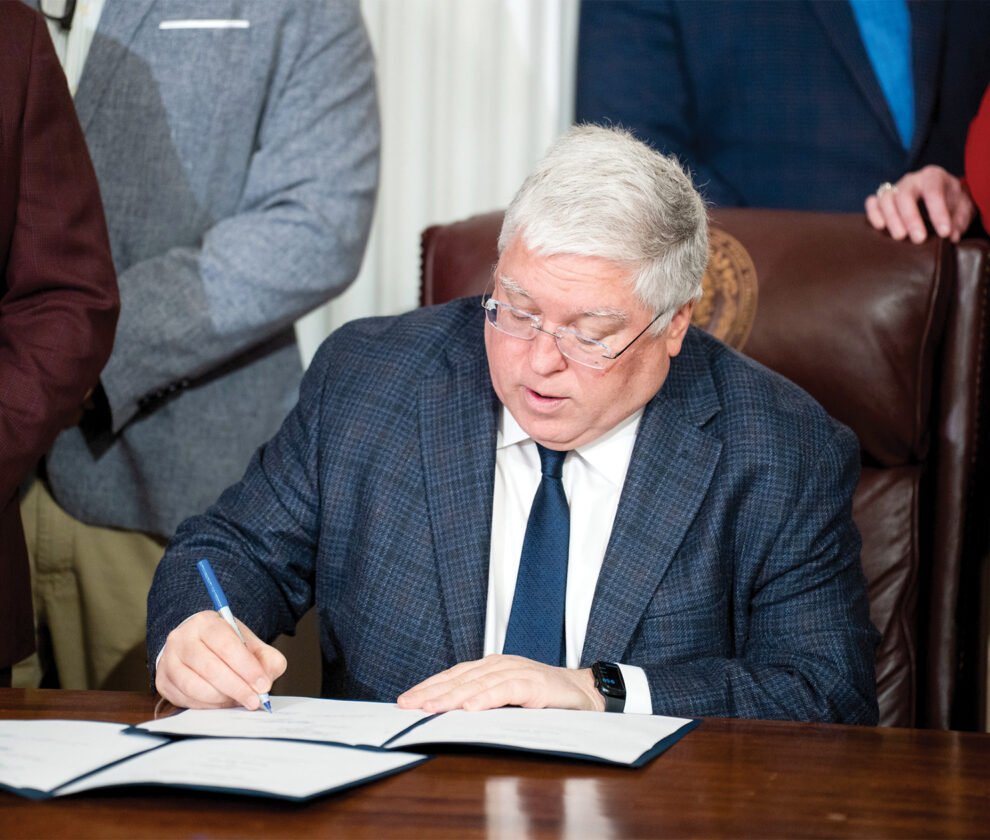
Photo provided by WV Governor’s Office Gov. Patrick Morrisey holds his first ceremonial bill signing March 2 for Senate bills 393 and 400, updating West Virginia’s tax code for tax year 2026.
CHARLESTON — With just 20 minutes to spare before a midnight deadline Wednesday, Gov. Patrick Morrisey finished signing the remaining bills from the 2026 legislative session, vetoing a dozen bills and letting several bills go into law without his signature.
In a statement released Thursday morning, Morrisey announced he had completed work on reviewing the 306 bills passed by the West Virginia Legislature over a 60-day period between Jan. 14 and March 14 during its regular session.
The state Constitution gives the governor a five-day time frame — not counting Sundays — to act on bills once they arrive to his desk during the legislative session. But once the Legislature gavels out, the governor has 15 days to sign or veto bills. This year’s 15-day deadline was midnight Wednesday. According to the Senate Clerk’s Office, the last batch of bill messages was sent to the clerk’s office at 11:40 p.m. Wednesday night.
Morrisey signed 118 of the remaining 306 bills. In his statement, Morrisey said many of the bills he signed dealt specifically with expanding the state’s workforce, improving public safety, and making state government more efficient.
“These are commonsense measures focused on opportunity, safety, and making government work better for the people of West Virginia,” Morrisey said. “We’re taking steps to grow our workforce, protect our communities, and ensure our state is prepared for the future.”
Bills signed by Morrisey include Senate Bill 402, which creates the West Virginia Micro-Credential Program, establishing a standardized system for recognizing specific professional skills and vocational training. The bill also incentivizes private sector engagement by expanding tax credits for apprenticeship programs, and introduces voluntary portable benefits plans tailored for independent contractors.
Morrisey signed two bills that were part of the House of Delegates Republican caucus’ Jobs First — Opportunity Everywhere economic development agenda. House Bill 4009, the Voluntary Portable Benefits Plan Act, will provide independent contractors with access to employee benefits like health insurance and retirement savings without the risk of the workers being legally reclassified as employees. House Bill 4005, the Workforce Development Act of 2026, expands vocational opportunities for high school students in West Virginia.
Other bills signed Wednesday and highlighted by Morrisey include: House Bill 4610, which will expand access to experimental medical treatments for certain eligible individuals; Senate Bill 1026, which increases penalties for individuals who disrupt religious services while protecting First Amendment protest rights; and House Bill 5638, clarifying the authority and responsibilities of the state chief information security officer and outline the process for cybersecurity program reviews.
“These bills reflect our commitment to preparing West Virginia for the challenges ahead while staying focused on the needs of our people today,” Morrisey said. “Each of these bills moves West Virginia forward.”
Of the 306 bills passed by the Legislature, Morrisey vetoed 12 bills, citing either technical flaws with the legislation, constitutional conflicts, fiscal concerns, or other issues. Morrisey vetoed one of the House GOP’s Jobs First bills — House Bill 4002 — which would have created the West Virginia Collaboratory, a research initiative based at Marshall University that would facilitate scientific research and data sharing across topics like economic development, workforce training and natural resource management.
According to Morrisey’s veto letter, he said HB 4002 would have violated the state constitutional separation of powers by allowing the house speaker and senate president to make appointments of non-legislative members to the board that would have overseen the West Virginia Collaboratory.
“The problem is the members of the Legislature who are charged with passing laws also can’t be responsible for enforcing them,” Morrisey said. “The Constitution requires ‘separate and distinct’ legislative, executive, and judicial branches, and prohibits each branch from ‘exercise[ing] the powers belonging to’ the others … And the Speaker and Senate President cannot appoint public officers.”
Several of the bills Morrisey vetoed dealt with child welfare and foster care. Senate Bill 744 would have moved the Critical Incident Review Team — charged with investigating fatalities and near fatalities of children in the child welfare system — from the Department of Human Services (DoHS) to the Office of Inspector General, with the Foster Care Ombudsman serving as the group’s chairperson. House Bill 2880 created the Critical Incident Review Team last year.
“Those changes are unwise,” Morrisey said. “Restructuring a program like this so soon after its initial implementation should always be done with caution because there will necessarily be so few data points on the current structure’s effectiveness, performance, and outcomes. And here, the changes will hinder some of the program’s best features.”
House Bill 4393 would have required DoHS to develop a statewide prevention plan to provide prevention services to children under the age of 18 and their families, including foster and kinship parents. Services listed in the bill include trauma-informed care, services aimed at at-risk children in the child welfare system, pregnant youth, post-adoption children, and children aging out of the foster care system.
Local News
Leonhardt to highlight Lincoln Day
EMS Budget Issue
Morrisey finishes session work with 12 vetoes, 10 bills not signed
EHS Theatre to offer Shakespeare
ELKINS — The Elkins High School Theatre will premiere its production of William Shakespeare’s “Twelfth ...
Felony charge dismissed by magistrate
Inaugural Band Festival set in Upshur
BUCKHANNON — A brand-new event will take place in Upshur County in May that will bring bands from around West ...