
Taking Flight
Red-tailed hawk released back into wild
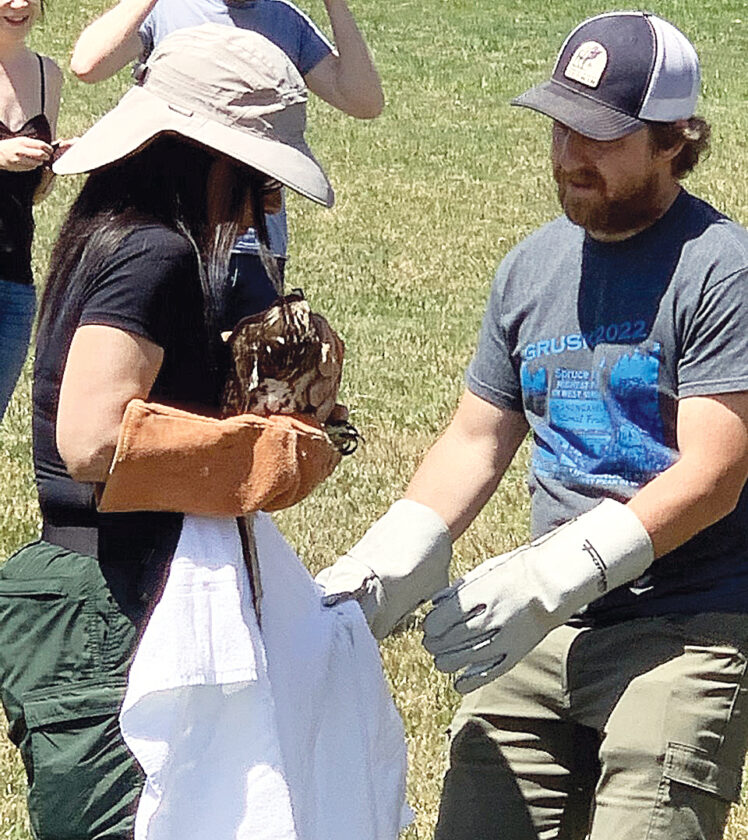
Jo Santiago and Dylan Lewis prepare to release a recently rehabilitated red-tailed hawk.
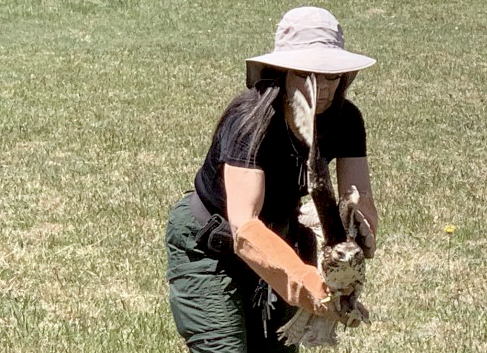
Jo Santiago releases a red-tailed hawk after it was rehabilitated after being struck by a car.
Jo Santiago and Dylan Lewis prepare to release a recently rehabilitated red-tailed hawk.
Jo Santiago releases a red-tailed hawk after it was rehabilitated after being struck by a car.
Trending
ELKINS -- After being treated at the Avian Conservation Center of Appalachia in Morgantown for close to a month, a male red-tailed hawk was returned to Randolph County and released back into the wild on Thursday.
Jo Santiago, a raptor specialist and rescue volunteer, who has saved countless birds from demise in the area, conducted the release next to Elliott Ridge Road on Chenoweth Creek.
Santiago was joined at the release by a host of spectators which included Dylan Lewis and Keri Lewis, trained birds of prey rescuers, and Jeff Hedrick, who was a big part of the bird's survival.
Back on the morning of March 13, Hedrick was driving on the Chenoweth Creek Road when he saw the hawk standing in the middle of the road. Certain the hawk would fly away when he got closer, he proceeded toward the bird. The hawk refused to fly away and because of oncoming traffic it was struck by Hedrick's SUV.
Being an employee with Randolph County 911, Hedrick has had previous encounters with Santiago as both work together when birds are discovered injured in the area.
"Randolph 911 has been helping me rescue birds for years now," said Santiago. "So Jeff knew exactly what to do."
After checking on the hawk, Hedrick immediately called Santiago, a first responder for injured or ill birds of prey. She met Hedrick at the scene and took the bird to her facility for initial emergency care. The hawk was then transferred to the Cheat Lake Animal Hospital in Morgantown the next morning before being sent to the ACCA to be under the care of Dr. Jesse Fallon.
Fallon found no injuries on the hawk from the collision, but did discover there was oil on the bird's feathers, which would make survival in the wild impossible for it.
"They don't know how the bird got oil on it," said Santiago. "It wasn't gasoline and it wasn't motor oil. But that oil was preventing the bird from being able to survive in the wild. It couldn't fly high and would have affected its hunting."
The ACCA washed the bird with Dawn dish detergent several times over the course of a month until all the oil was removed from its feathers.
"If you can imagine, the hawk wasn't too fond of someone giving him a bath," said Santiago. "But they had to give him several baths to gradually get the oil off of him."
Once released, the hawk sailed off effortlessly across a field before landing in a tree. The raptor and many others have been successfully rescued because of the compassion and concern of Randolph County 911 over the course of many years.
"Most people don't realize that rescuing birds is as much about helping people as it is about helping birds," said Santiago. "But Randolph County 911 knows this, as does the Elkins Fire Department, the Elkins City Police, the Randolph County Sheriff's Office and the State Police. I'm deeply grateful to all those first responders who help the birds in need."
Santiago, who is retired from the U.S. Forest Service, owns and operates Flying Higher LLC., which is a raptor education business where Santiago gives presentations to the public.
If you find an injured or ill raptor, please call the ACCA at 304-906-5438 for help or the West Virginia Division of Natural Resources.