Former Special Olympics director sentenced for embezzlement
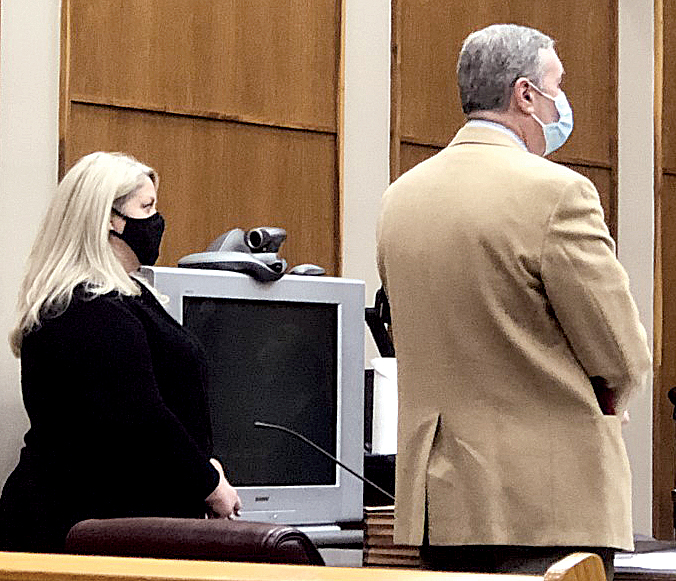
The Inter-Mountain photo by Amanda Hayes Charliena Gilmore appeared in Upshur County Circuit Court for sentencing Thursday morning with her attorney, James Hawkins.
The Inter-Mountain photo by Amanda Hayes
Charliena Gilmore appeared in Upshur County Circuit Court for sentencing Thursday morning with her attorney, James Hawkins.
BUCKHANNON — The former director of Upshur County Special Olympics will spend a year on home confinement and must write a letter of apology to the organization.
Charliena Jane Helmick Gilmore, 45, of Buckhannon, previously pled guilty to one count of embezzlement on Nov. 12, 2020, admitting to embezzling just over $16,000 from December 2015 to February 2019.
Restitution has already been paid back to the organization, a fact that Gilmore’s attorney pointed out as he first asked the court to consider deferred adjudication. Under deferred adjudication as defined in West Virginia Code 61-11-22a, the court could have deferred acceptance of Gilmore’s guilty plea for up to three years.
If Gilmore had complied with the terms and conditions imposed by the court, she would have then been able to withdraw her guilty plea and have the matter dismissed by the court or plead to a lesser offense. Hawkins argued that the most compelling factor for deferred adjudication is that restitution had already been paid back.
Gilmore gave a full confession, provided documentation and didn’t try to diminish or mitigate or beg of any part of the situation, according to Hawkins.
“That was done very early on in the case,” he said. “It was a situation where Mrs. Gilmore has taken responsibility from the get-go in the case.”
The attorney noted that prior to law enforcement’s involvement, an agreement between the parties had been reached in which Gilmore would make full payment but she had defaulted on one payment and UCSO took the case to the authorities.
“In the interim, [Gilmore] had made arrangements with her parents to secure the funds,” Hawkins said. “She took that initiative. I think that speaks volumes not only in favor of the deferred adjudication, but in the healing process therein.”
Hawkins described Gilmore as being active in the community and donating her time to make the community better.
“There have been several letters offered in support of her — not only from family members but from members of where she has served on other boards,” he said. “They speak very highly of her and offer opinions that are voluminous that this is out of character for her.”
Hawkins said that there were circumstances that led to desperation for Gilmore and different factors went into her decision to embezzle the money.
“Deferred adjudication for her will accomplish several goals, keep her under supervision and restrict some of her movements,” he said. “I’m confident and satisfied that she is a very low risk to offend in any way and to violate any terms and conditions of deferred adjudication,” he said. “I don’t see any useful purpose in saddling her with a felony conviction at this point in time. I think she is low risk to commit any further offenses. I think she is, in fact, an excellent candidate for this.”
Hawkins acknowledged the seriousness of the offense.
“There are a lot of people in this organization who felt betrayed certainly and felt their trust was violated and rightfully so,” he said. “The efforts she has made since that time demonstrate remorse.”
Prosecuting Attorney Bryan Hinkle told the court that the state objected to deferred adjudication. Twenty-sixth Judicial Circuit Judge Jake Reger denied the motion for deferred adjudication and said he did not feel the case was appropriate for that.
“She had violated public trust and trust in Special Olympics by stealing from them,” he said. “I don’t want people to think they can go out and steal money from Special Olympics and get deferred adjudication for it.”
Hawkins then asked the court to consider alternative sentencing, noting Gilmore’s lack of significant criminal history although there were some worthless check issues. Gilmore also has education and employment background and no issues with substance abuse and has good family support.
“When you ask yourself the ultimate question, what is the useful purpose of incarceration, I would suggest to the court there is none,” he said. “I think you are dealing with a person here who has been humiliated, punished, taken responsibility, and I see in this case no useful purpose of incarcerating her.”
Gilmore told the court that the past year had been very hard, but she wanted to apologize to the
organization.
“Not only did I hurt them, I hurt the athletes, I hurt the parents and I hurt the volunteers,” she said. “Part of my bond was I could have no contact with any of these people and I could not apologize. I never should have done it. It was the worst part of my life. I took an organization I had been part of for over 20 years and took advantage of them.”
“I just hope what I have done, won’t hinder what they have been trying to do,” she said. “They run solely on those contributions. I still some days don’t know why I did it. I was in a desperate situation.”
The prosecuting attorney called the embezzlement “shocking and appalling” and asked for the sentence of one to 10 years under the statute.
“If Gilmore was in such dire straits and needed access to money, why didn’t she make those arrangements initially to get the money she needed rather than steal it?” Hinkle asked. Reger said that when people donate to organizations they want to make sure money is used in the right way.
“It wasn’t here because you stole it and that is a problem for the court,” he said. “It’s stealing money from Special Olympics which is pretty hard to stomach.”
But Reger noted that Gilmore had a good work history and was a college graduate and that makes a difference to the court. Reger sentenced Gilmore to an indeterminate sentence of one to 10 years for the felony, but said he would grant the alternative sentence on home confinement for one to 10 years.
“You get finished with your one year of home confinement and you will petition the court to be released from home confinement and to be put on parole,” he said. “It’s a close case for me on whether you should go to the penitentiary or not. In some ways, this is more egregious because it is Special Olympics.”
Reger also imposed 100 hours of community service to be completed within one year and a letter of apology for Special Olympics.
Local News
Randolph BOE may seek help with superintendent search
ELKINS - The Randolph County Board of Education will vote at its next meeting on whether or not to have the West ...
Morrisey announced $3.3 million to aid Weirton
Community Calendar
EDITOR’S NOTE: The Community Calendar is reserved for nonprofit, civic organizations. Unless otherwise noted, ...

Morrisey: Tax relief will bring economic growth

Davis Medical plans Critical Access Hospital transition