$1.9M water loan awarded for Philippi
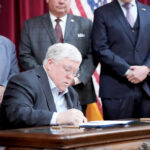
CHARLESTON — The City of Philippi will receive an almost $2 million West Virginia Infrastructure and Jobs Development Council loan for its Little Laurel Run reservoir project, Gov. Patrick Morrissey announced.
During a press conference, Morrisey said more than $15.4 million in grant awards would be given to projects across the state for water and sewer upgrades, as well as conservation efforts. Among those grants, a total of $12,643,588 will be going to water and sewer infrastructure projects in 13 counties.
“As my administration continues our work to make West Virginia more competitive with our neighboring states, these critical upgrades to water and sewer infrastructure are moving the needle,” Morrisey said during the press conference. “Clean water and functional infrastructure lift up the standard of living and propel economic growth in our communities.”
Morrisey announced that the City of Philippi was approved for “an additional low interest IJDC loan” totaling $1,928,000 for the city’s project in the Little Laurel Run area.
The project will construct a reservoir that will provide a 30-day raw water supply. Once completed, the system improvement is expected to affect 1,515 customers in the area.
“These funds, along with previously approved IJDC low interest loan, IJDC grant, Water Development Authority Economic Enhancement Grant Fund grant, Appalachian Regional Commission grant and Barbour County Commission grant, provide the $19,158,000 needed for this project,” a press release from Morrisey’s office stated.
The Century Volga PSD in Barbour County will also be receiving grant funding for water and sewer infrastructure projects.
The PSD will receive $25,000 to “study high metal content in sludge at the wastewater treatment plant, determine potential alternatives for a solution and provide estimates for the construction work,” in Century, Morrisey announced. The funds, combined with a grant from the West Virginia Legislature, cover the total project cost of $50,000.
During the press conference, Morrisey also announced the grant recipients for the 2026 Stream Partners Program.
In Upshur County, the Buckhannon River Watershed Association will receive $5,000 from the program. The $5,000 will go towards the association’s efforts to “improve and protect” the Buckhannon River and Bull Run sub-watershed through education, planning and community engagement.
The Friends of Blackwater in Tucker County will be receiving $5,000 from the program. The Friends of Blackwater group funds restoration and stewardship activities along the North Fork of the Blackwater River, including habitat work, trail and stream monitoring and education.
The Save the Tygart Watershed Association will also be receiving $5,000 efforts to improve the Tygart Valley River Watershed through cleanups, monitoring, restoration projects, and youth education.
On Dec. 12, Morrisey also announced $2,824,962 in grants from the West Virginia Department of Environmental Protection for water quality improvement efforts, watershed restoration and stream stewardship.
“We want clean water, and we want to make sure our lands are left in better condition than when we inherited them,” Morrisey said during the press conference. “We are always looking to leave the next generation in a better place than where we are today.”
Among the 2025 Chesapeake Bay Program Grant recipients is the West Virginia Department of Agriculture, which will receive $343,979. The money will go towards funding Nutrient Management Specialists who “prepare nutrient management plans, process soil samples and help producers adopt BMPs. The funds will also be used as well in supporting tracking and reporting of agricultural BMPs, both cost-share and voluntary, installed across the region.”
Another grant recipient is the West Virginia Division of Forestry, which will receive $70,000. The funding will help support foresters who assist private landowners in preparing forest management plans, improving timber harvest practices and adopting forestry BMPs “that protect water quality and reduce sedimentation.”
Local News
Officials lay out case for appeal of religious vaccine exemption ruling

Repairing Service Lines
County OKs a $10.9M 2027 budget
ELKINS — The Randolph County Commission has approved a $10.9 million general budget for the 2027 fiscal ...
Elkins Council votes on alley parking
ELKINS — Elkins City Council has approved the final reading of an ordinance that clarifies within City Code ...

Randolph-Tucker Master Gardeners kick off spring events