Jobs First: Most of WV GOP House agenda crosses finish line
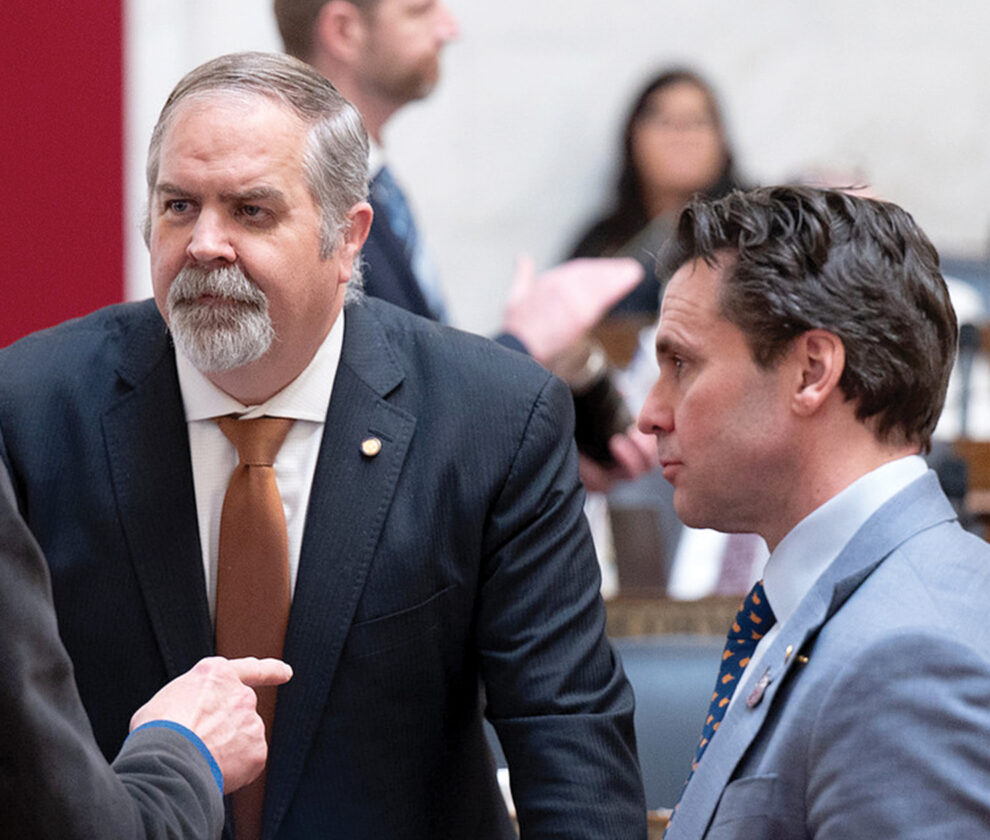
Photo Courtesy/WV Legislative Photography House Finance Committee Vice Chairman Clay Riley, center, helped shepherd much of the House Republican caucus’ Jobs First agenda through the legislative session.
CHARLESTON — In December, members of the Republican supermajority in the West Virginia House of Delegates unveiled their legislative agenda focused growing the state’s economy and producing jobs. Nearly four months later, most of that agenda is awaiting Gov. Patrick Morrisey’s signature.
House Speaker Roger Hanshaw, R-Clay, first promoted the House Republican caucus’ Jobs First – Opportunity Everywhere economic development package of bills during December legislative interim meetings at the State Capitol Building.
“Putting jobs first works everywhere; whatever the issue, it’s most effectively solved in an environment that has a robust jobs economy, that has a robust jobs program that puts people to work in good-paying jobs and gives them the capacity to make decisions for themselves and their families,” Hanshaw said then. “West Virginians said they wanted to put economic growth in job creation at the center of public policy debate here in West Virginia. And that still shapes our policy landscape today.”
Flash forward to midnight on March 14, the end of the 2026 legislative session, and 10 out of 16 Jobs First bills completed the legislative process, with one already signed by Morrisey. House Finance Committee Vice Chairman Clay Riley, one of the shepherds of the Jobs First agenda this past session, said he was proud of the House’s work and appreciated the support of the state Senate.
“Our caucus really dove in with our members and said, where do you want our focus to be as we go into the session?,” said Riley, R-Harrison. “And while we always do it, I felt like we were a little bit more laser focused.”
Riley said the Jobs First agenda came about from members of the House Republican caucus returning home after the 2025 legislative session and during legislative interim meetings, asking for feedback from constituents on what they would like to see in an economic development package.
“We really worked throughout the offseason,” he said. “Our entire caucus drove these issues and began working on pieces of legislation that would really fill in the agenda.”
Brian Dayton, the vice president for policy and advocacy at the West Virginia Chamber of Commerce, said the entire 10-bill package would send positive messages to those wishing to locate a business in West Virginia or to long-time in-state businesses wishing to expand.
“I would say there’s a lot of really good work that was done,” Dayton said. “First of all, shifting the focus to jobs and the economy just sends a really good message, both internally and externally.
“Businesses looking to expand, they’re happy to see that you have a legislative body focusing on jobs and economic development,” he continued. “That gives them more confidence to move into an area. I think just from a very macro level, that was a good move to do coming out of the House.”
The first bill the House passed was House Bill 4007, which would increase the annual financial limits for projects funded through the Industrial Access Road Fund, effectively doubling the available unmatched and matched funding for individual counties.
The bill mandates that the Division of Highways provide a formal response to project requests within 90 days and clarifies that these funds are only for economic development sites, such as manufacturing hubs and airports.
HB 4007 passed the House on Jan. 23, just 10 days after the start of the session, in a 90-4 vote. The Senate took up the bill on March 14, one day before the end of the session, and passed it unanimously.
“We heard from a business last fall that was able to significantly increase their output, their productivity, hire more jobs, just because they needed a road widened to their business,” Dayton said. “Once they were able to get that road widened, then they were able to really go ahead and ship more goods and have more product coming in.
“It’s a bill like that that on the surface, you’re going, OK, that seems kind of minor, but it can make all the difference in the world to a business and their ability to grow.”
The first Jobs First bill to complete the legislative process and be signed into law by Gov. Morrisey was Senate Bill 1, a collaboration between the House and the Senate.
SB 1 establishes the West Virginia First Small Business Growth Program, under which specialized growth funds collect capital from investors to provide financing to eligible small businesses that maintain the majority of their operations and workforce within the state. In exchange for these investments, growth investors receive non-refundable tax credits that can be applied against their state tax liabilities starting in 2029.
SB 1 was a combination of the provisions in House Bill 4003 and a legislative priority of Senate President Randy Smith, R-Preston.
“We applaud Governor Patrick Morrisey for putting West Virginia small businesses front and center…,” Smith and Hanshaw said in a joint statement on Feb. 24. “This bill helps give those small businesses that little boost they need by drawing in private investments to let them expand their efforts when they’re ready, not just when other traditional sources of lending are ready. Small businesses are the backbone of this great state, and we’re proud to be a part of helping to strengthen them statewide.”
Other bills awaiting the governor’s signature include House Bill 4002, that would create the West Virginia Collaboratory, a research initiative based at Marshall University that would facilitate scientific research and data sharing across topics like economic development, workforce training and natural resource management.
Local News
Tygarts Valley Conservation District hosting hay class
PHILIPPI - The Tygarts Valley Conservation District Office will host a hay techniques, testing, and discussion ...
Randolph BOE to vote on Proximity Learning
ELKINS - The Randolph County Board of Education will vote on whether or not to make Proximity Learning available to ...

Special Ceremony
House of Delegates meets for informational meetings

Lawmakers briefed on new SAFE child welfare case system