Work behind the scenes led to Mountaineer victory
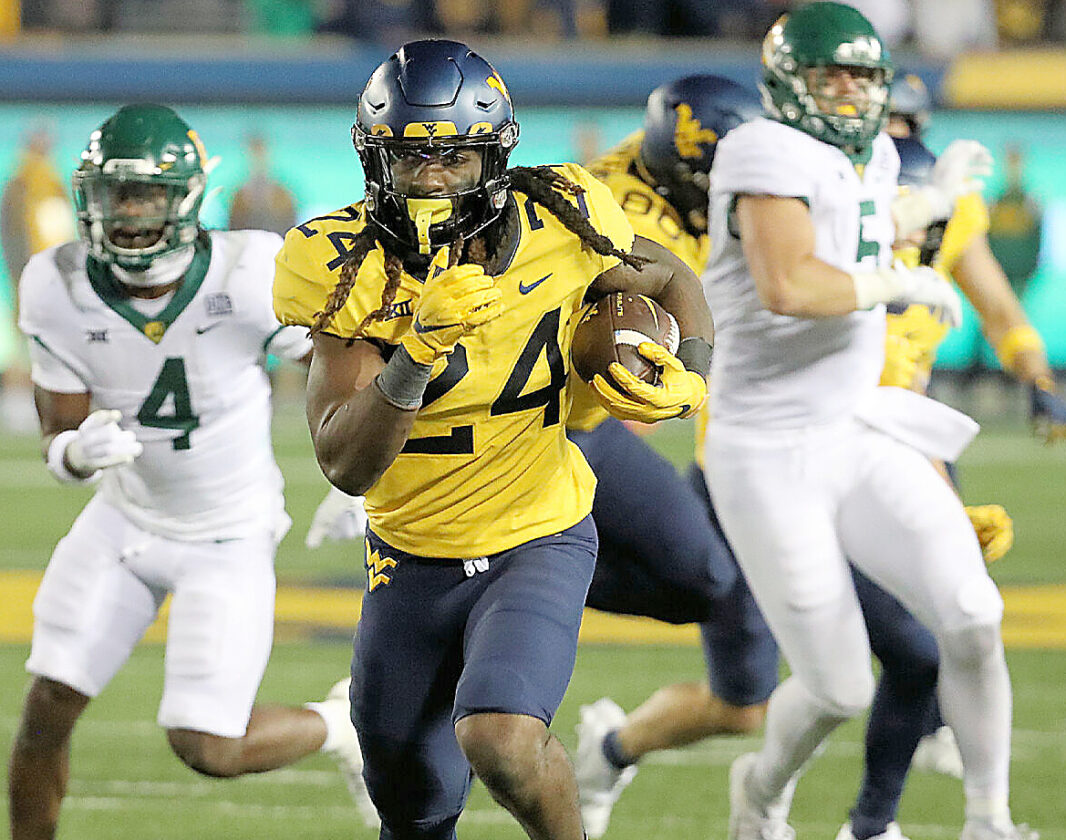
Photo courtesy of BlueGoldNews.com Tony Mathis breaks free for a scoring run during WVU’s 43-40 win over Baylor Thursday night at Milan Puskar Stadium.
MORGANTOWN — It started, perhaps, all those many years ago when the late John Madden took us in with his new-fangled telestrator, explaining with unrestrained enthusiasm how this play or that play evolved.
Before long, we all felt we had become football coaches, picking out double teams, crackback blocks, slip screens and every bell and whistle a coach could put in — and some they couldn’t but did anyway.
Our vocabulary began to grow as a broadcast became more and more inside football until it reached the absurdity of today where we are talking about — and believing we know about — such things as “cover two” defenses, 12 personnel alignments, Y receivers and H backs.
Forget that the closest we ever got to playing real football was putting on a helmet to ride our bicycles, and we thought the only use for X and O was to draw a football play, not to spell extraordinary.
It has reached the point that we felt we knew what made good coaching without realizing that the intricacies of the game, while obviously important, were not what good teams were built upon.
If West Virginia’s stunning 43-40 victory over Baylor on Thursday night proved nothing else, it proved that good football teams are not built on the schematics but instead on the interpersonal relationships between coach and player, and even more importantly, between player and player.
As WVU’s coaches and players discussed how they overcame as much adversity as they faced — ranging from injured personnel to coming off a devastating loss to Texas and a disgruntled fan base — it became clear that coaching went far deeper than into knowledge of football plays, film study or analytics.
“It wasn’t right by me, but the coaches talked about straining all week,” Cox said. “I felt I could make a play, so I just jumped on the pile and seen it opening up. Thanks to Mike Lockhart for pushing the guy off, so I came away with the ball.
“The guys around me made me play better. I know when one side is struggling, the other side has to complement them and pick them up. I felt that was my time to make the play, but it wasn’t just me out there. My teammates were out there playing hard.”
Running back Tony Mathis had opened the season well but had suffered through a down period running the ball as CJ Donaldson, the freshman who came out of nowhere, became the featured running back.
Donaldson was out for this game, so the coaches went to work coaching Mathis up … not on the Xs and Os but on his approach to the game.
Tony Scott, the running back coach, explained why Mathis exploded for 163 yards and two heart-stopping touchdown runs.
“We challenged Tony to be the Tony Mathis he was toward the end of the season last year,” Scott said. “Just run downhill with no fears, tough to tackle. That’s the Tony Mathis we are accustomed to seeing.”
Conversation, instruction, trust in what they were saying … that’s what it was.
Mathis listened, absorbed what he was told, and the improvement oozed out of every pore as he played.
“The coaches told me all week that I had to be decisive, that I was a better runner when my shoulders were squared up.” he said.
And belief in his teammates.
On his first touchdown, he made a knee-buckling cut. Good running, yes, but it showed how much he believed in what the team was trying to do.
“I was just following my blockers,” Mathis said. “The hole wasn’t there, so I just followed them and it came open.”
And when it came open, he broke for the goal line, taking advantage of his wide receivers’ blocking.
“The wideouts did a phenomenal job blocking tonight. Every big run came from the wideouts blocking,” he said, rather than offering self-praise. “The wide receiver blocking makes a big difference. That’s the whole key. All the inside runs that bounce outside, that’s all from the wideouts blocking downfield.”
Then there was one of those blockers, Kaden Prather, who had his own tale to tell, a tale of how he came back after an awful opening game against Pitt where he could not catch the ball.
He could have sulked, but instead, he and Coach Neal Brown had a conversation.
“Coach Brown sat me down and talked to me about how I played. It made sense, and I just got back to the basics. My results have been different since then,” he said.
A lot different, 34 catches in the last five games, but the Pitt game had made a huge impression on him.
“That was a feeling I never want to feel again. Me and coach [Tony] Washington sat down and talked about what I needed to do so I never feel like that again,” Prather said.
That conversation was about Prather’s practice habits.
“That I had to practice faster, practice harder every day, just get out of my lazy ways,” he said.
Sometimes it is easy to be that self-critical, but Prather is impressive in his approach to the game.
“I just got better at critiquing myself instead of letting someone else doing it. I’ll catch myself doing something lazy and before Coach Washington or Brown can talk to me about it, I’ll get myself going,” he said.
Local Sports
Sissler pitches Cougars over Bulldogs
BAKER — Shayne Sissler tossed a five-inning no-hit gem to lead defending Class A state champion East Hardy to an ...
Marple twirls no-hitter for Lady Bucs
TENNERTON — Kynnedy Marple twirled a five-inning no-hitter as Buckhannon-Upshur picked up a 10-1 victory over ...

Tigers hand Polar Bears 11-8 loss

WVU’s Bray looking forward to getting back on the field after another season-ending injury

Charleston Catholic’s Ranson wins Hardman Award