
Elkins astrophysicist recognized for research on gravitational waves
Trending
ELKINS -- An Elkins resident is among 190 astrophysicists from the U.S. and Canada to receive international recognition for 15 years of research data on gravitational waves that was recently released.
Nate Garver-Daniels of Elkins and his colleagues from the North American Nanohertz Observatory for Gravitational Waves (NANOGrav) Physics Frontiers Center (PFC) are being recognized for data that focuses on how gravitational waves change the speed of rapidly rotating neutron stars, known as pulsars.
"We have been really working hard to make sure that this was a solid (thing), that we were actually seeing what we thought we saw and that everything was good," Garver-Daniels told The Inter-Mountain this week. "Waking up and having it (the study) be on NPR and being on newspapers all around the world is really cool. It's very exciting."
Working for the West Virginia University Research Corporation, Garver-Daniels is currently the Senior Systems Administrator for High Performance Computing. He previously did computer work for WVU's Department of Physics and Astronomy.
Garver-Daniels, who has a bachelor's degree in physics, has worked with NANOGrav's Cyber-Infrastructure Working Group since 2011.
The data that NANOGrav released on June 28 focuses on 15 years of observations on different pulsars in the sky. The goal was to find pulsars that rotate in a millisecond, spinning faster than a blender, and time them to collect data. These types of pulsars are very consistent and very good at keeping time, almost better than an atomic clock.
Once found, these pulsars would be timed once a month. As more and more pulsars were found and their subsequent data was collected, NANOGrav's researchers began to see shifts in the time that pulses arrived to telescopes. This was caused by gravitational waves.
Gravitational waves, first put forward by Albert Einstein in his general theory of relativity, are invisible ripples in space-time that move at the speed of light and stretch and squeeze anything in their path.
"We've taken all of this data and effectively what we've done in taking the data is created a galaxy sized instrument," said Garver-Daniels. "Each distance from the Earth to one of the pulsars is an 'arm' in this instrument.
"So, if you think about each one of those stars as tethered to us on a string, you've got all these strings in different places in the sky that are connected together, and as these really low frequency gravitational waves are moving, it squeezes and stretches space and time."
NANOGrav's researchers were looking for 200 to 300 nanosecond changes in the gravitational wave time. For comparison, if the entire Earth was stretched and compressed in a similar way, the Earth would be moved as much as the width of a virus cell.
"As you take these different pairs of pulsars, what you can do is look at them and if you said 'Okay, well, these two points in the sky are in the same place and I'm looking at them and they're getting stretched,' you see them happen at the same time," explained Garver-Daniels. "So, you can't really see a whole lot, but if you take it and you look at this one here and one over there, you can see them out of phase getting stretched and shifted. So, you can start to build up this signal that you see of the different pairs of them getting moved around in time."
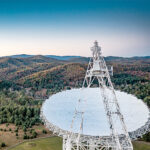
Currently, NANOGrav is regularly timing up to around 70 different pulsars. Data is collected through several different telescopes in North America, including West Virginia's Robert C. Byrd Green Bank Telescope, in Pocahontas County.
"Something that people don't know about West Virginia is that we actually have a really, really strong astronomy community here, and lots of people from all different walks of life have been involved in it – different people at the university, different people that work at Green Bank," said Garver-Daniels.
"I think that it's really cool and important for people to see that people in West Virginia are doing this kind of work. That we can do science, we can do top-end, high-level computational and astronomy work."
To learn more about NANOGrav's study, visit nanograv.org/news/15yrRelease.