
WVU student from Elkins to compete in China
Trending
MORGANTOWN – An Elkins native will compete on the U.S. National Team at the fifth International Soil Judging Contest in China in June.
After placing eighth individually during the 2026 National Collegiate Soils Contest in Raleigh, North Carolina, in March, Emma Quint, 19, has earned a spot on the U.S. National Team. The contest will take place from June 2-6 in Nanjing, China, with the 23rd World Congress of Soil Science taking place immediately after from June 7-12.
A sophomore studying environmental, soil and water sciences through the West Virginia University Davis College of Agriculture and Natural Resources, Emma Quint is the daughter of Heath and Erin Quint, and the granddaughter of Sharon McQuain, and Larry and Debbie Cone, all of Elkins.
When asked what got her into environmental, soil and water sciences, Quint said she’s always liked being outside in nature. After transferring from Berea College in Kentucky to WVU this school year, a friend of Quint’s invited her to come try soil judging.
“I fell in love with it and I changed my major to soil science,” Quint told The Inter-Mountain. “I’ve always liked it, but she pushed me.”
As Quint explained, during soil judging a 150 centimeter pit is dug out of the ground, and experts take samples from each layer of the soil. During a process called texturing, experts try to determine how much sand, clay and silt is in the soil. Those testing the soil will also perform calculations to decide what the soil might be suitable for.
“Is it good for building? Is it good for agricultural stuff?” Quint said. “Can you put a sewage tank in there? I know that sounds kind of gross, but that is one of the biggest things we calculate for.”
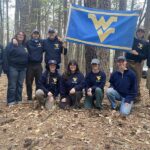
In March, Quint and nine other WVU Davis College students competed in the 64th annual National Collegiate Soils Contest, which was held in Raleigh. The WVU Soils Team was among 270 students from 28 schools across the country examining diverse soils of the region from 300 to 3 million years old, according to the WVU Davis College.
Quint explained that the team arrived in Raleigh a few days before the competition began to practice with the area’s soil. During each day before the contest, the team would visit four or five different soil pits to practice filling out the score sheets in its entirety for each pit. Quint said the practices helped the team get used to what they would see during the day of the competition. She added that the team learned about soil that is unique to coastal states like North Carolina.
“On the day of the competition, we woke up super early, and they drove us to the middle of nowhere and told us to get in the pits,” Quint said. “The competition has two parts. One part is group judging where our entire team works together to fill out one score card, and usually that’s more precise on those since you have so many people working together. We also have individual judging, which is the top four students out of the whole team make up a smaller team, and they go out and fill out an entire scorecard by themselves. So we had group judging on the first day of competition and individual judging on the second (day).”
At the end of the competition, the contest judges added together all of the correct items found in the soil that are listed on the scorecards from the group soil judging and all of the individual soil judging. Quint explained that each item is worth so many points, but there isn’t a set amount of points for each pit that was judged. Quint placed eighth individually in the competition, and the WVU Soil team all together took fifth place in the group judging portion. This added up to a ninth-place finish overall for the team, according to the WVU Davis College.
“It felt really, really amazing (to do so well),” Quint said. “A lot of us on the team are first year (soil) judgers. So it just felt so amazing to be able to come together and do so well for so many of us, it being our first time.”
With the eighth-place individual finish under her belt, Quint was able to earn a spot on the U.S. National Team for the annual international judging competition. Quint said earning that spot felt “even better” as she was not expecting it. Before the Raleigh competition, Quint said she had been making jokes about going to China. Now she says, “I guess if you speak it into existence, it happens.”
“It’s a really amazing opportunity for someone like me,” Quint said. “I mean, I’m from Elkins… where maybe not everyone is as fortunate financially. So getting to do this and explore, not just a new country based on stuff I’m interested in, like my major, but it’s really amazing to be given to explore there culturally. This isn’t something I think very many people get to do, especially for almost free.”
The international competition will be different from what Quint experienced in Raleigh. As Quint explained, the teams will also have several days before to practice, but she has to learn a new way to judge and describe soil. The United Stated uses a method known as Soil Taxonomy, while other parts of the world use the World Reference Base, which is the international standard endorsed by the International Union of Soil Sciences.
“So during the competition, I will have spots where I fill out like I did in Raleigh, but there will be added boxes and points to fill out for the new way,” Quint said. “So it is a bit of a challenge. The U.S. Team and I, we have been meeting on Tuesdays for an hour each week to discuss and get more familiar with the way the competition is going to work.”
The United States will have eight students and four coaches attending the soil judging competition from all across the country, Quint explained. The group will be divided into two teams of four students and two coaches for the competition day. Quint has also designed the artwork that will be on the back of the competition t-shirts that the U.S. Team will wear in Nanjing.
Quint is one of two individuals from WVU who will be attending the competition. The WVU Soils Team assistant coach, Damon LeMaster, will be joining her in China as one of the head coaches for the U.S. Team. LeMaster, who is also a West Virginia native, is currently studying at WVU to get his PhD.
“I think it is important to let people know that (West Virginia) natives are capable of doing amazing things,” Quint said in a written statement to The Inter-Mountain. “(LeMasters) has been such an amazing teacher and mentor, I truly don’t think I would’ve made it to China without him or the rest of my team… I hope that this lets all the nerdy science kids in Elkins know that they can do great things too!”
Quint said she “absolutely” plans to try to go to the international competition next year. She praised her teammates on the WVU Soils Team, saying she’s found “a nice little community of people.”
“I honestly didn’t think I’d be any good at it or make any friends, but every single person on that team is one of my best friends now,” Quint told The Inter-Mountain. “I hope I can bring knowledge back from the competition in China to them, so they can not just learn more, but be better soil judgers afterwards. I’m just so excited.”
When asked if there was anything she wanted the people of Elkins to know about the importance of soil judging, Quint said it’s good to encourage the pursuit of knowledge of any kind.
“Especially environmental knowledge,” Quint said. “Soil is the foundation for all forms of life, so we’ve got to learn to take care of that. Especially in West Virginia, where things maybe aren’t going well all the time. We should learn to take care of our soil here.”