
Farther Than Ever
Behind the scenes of Artemis II with three WVU alumni
Trending
MORGANTOWN – The journey of the Artemis II astronauts through deep space has captured the hearts and imaginations of millions of people, not least of whom are the engineers and technicians who designed, tested and built the Space Launch System rocket and Orion crew capsule.
Three West Virginia University alumni who work on these technologies have been living and breathing the Artemis II mission -- but they say that following the crew's journey has been as spellbinding for them as it is for other Earthlings.
Below, Taylor Hose, Eleanor Kearney and Kristin Smaltz share their stories of what it's like to build a spaceship, launch a crewed mission and inspire a planet.
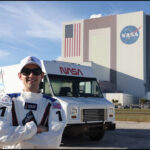
TAYLOR HOSE: IN THE MOMENT
Flight vehicle processing technician supporting Amentum at Kennedy Space Center
BS, Multidisciplinary Studies, 2018
Martinsburg, West Virginia
"I was in charge of the Artemis II closeout crew on launch day. My team and I were in the white room with the astronauts, we got them into the vehicle, strapped them in and closed the hatches behind them.
"When I think about being part of that, it's surreal, and I'm not entirely sure that it has sunk in yet. I can honestly say I wasn't stressed -- my team has trained so much over the past few years, I was completely confident in everyone's abilities to do their jobs perfectly.
"Houston has an Orion mock-up, and we do a lot of emergency egress training there. For example, we prepare for how we're going to get the crew out of the vehicle if there's an emergency while we're on the pad.
"Our team got our anxiety out during the first and second wet dress rehearsals, which are prelaunch tests to fuel the rocket. Once we got to launch day, I knew we were good to go. Everyone knew exactly what they were doing, so I was up there enjoying it, trying to live in the moment.
"When Orion did its flyby of the moon, we tuned in all day. It was so cool listening to the crew describe all the craters, and the eclipse was amazing.
"For recovery, I'm part of the shore team, so once the ship gets back to the shore with the capsule after splashdown, we'll get the capsule off the ship and get it prepped for transportation.
"One summer when I was 5 or 6, my dad and I watched a space shuttle launch on TV in our living room in Martinsburg. That same night, my family went to the fairgrounds, and I remember that they had a game with a big inflatable astronaut that I must have played 15 times.
"From then on, I knew I wanted to be an astronaut, a pilot and an aerospace engineer. In ninth grade, I started doing engineering research about the effects of winglets on an airplane that I ended up taking to international science fairs in San Jose and Los Angeles. For that project, I began by building a small tabletop wind tunnel with some foam wings, but before long, a family friend had built me a 9-foot wind tunnel in the basement.
"I've always wanted to fly, and when I was at WVU, I took lessons at RSA Flight Training. My first time flying a plane myself was also my first time ever in the pilot seat -- my flight instructor had me taxi out to the runway and explained what to do, and then he said, "All right, do it." It was incredible.
"I originally started at WVU in Criminology. I switched to a double major in Political Science and Russian, then did three years of Mechanical and Aerospace Engineering before officially majoring in Multidisciplinary Studies. My engineering classes at WVU have helped me analyze specific circumstances, extrapolate data and be hands-on in my job. Having explored so many different things when I was a student allows me to look outside the box and find different solutions to problems.
"At Kennedy Space Center, my shop is the upper-stage shop, so we've been working on the crew module since spring of 2025. We get the vehicle ready to fly: fill it with the hypergolic fuels, high-pressure gases, some coolants. We install the launch support system on top of the capsule. Then we go to the vehicle assembly building and stack it on top of the rocket. We install all the payloads the crew is going to use and the seats, and a few of us are spacecraft operators, so we're certified to flip all the switches in the spacecraft to power up, power down and run tests in tandem with the firing room. A lot of the time, a typical workday for me is sitting inside the crew capsule and monitoring.
"There are many opportunities for us to expand humanity as a multi-planetary species -- so that in the case of a catastrophe, we can still thrive, and because there are so many resources in our solar system that can enhance our society.
"Humanity is born to explore. We've always, from day one, said, "What's over that mountain? What's over that ocean? What's on the moon?" And now we're making the next steps."
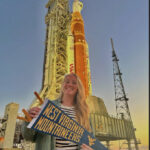
Submitted photo
WVU alum and NASA engineer Elearnor Kearnery poses with a WVU pennant in front of the Artemis II rocket at Kennedy Space Center Launch Comples 39B.
ELEANOR KEARNEY: MY MISSION
NASA main propulsion systems engineer, Kennedy Space Center
BS, Mechanical and Aerospace Engineering, 2022
Harpers Ferry, West Virginia
"Artemis II has felt like my mission. It's been my rocket. As soon as Artemis I launched in November of 2022, we started getting ready for Artemis II.
"Most of the launches that happen on the Space Coast do not have people on board. Everyone who lives around here gets used to rockets and satellites going up, but when there's a crewed mission, there's something in the air that makes it extra special. Everyone at work has the NASA broadcast livestream on at all times right now while Orion is up there. We're really rooting for these astronauts.
"This mission got real for me one day when my team and I were working on the RS-25 engines, and we noticed some people watching us from a few yards away. We realized, "Oh, that's the crew. They're the ones who get to ride this vehicle."
"On the day of launch, we watched them go out to the launch pad and take a second to stop on the mobile launch platform and stare at those engines. It was almost the same spot where I had seen them months beforehand , looking at the same engines, except this time we've got a fully fueled rocket and they're about to take the elevator up to their capsule.
"Watching them get in their seats, all ready to go -- that's when it hit me: ‘I'm launching these humans to the Moon’
"At NASA, we use these Artemis missions to incrementally increase our skills. With Artemis I, there was a capsule that went around the moon, but it had no astronauts. There were two mannequins that we called "moonikins," and those had pressure sensors so engineers could tell what loads the astronauts would be under.
"With Artemis II, we're working a similar mission, but with humans inside. The capsule goes up, does a lap around the moon, and then it comes back home safely.
"Artemis III is where things can start to get complicated. Artemis III will be sending the capsule up to low earth orbit, where they'll be able to practice docking maneuvers, and make sure the capsule can interface correctly with the Human Landing Systems.
"My love for aerospace started when my seventh-grade science class watched a video of a space shuttle launch to learn about Newton's Laws. I thought riding in one seemed like fun. I was a little bit of an adrenaline junkie in middle school, where I loved doing high-ropes courses and riding roller coasters.
"I chose WVU because it's the only university in the state that offers an aerospace engineering major and I was excited about the Mechanical and Aerospace Dual Degree Program, the award-winning student organizations like the Experimental Rocketry Club, and the Statler Ambassador Program. I was in the marching band in high school and wanted to be part of the Pride of West Virginia. I played the mellophone for the Pride for my first two years, and also played for the WVU Pep Band every basketball season.
"As I learned more about engineering, I realized that the rocket launch itself was what was thrilling to me. I stopped wanting to be an astronaut -- in part because I like my creature comforts -- and I knew I wanted to be a part of launch. There's no better place to do that than Kennedy Space Center in Florida, which is where I work now as an engineer on the Main Propulsion System of the SLS rocket -- the system that takes the propellants from the cryogenic tanks into the engines at the right times and ensures the right conditions for ignition.
"For my first summerlong internship, in 2019, I was funded by the NASA West Virginia Space Grant Consortium, and I went out to Ames Research Center, a NASA Center in Mountain View, California. Later that year, one of the branch chiefs at Kennedy Space Center saw my resume and said, "I like that she has NASA experience and knows how to communicate with people. Let's get her on board." So I took the spring 2020 semester off and came down to Florida to start as a NASA Pathways Intern, which has a direct lead to a full-time career.
"A lot of engineering school is learning the math and science in order to understand what's going on behind the hardware. But my day-to-day job is pretty minimal on math and very much involves effective communication and working on teams. Communication abilities have been critical, and I developed those being a Statler Ambassador at WVU."
KRISTIN SMALTZ: SPACE BALLET
Boeing aerospace engineer, SLS upper stages mission integration, Houston, Texas
BS, Mechanical and Aerospace Engineering, 2007
Morgantown, West Virginia
"In 2006, while I was still a WVU student, I got an internship with Boeing in Houston, and in a sense I've kept that same job ever since.
"At that time, the space shuttle was returning to flight after the Columbia accident, and my internship was with the space shuttle program. They had the interns focused on process improvements for getting the shuttle back up and running, and I got to work a launch on console.
"Then I got to come back to Boeing the very next summer as an intern again before starting there full time. All in all, I flew out the last 20 shuttle flights before the NASA space shuttle program ended, so I've gotten to work a lot of missions and even see a few launches.
"There's just nothing like seeing a launch in person. The vehicles are so large, and I got to go fairly close to the launch site. You can feel the rumble and the vibrations.
"My background, the area where I just happened to land and fell in love with, is trajectory optimization. That's getting from Earth into orbit and what it takes to get there, how to optimize that path.
"When I started with Boeing, following the tragedy with Columbia, keeping the crew safe was the priority.
"Today, again, our number one goal is making sure that they're safe and bringing them home to their families.
"Almost everything else has changed since 2006. The space shuttle was designed to go to low earth orbit and stay in low earth orbit. It was designed to take heavy payloads to destinations in low earth orbit, such as the International Space Station. Most of my missions were to build out the International Space Station. We also did a Hubble space telescope repair, and that was as high of an orbit as we went.
"Going out to the moon is a whole different ballpark, a different trajectory analysis. It takes a lot more energy to get there, so there are more engines on the core stage of the Space Launch System. There are multiple stages, including the solid rocket boosters, the core stage and the upper stage that are all part of the Space Launch System. On top of the rocket is Orion, the crew capsule, which has its own set of engines. My focus has been working on the core stage and, specifically for Artemis II, the upper stage.
"Working on Artemis II has been really exciting. I work on the rocket, so after the launch I became a spectator like everyone else, rooting on the crew to get home. That said, about three and a half hours after the initial launch, to build toward the next mission, we did a big technology demonstration of ‘proximity operations,’ where Orion and the upper stage were interacting and practicing for rendezvous and docking, so the crew could get a feel for how the stage handles and would be prepared to dock on future missions. I had a huge role in developing that procedure, which I like to call a "ballet in space," and monitoring it on launch day.
"There's so much excitement built around this mission, putting people back on the moon. I've been working on this program since before Artemis II even had a name. In 2011, when the last NASA space shuttle landed, I ported straight over to what became the Artemis mission.
"We had the Artemis I launch that was unmanned, and there wasn't a break between it and Artemis II, because we had to get ready to put people on board. Now we're staying tuned for details on what the next mission looks like and the new objectives, so we can get started on the mission design. Then we're going to spin up and get rolling onto Artemis III and beyond, and we'll keep going until we have boots on the moon.
"I'm just really happy to see everything work so well -- seeing the crew get there, keeping them safe and watching them up in space has been phenomenal. It's a very exciting time to be part of."