
Rescued Hawk Released
Bird returned to wild at fish hatchery

Trending
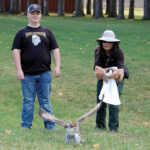
Raptor specialist Jo Santiago, right, and raptor rescue volunteer Connor Sneberger release a hawk back into the wild after it spent 11 weeks rehabbing.
BOWDEN -- After undergoing months of rehabilitation, a rescued raptor was recently released back into the wild at the Bowden Fish Hatchery.
The bird, which was an immature male red-tailed hawk, was set free last week at the same location where it was found back in August at the Fish Hatchery. The facility's manager, J.R. Wilson, came across the hawk while working and noticed it was unable to fly.
Knowing something was wrong, Wilson immediately contacted raptor specialist Jo Santiago for assistance. Santiago sent her raptor rescue volunteer, Dylan Lewis, to the location so that he could survey the situation at the hatchery and assist.
Upon his arrival, Lewis saw that the hawk could not fly, but was able to run very fast, escaping his and Wilson's grasps on several occasions until the raptor became too tired to continue running from the two.
Lewis took the hawk to Santiago, who discovered it to be severely dehydrated and starving. Knowing the bird had been on the ground for a while, Santiago gave it several rounds of electrolytes throughout the night to help stabilize the bird.
The next morning, Lewis transported the hawk to Dr. Jesse Fallon, a raptor specialist at the Avian Conservation Center of Appalachian in Morgantown. After a thorough examination, Fallon determined that the hawk was suffering from "failure to fledge," which means that after leaving the nest, he was unable to find enough food to sustain himself. Because of this, the hawk gradually became weaker and unable to care for himself.
"With failure to fledge, sometimes young birds just don't get it together," Santiago said. "They're not able to hunt well enough to get enough food. Once they start doing that it's like a downward spiral, because they become weaker and weaker. It's not an unusual thing, we come across it from time-to-time."
The red-tailed hawk remained under the care of Fallon and the ACCA staff for 11 weeks. While there he regained his appetite and became healthy and strong.
"Dr. Fallon said the hawk started eating everything in sight once we took him there," Santiago said. "They flew him 11 weeks later to test fly him and called and said he was ready to come home."
Santiago said she doesn't feel the hawk will revert back to its old ways now that it has been rehabilitated.
"I don't think he will have any problems," she said. "We watched it when we released it and the release went well. The bird had a sense of well-being and knew that it was back home. It did all of the really good behaviors and if it has any problems the guys at the Fish Hatchery will notice and let us know if there are any problems. He's a truly stunning hawk and I think he is going to be fine."
Those who come across a bird in need of help are asked to contact the ACCA hotline at 304-906-5438,“ or the West Virginia Department of Natural Resources.