
Sabins took an interesting path to Morgantown
Trending
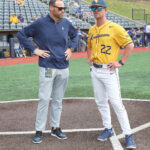
MORGANTOWN -- Steve Sabins is wrapping up a decade in West Virginia this season but his journey from accepting a job as an assistant to coach Randy Mazey despite Mazey trying to talk him out of accepting it at the time has been a wild and wonderful ride.
It took a gutsy move by Sabins to pass up an offer to become head coach at Cincinnati after the 2023 season to accept a promise that he'd become Mazey's replacement for the 2025 season, a sign of loyalty that has paid off with a record-smashing first season and the program's third consecutive NCAA trip.
Mazey had bounced around the collegiate coaching map from 1990, when his playing career ended, until 2013 when he left TCU as its highly regarded pitching coach to take over a Mountaineer program yearning to makes its way into becoming a national power in the Big 12. It had a new stadium and Mazey was in the market for an assistant coach, when Sabins applied for the job out of nowhere.
He didn't know much about the state or the WVU program at the time, having been a volunteer assistant at Oklahoma State, but he had the itch to start climbing the ladder of success and was willing to take a full-time assistant's job anywhere.
And we do mean anywhere!
"He tried to scare the hell out of me, but I told him I'd take a Big 12 job if I was in Iraq," he said on Monday as he awaited his first practice heading toward his Friday date with Kentucky in the NCAA Tournament regional at Clemson.
What Sabins was doing at Oklahoma State wasn't exactly what he pictured when he ended a rather indistinct injury marred playing career.
"I was a volunteer at Oklahoma State. I was living on camp money, working in the cage with 7-year-olds to try and pay the bills," Sabins said.
He interviewed for the WVU assistant's job but Mazey wanted to make sure Sabin's knew what he was getting himself into by pulling up stakes in the southwest, where he'd spent his life having grown up in Texas.
"I was from Texas and I came here from Oklahoma. I had no idea where Martinsburg to Hurricane to Pittsburgh was," he admitted.
Mazey spoke honestly to him.
"Maze tried to scare me away from taking the job," Sabins said. "That was more his mentality. He was going, 'It snows here. You guys are going to have babies and do you want to be pushing the stroller through the snow?'"
But Sabins was looking for full-time work with a group advanced beyond 7 years of age, along with, most importantly, a full-time paycheck.
Despite the new facility in which WVU was playing, the Mountaineers were hardly looked upon as a program that could win 41 games, as they did this season, but Sabins had this feeling in his gut that it could be done
That's the way he is.
"I believe. That's part of my mentality," Sabins said. "I thought we'd turn this place into a monster. At the same time, when you volunteer and someone is going to give you a full-time job, that's what you're after.
"I had applied for a job at Loyola. I applied for a job at Appalachian State … as an assistant. So, I'd have gone a lot of places to be a full time assistant. It wouldn't have mattered, so long as it worked out. Randy saw something in me that he offered me the job."
Sabins wasn't Mazey's first choice.
"There was another assistant who was offered the job first who turned it down, so there were a lot of things that had to happen for me to get it," Sabins said.
The partnership between the two men grew, as did the program. Over eight years he became Mazey's right-hand man, but Mazey decided that after the 2024 season he would take an early retirement at age 59 to enjoy his family, his son who had overcome a traumatic brain injury to continue his baseball career and daughter having reached the age they would start making their way into life.
At the same time, Sabins was looking to become a head coach.
"I got an opportunity when I was young and without experience, so this was a dream come true for me," he said.
There was an immediate opening at Cincinnati, where they were moving from the AAC to the Big 12, and they were interested when Sabins applied for the job having experienced a similar situation during WVU's early days in the conference.
They offered him the job, but …
West Virginia -- the school, the city, the state -- had become his home. He was caught up in a situation where Mazey was going to coach one more year. He was comfortable at WVU, had built up connections and fallen in love with the area.
He wanted a head coaching job but didn't want to leave West Virginia.
It was decision time.
"That was insane … most tight, tense, high pressure situation I'd ever been in," he said. "I'm extremely thankful for Cincinnati and for West Virginia. Cincinnati was gracious enough to think I could lead their program. That's truly how I feel.
"When you are an assistant coach and have to provide for your family, you want to try to work for an extended amount of time to provide for your family. The difference between a five-year contract and one-year contract is very different.
"We had a coach who had already expressed his desire to retire in Randy Mazey. There's no guarantee anything on that. They can tell you they think you have a chance to follow him but until things are done contractually, you can't rely on that."
So, they talked — Sabins, Mazey and athletic director Wren Baker. Was there a way they could give Mazey his final year, then still have Sabins around to succeed him?
"It was an extremely taxing time. Wren Baker was sensational. He's a decision maker that uses analytics and metrics, but also his gut. He basically, within a 24-hour period after the offer from Cincinnati, worked with Coach Mazey and the administration and came up with the idea they would offer me a head coaching job within a year."
Sabins decided to gamble that they would keep their word, honor a commitment that he would be "coach-in-waiting", give up a year as head coach at Cincinnati hoping to be able to pick up where Mazey left off, take advantage of his own recruiting and familiarity with players he had recruited.
"I was great. I tell recruits all the time about that, about delayed gratification. I wanted to be a head coach and you guys want to make a good salary. Basically, what I did, I turned down a head coaching salary to wait a year to take this job. That's a lot of money, a lot of risk where things can change," he said.
"But I was confident in my decision and I wanted to be here. I love this place. I recruited the players and feel we can win."
Mazey had a big final year, went to a Super Regional and Mazey has had a huge start on his head coaching career, a school record in victories, a Big 12 title, a third consecutive trip to the NCAAs for the first time in 61 years … but the team slumped at the end.
In a way, he is starting over as the NCAAs begin, having ended the year losing 7 of the final 9 games.