
‘Time for the NCAA to realize its teams, not metrics, that make the tournament great’
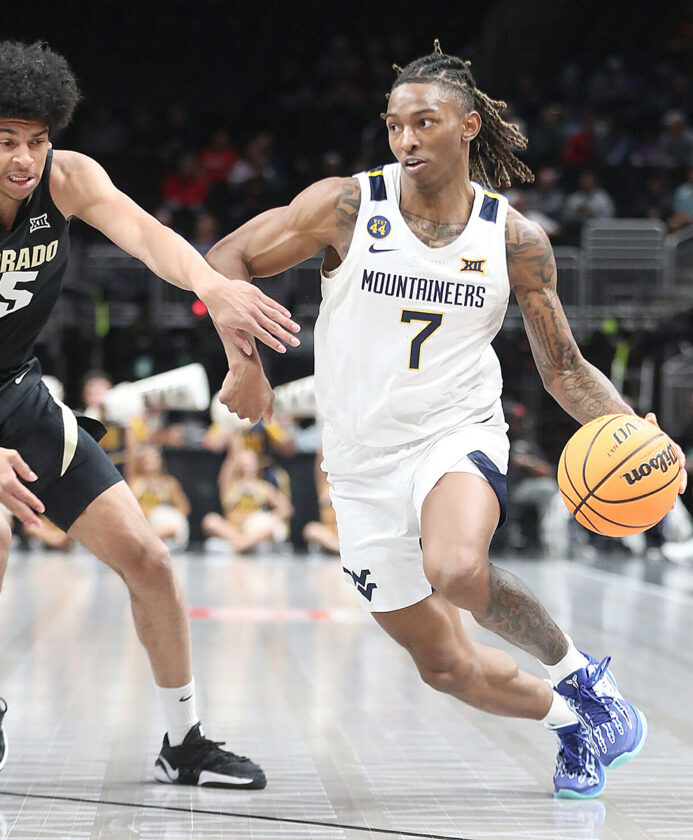
Javon Small
MORGANTOWN — I hate metrics.
Call me old. I don’t mind. I don’t hate that they exist. I hate that they have become a crutch in our sporting world, more an excuse for what happened than an explanation of what will happen.
Yeah, it’s the computer age and I’m coming at you from the abacus era, but they work against all that was great about sports.
This, of course, has been shoved to the front of the line of sports interest in these parts by the NCAA selection committee’s snub of West Virginia in favor of North Carolina for the final spot in the field.
They argue about NET and Quad 1 wins and strength of schedule, a X minus Y squared plus three equals chaos.
Yesterday my compadre from BlueGoldNews.com tried to explain away the decision through metrics. He didn’t agree with the decision that was reached but felt it could be explained, as if anyone can explain the inexplicable.
“However, in analyzing the decisions that kept WVU on the sidelines, it doesn’t do any good to focus on emotional issues such as what the team looked like at the end of last year, where it was picked to finish this year, or that the team played with a lot of heart and emotion. Those things matter to fans, but not the selection committee, which made the worst decision since Neville Chamberlain’s agreement with Germany in 1938,” he wrote.
“It doesn’t matter that WVU played with a short rotation and through several injuries and physical challenges. Most schools have those.”
In other words, what Kinder was saying was that the committee ignored all the things that really made WVU the right choice.
What’s happened in sports is they’ve gone from being fun with people to fun with numbers. Emotion is what drives teams, not trends.
What do you love about sports? Upsets, impossible half-court buzzer beaters, Willis Reed or Kirk Gibson limping onto the field and delivering championships.
The lure of sports is not in the games being played, but the people who play them.
When was the last time you saw a player nicknamed “Dizzy” or Daffy”? Why did Pat McAfee charm you as a Mountaineer or Owen Schmitt or Bruce Irvin? It was the persona they had, the shadow they cast, far more than their exploits. It was less what they did than how they did it.
We have been presented with the idea that metrics is a new thing.
It isn’t.
My background in baseball, which is probably the sport most grounded in metrics, has thousands of examples of how they mostly knew the metrics before they knew they were the metrics.
We think of the shift as a modern innovation but it started with Lou Boudreau’s way of trying to defend Ted Williams.
In the early 1990s I covered the St. Louis Cardinals and would spend part of my afternoons as a writer in Whitey Herzog’s office as he sat putting together by hand with different color pens and a ruler where he each opponent hit the ball each time he faced him.
And don’t think the athletes didn’t know what the heck was going on.
Andy Van Slyke, a left-handed hitter, didn’t need the stats to know that he couldn’t hit Houston’s right-hander Mike Scott and got to the point where he sat out when Scott was hitting. For the record, he hit .026 without an extra base hit before deciding playing against him was hurting the team.
Switch-hitter Pete Rose, as you might know, was a pretty good hitter. Fact is he owned more base hits than anyone in major league baseball history.
But he didn’t know a computer to tell him that he couldn’t hit left-hander Randy Jones. Fact was, his career average against Jones was .176, which was enough to send him to the plate batting left-handed, just to see if he could hit him that way.
A few years back Jones remembered the moment and told a funny story about it.
“I’d give Pete that 74 mph sinker and he’d be over the top of it with a ground ball to short, or grounder to second,” Jones said talking to a group of kids. “One thing Pete never realized was that I never threw him a slider. Didn’t have to. One time, before a home game against the Reds on Sunday afternoon, Pete decided to hit left-handed against me.
“I said to him before the game, ‘You sure you want to do this?’ Rose replied, ‘Just pitch to me.’ I pitched him three sliders on the outside corner and he never took the bat off his shoulder as I struck him out. I look over to the Reds’ bench and I see (Manager) Sparky Anderson and Johnny Bench laughing as Pete walked by them saying ‘I didn’t know he had a slider.'”
There are so many incidents where the metrics went spinning down the toilet. Woody Woodward was a smart player who would become a major league general manager, but hit just .236 over a 9-year career with one home run.
Trouble was, Tom Seaver, the Hall of Fame pitcher, couldn’t get him out. Woodward went 12 for 31 against Seaver and struck out just one time against the man who retired with the fourth most strikeouts in MLB history.
In one game, where Woodward had four or five hits, Seaver actually threw his glove down on the mound after Woodward got a hit off him.
Bill Plummer was the backup catcher for Johnny Bench, hitting .188 for his career but against Steve Carlton, one of the greatest left-handers of all-time, he had 6 hits in 14 at bats, a .429 average with two home runs and never striking out.
So don’t give me metrics. The players know them, the managers know them.
The truth is that what made WVU a more enticing choice for the tournament than North Carolina wasn’t in the numbers.
It was in the players and how they exceeded expectations. Schools aren’t knocking North Carolina coach Hubert Davis’ door down to offer him jobs. On the other hand, they have Darian DeVries, WVU’s coach, on speed dial.
The intrigue in the NCAA tournament is in the players, the coaches, the upsets. It is because the metrics don’t work that it is the most popular event of the sporting years, not vice versa.
Local News

Man facing felony over $2,500 check
What Mister Rogers taught us about communication
Clarity is not about saying more. It is about removing everything that is not necessary. This came home to me last ...

This Week in WV History
Area Religion Activities
Parish House Announcements, Buckhannon On the parish calendar: Sisters group meets at 9 a.m. Tuesdays at ...

WVU student from Elkins to compete in China
Officials weigh in on statehouse races
CHARLESTON – West Virginia Gov. Patrick Morrisey and U.S. Sen. Shelley Moore Capito are supporting different GOP ...