Greene must take more risks
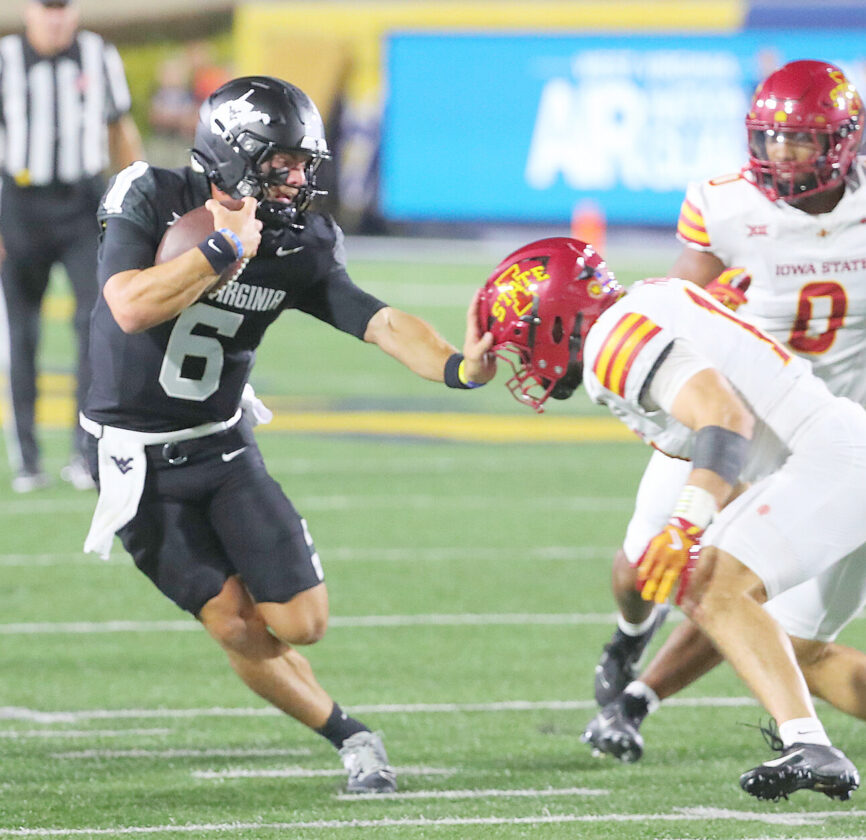
Photo courtesy of BlueGoldNews.com WVU quarterback Garrett Greene stiff arms an Iowa State defender during Saturday night’s Big 12 contest.
MORGANTOWN — Instead of throwing the ball to the other team as he did last Saturday in a 28-16 loss to undefeated No. 9 Iowa State, it’s time for West Virginia quarterback Garrett Greene to throw caution to the wind and go back to being the kamikaze quarterback fans loved and defenses feared over the past two seasons.
Call it a feeling you get when watching Greene go about his business on the field, but he doesn’t seem as free and fearless as he was as he was creating his devil-may-care, let-it-all-hang out competitor.
It isn’t that he’s playing with less intensity, it is more that he appears to be playing with a cautious intensity.
It is, as if, the Mountaineers’ efforts to make him less vulnerable as he ran the ball in the past and to concentrate more on his decision making than that has him thinking more and gambling less.
Add to that an effort over the off-season to work on his passing techniques to improve on a 53% completion mark last season and it’s almost as if this player who had lived off his daring approach to the game has tried to rein it all in and isn’t being as effective as he was.
There have even been grumblings on social media that Nicco Marchiol, his backup, should be moved into the starting position.
This, of course, is the knee jerk reaction — emphasis usually more on jerk than knee — of fans when things go bad but coach Neal Brown says that is not in the plans at the moment.
“You go across the country and everyone is enamored with the backup quarterback. We’re fortunate here. We have one who can play,” Brown said in addressing any suggestion of a change. “Are there scenarios where Nicco can play? Yes. There’s definitely scenarios where he can play.
“Has Garrett done enough to lose his job? No,” Brown continued, before adding, “Did he play as well as he needed to on Saturday for us to win? I would say no to that as well.”
But Brown wasn’t hedging his bet. Greene is his quarterback.
“Garrett’s our starter. Nicco is a really good player and I believe he is going to be the starter at some point, but Garrett is the starter.”
Brown admits there have been problems.
“Garrett hasn’t done anything,” he began, hesitating before saying he would regret. “He’s played well enough.”
And what’s that saying about leaving well enough alone?
“He has to make better decisions. One of the interceptions was clearly pass interference, so I don’t really blame him. The second one he made a really poor decision,” Brown said. “Nicco has a really bright future. We can win games with him. There are scenarios where he can play in situations.”
But it’s Greene’s team.
However, it is a team that needs the kind of spark that the daring, dashing Greene provides when he’s turned loose.
To date, WVU admits that Greene hasn’t been used as often on planned runs in the run game.
“They all are pretty much scrambles, to be honest with you,” offensive coordinator Chad Scott said.
And when asked if they might call more runs for him, he said he did not expect to see that.
“No, he’s doing enough,” Scott said. “Plus, you don’t want to have him getting hit all the time. He’s doing a good job scrambling. I like for him to sit in the pocket some times and turn it loose, but he does a good job of extending plays when things break down or they are covered downfield.”
It’s true that Greene’s best work is done freelancing and going off script as plays develop, but there have been too many moments when he’s making bad decisions instead of just proceeding recklessly ahead.
Take his effort at a slide two weeks ago when he came up just short even though he could have continued forward and gotten out of bounds with the first down and room to spare.
And then this past game he was scrambling and seemed to have nothing but open field ahead of him but instead of taking it he tried to force a pass into an area where it shouldn’t have gone.
“I think it’s more a situational deal,” Scott said. “A lot of times he extends plays and helps us out immensely. It keeps us in drives and keeps us in the game. It’s good in situations where you are in the red zone or you are in the score zone, the 15-yard line, the 10-yard line or in any third down situation where it’s crowded and the windows are real tight and you’re moving, on the run. Maybe you’re going left and you are a right-handed quarterback and are 1-on-1 in space.
“I tell the guys that the defender then is like a shark out of water. Rather than put the ball at risk and throw it into that tight window off schedule, go win that 1-on-1 with that shark out of water,” Scott continued. “That’s what happened the other day when it was third and long, he was running left, it was an off-schedule throw and he had to throw across his body. He should have taken off and run. He has to be smarter in situational play.”
It’s extremely hard to draw any conclusions from year-to-year comparisons as opponents change and the cast around a player changes.
It’s especially difficult to compare Greene’s start this season from the previous in that he was injured after just a cameo in the Pitt game and missed the Texas Tech game, so essentially he started late.
To try and even that off we compared Greene’s performance in his first six games this year to his last six games in 2023, but the competition this season was more difficult.
Still, there were differences in Greene’s explosiveness. In the first six games last year he averaged 5.9 yards per carry with 3 touchdowns while last year over the final six games he averaged 7.2 yards a try and scored 8 touchdowns.
Through the air, Brown has improved his pass completion percentage, as he set out to do with 57% compared to 53.9% over those final six games, but he had been shooting to reach at least 60% this season.
And while he had about the same yards last season (1,222) passing as he did this year (1,267), and had 8 touchdowns in both, his interceptions jumped from two last year to six this season while his average per attempt last year of 8.7 yards per try fell to 8.0 and his average per completion fell from 16.1 yards to 14.1.
WVU is now halfway through this regular season and stands at 3-3, where last year, it was 4-2 against what proved to be a much easier schedule as WVU this year has losses to three nationally ranked, undefeated teams, two of them in the Top 10.
Local Sports
WVU’s Maxx Yehl has overcome a lot
MORGANTOWN - It was probably easier for West Virginia University’s baseball coaches to find left-handed pitcher ...

Tigers cruise past Keyser to stay alive

Woods, Bulldogs stave off elimination

Mountaineers begin Big 12 tourney play tonight
Orndorf pitches Falcons over Colts
RIDGELEY — Lanson Orndorf has made a living coming up big for Frankfort in postseason play on the mound. The ...